

Commentary
- +3
Marwan Muasher, Amr Hamzawy, Rain Ji, …
{
  "authors": [
    "Yasmine Farouk"
  ],
  "type": "commentary",
  "centerAffiliationAll": "dc",
  "centers": [
    "Carnegie Endowment for International Peace",
    "Malcolm H. Kerr Carnegie Middle East Center"
  ],
  "collections": [],
  "englishNewsletterAll": "menaTransitions",
  "nonEnglishNewsletterAll": "",
  "primaryCenter": "Carnegie Endowment for International Peace",
  "programAffiliation": "MEP",
  "programs": [
    "Middle East"
  ],
  "projects": [],
  "regions": [
    "Middle East",
    "Saudi Arabia",
    "Gulf"
  ],
  "topics": [
    "Foreign Policy"
  ]
}
Source: Getty
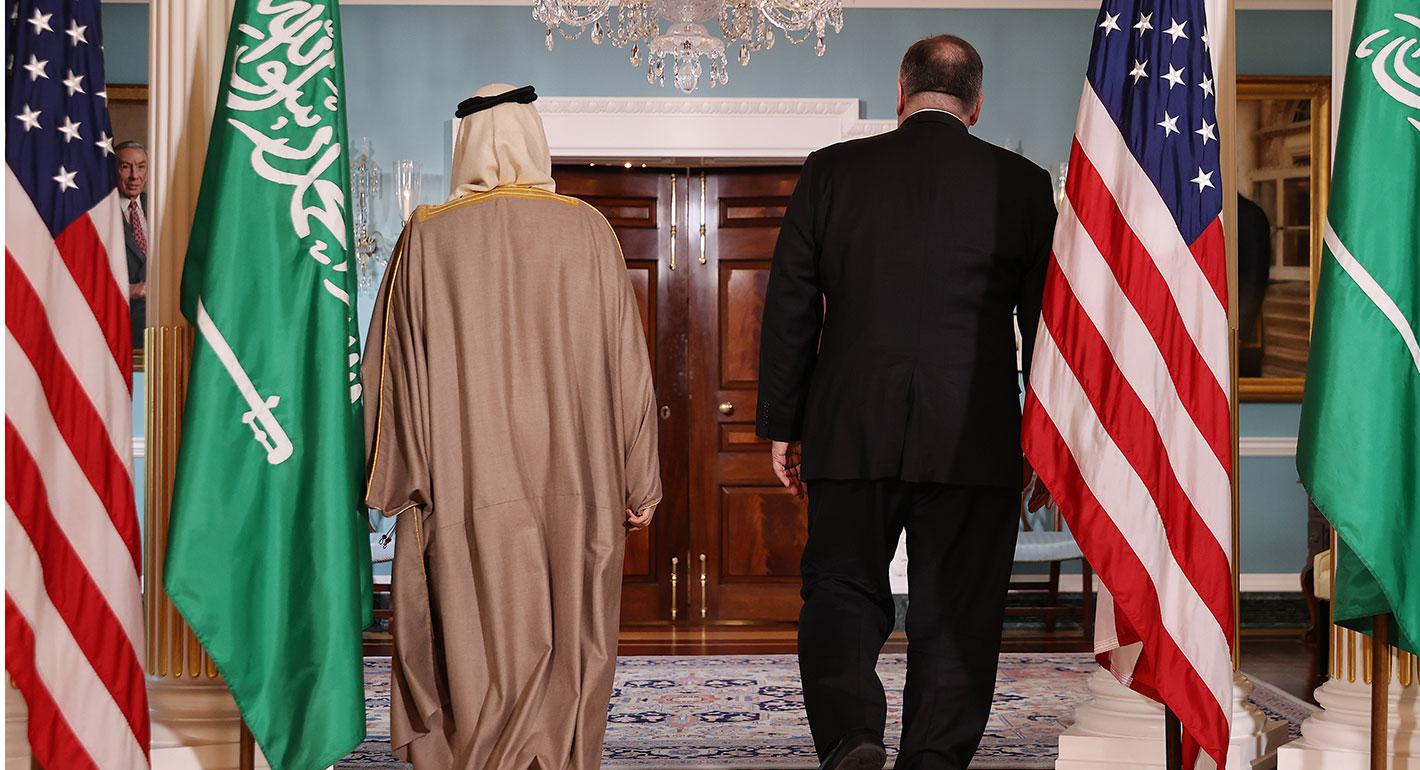
The U.S. secretary of state will arrive in Saudi Arabia on February 19. Can he and Saudi leaders rekindle the spark in the two countries’ long-standing relationship?
U.S. Secretary of State Mike Pompeo is visiting Saudi Arabia the week after the two governments celebrated the seventy-fifth anniversary of the first meeting between their heads of states. Although the official narrative portrays the two sides as staunch, closely aligned allies, it is now time for high-level U.S. and Saudi officials to talk about what has gone wrong.
The historic 1945 meeting is remembered differently in the two countries today. One Saudi newspaper recently hailed the momentous occasion as a reminder of a “relationship like no other,” but a foremost Washington expert complained that the “relationship [is] in decline, perhaps terminally, and need[s] recasting.” These clashing perspectives reflect a recurring gap between Washington’s and Riyadh’s expectations for their relationship. If this gap is not bridged, Saudi-U.S. ties will remain stuck in the crisis mode they have been mired in since journalist Jamal Khashoggi was assassinated in October 2018.
U.S. President Donald Trump’s administration has consistently perceived Saudi Arabia as a client in a transactional relationship. Trump expected the Saudis to lead efforts to reorder Middle Eastern geopolitics, paving the way for a reduced U.S. presence in the region. In exchange, Riyadh received Washington’s unconditional political support. This reordering included an Arab overture to Israel and pressure on the Palestinians, regional support for the United States’ maximum pressure campaign against Iran, and the Saudis’ active involvement in the management of regional conflicts.
Yet Saudi Arabia cannot, and has not, managed to help the United States reach those overriding objectives. In fact, it is no longer clear if Riyadh is still on the same page as Washington. Instead, Saudi Arabia has been emboldened to pursue the ongoing war in Yemen, violently repress its own citizens, infiltrate the American social media company Twitter, imprison U.S. citizens, and allegedly help Saudi suspects escape the U.S. judicial system. The result of these policy choices has been sharper media coverage and bipartisan scrutiny of the Saudi-U.S. relationship, threatening its future and potentially turning it into a liability for a U.S. leader known for his impatience with Middle Eastern politics and dependent friends.
Saudi Arabia expected that, as part of its unconditional U.S. political support, it would be treated like a staunch ally. The Saudi crown prince, Mohammed bin Salman, anticipated close U.S.-Saudi policy coordination and U.S. military support, so that Riyadh could implement a common agenda held by both sides. That hasn’t really happened.
The Trump administration did not support Saudi Arabia’s boycott of Qatar, its demand for a formal commitment to the kingdom’s defense (like that of the North Atlantic Treaty Organization), or a U.S. military response to the Iranian attack on Saudi oil infrastructure. In fact, Trump made it clear that U.S. support for Saudi Arabia is transactional, that Washington no longer needs Riyadh’s oil, and that he is only interested in the kingdom’s money.
Despite boosting Saudi defense, the Trump administration nevertheless continues to implement an America First strategy toward Iran that aligns with the president’s usual treatment of U.S. allies and his pattern of unpredictable, unilateral behavior in Syria. Furthermore, the administration doesn’t want the United States to defend Saudi Arabia without the participation of other countries. What’s more, the White House is pushing Saudi Arabia’s rapprochement with Israel to the limits, threatening to disturb the regime’s stability at home and curb its influence abroad.
Instead of improving things, the Trump administration’s management of Saudi-made crises has entangled Riyadh in polarized U.S. politics. And rather than reducing U.S. involvement in the Middle East, uncalculated Saudi support for Trump’s policies have encouraged the United States to intervene excessively and do far more than Saudi Arabia can handle. Consequently, while Riyadh is still putting a big wager on the Trump administration to come through, it is already attempting, not without difficulties, to hedge its bets.
With all eyes on the upcoming meeting, the U.S. Department of State released a statement that Pompeo will discuss “Iran, Yemen, and human rights” in Saudi Arabia. A senior official added the administration’s recently revealed Middle East peace plan to the list. Those issues are top priorities for both countries. But a conversation limited to these topics alone will not lift the bilateral relationship out of crisis mode. A frank discussion about managing the gap in mutual expectations could start to repair the relationship and could even push both countries to face the limits of their regional policies.

Former Nonresident Scholar, Middle East Program
Yasmine Farouk was a nonresident scholar in the Middle East Program at the Carnegie Endowment for International Peace.
Recent Work


Marwan Muasher, Amr Hamzawy, Rain Ji, …
Yasmine Farouk
Carnegie does not take institutional positions on public policy issues; the views represented herein are those of the author(s) and do not necessarily reflect the views of Carnegie, its staff, or its trustees.
The ninety-three-year-old Biya’s absence and refusal to name a vice president threaten to upend domestic and regional stability.

Lesley Anne Warner

With the growth in points of friction between the great powers, organizations like the SCO will continue to play a role in the strategic adaptation of the smaller powers caught between them.

Temur Umarov

Amid celebrations of bilateral ties was a deeper focus on stability in the Middle East.
Amr Hamzawy

Canadian Prime Minister Mark Carney has twice inspired praise for standing up to U.S. President Donald Trump: at the 2026 World Economic Forum in Davos and on Canada-U.S. trade negotiations. Is Carney showing a third way better than the EU has in dealing with the Trump administration?

Rym Momtaz, ed.

Middle Eastern states should welcome an accelerated U.S. disengagement from their region.

Michael Young