

Commentary
Before the next wave of EU enlargement takes place, the union needs to grapple with thorny questions of how power is distributed among its members.
Emil Sondaj Hansen, Ditte Brasso Sørensen
{
  "authors": [
    "Kathryn Botto"
  ],
  "type": "other",
  "centerAffiliationAll": "dc",
  "centers": [
    "Carnegie Endowment for International Peace"
  ],
  "collections": [],
  "englishNewsletterAll": "asia",
  "nonEnglishNewsletterAll": "",
  "primaryCenter": "Carnegie Endowment for International Peace",
  "programAffiliation": "AP",
  "programs": [
    "Asia"
  ],
  "projects": [],
  "regions": [
    "East Asia",
    "South Korea"
  ],
  "topics": [
    "Political Reform",
    "Security",
    "Foreign Policy"
  ]
}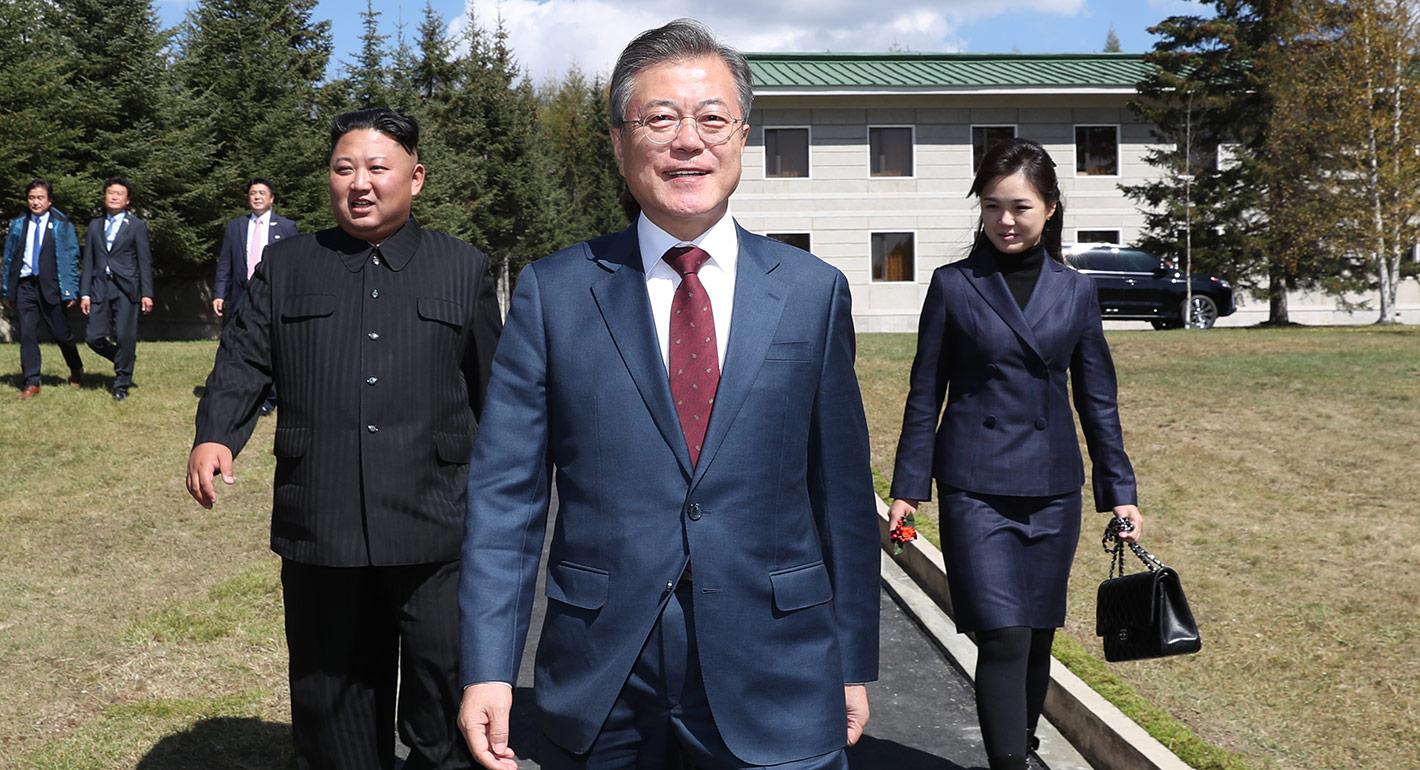
Source: Getty
It is impossible to divorce the U.S.-South Korean alliance and inter-Korean issues, or to separate them from the overall context of international relations not only in Northeast Asia, but also in the global arena.
Source: Korea Economic Institute of America
While President Moon Jae-in has a calmer demeanor than his mentor and friend, former President Roh Moo-hyun, there can be no doubt that his vision for transforming Northeast Asia is as far-reaching. While Moon has been more careful to assuage the U.S. president, less abrasive in his language toward Japan, and more strategic in reaching out to leaders in China and Russia, his strategy of putting North Korea at the forefront of regional realignment has similar geopolitical ambition. The objective is the rejuvenation of a reintegrated peninsula with the capacity to steer actions by all of the great powers rather than falling prey again to their machinations that are not in Korea’s interest.
During his presidential election campaign, candidate Moon remarked of his life-long friend, Roh Moo-hyun: “If I take the office, I’ll tell him at his memorial service, ‘Now you rest in peace. I’ll realize your unachieved dreams.’” Though Moon served as a top aide in the Roh administration, he saw himself as ultimately returning to a career in law. But Roh’s tragic suicide galvanized Moon to enter electoral politics for the first time and win a seat in the National Assembly. It was fitting, then, that when Moon gave his first speech on his vision for inter-Korean relations at the Körber Foundation on July 6, 2017 he characterized himself as “inheriting” the engagement policy of his progressive predecessors Roh and Kim Dae-jung.
This article was originally published by the Korea Economic Institute of America.
Kathryn Botto
Former Senior Research Analyst, Asia Program
Kathryn Botto was a senior research analyst in the Asia Program at the Carnegie Endowment for International Peace. Her research focuses on Asian security issues, with particular emphasis on the Korean Peninsula and U.S. defense policy towards East Asia.
Carnegie does not take institutional positions on public policy issues; the views represented herein are those of the author(s) and do not necessarily reflect the views of Carnegie, its staff, or its trustees.

Before the next wave of EU enlargement takes place, the union needs to grapple with thorny questions of how power is distributed among its members.


Emil Sondaj Hansen, Ditte Brasso Sørensen

The real test may come after the leaders leave the room.



Sheena Chestnut Greitens, Oriana Skylar Mastro, Yukon Huang, …

The Horn of Africa countries are among those facing a new security calculus.


Andrew Leber, Lesley Anne Warner

The European far right might fail to steer EU policy in the direction Russia wants, but they will create enough chaos inside Europe to benefit the Kremlin.

Dimitar Bechev

The new U.S.–Denmark–Greenland agreement will help Washington exert political, economic, and financial dominance under the guise of security. Yet, it acknowledged Copenhagen’s and Nuuk’s sovereignty on the island.

Marc Pierini