

Article
A notable degree of participative democracy has firmly arrived in Europe. But to have more far-reaching impact, democratic deliberation needs to move into a radically new phase.
Richard Youngs
{
  "authors": [
    "Aaron Sobel"
  ],
  "type": "commentary",
  "centerAffiliationAll": "dc",
  "centers": [
    "Carnegie Endowment for International Peace"
  ],
  "collections": [
    "Democracy and Governance"
  ],
  "englishNewsletterAll": "democracy",
  "nonEnglishNewsletterAll": "",
  "primaryCenter": "Carnegie Endowment for International Peace",
  "programAffiliation": "DCG",
  "programs": [
    "Democracy, Conflict, and Governance"
  ],
  "projects": [],
  "regions": [
    "Southeast Asia"
  ],
  "topics": [
    "Democracy"
  ]
}
Source: Getty
Other countries have used laws like the Philippines’ new antiterrorism bill to jail protesters, journalists, and opposition politicians en masse. To save Filipino democracy, governments around the world must speak out before July 9 and stay vigilant going forward.
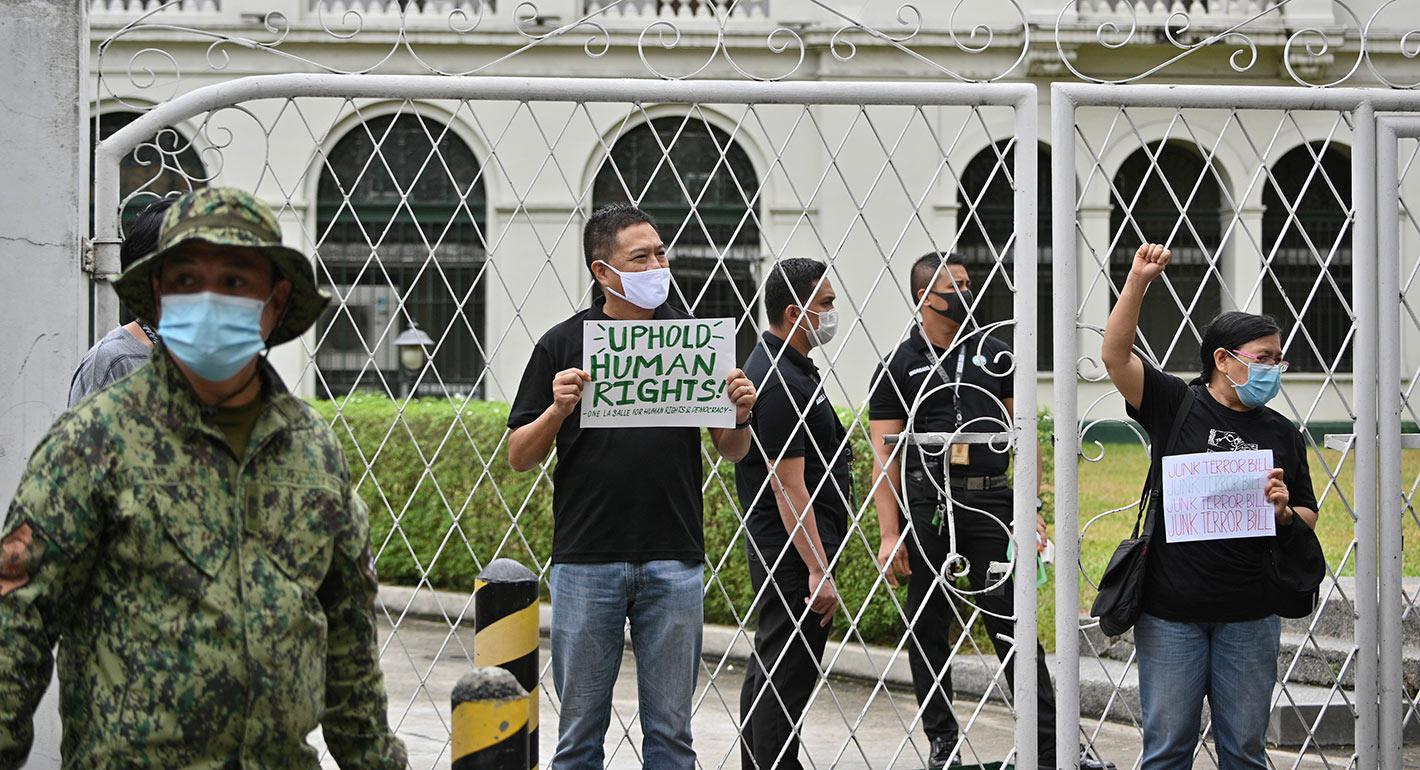
Since the Filipino House of Representatives passed a new antiterrorism bill on June 3, protests have rocked the Philippines. The recent conviction of Maria Ressa, a famed journalist who reported on the Philippines’ bloody drug war, is a chilling indication of how President Rodrigo Duterte will use the Anti-Terrorism Act. As calls on social media to drop the law (#JunkTerrorBill) multiplied, the Filipino Department of Justice announced on June 11—the eve of the country’s independence day—that protest rallies were temporarily banned. Despite threats of arrest, hundreds continued to demonstrate against the bill.
The Anti-Terrorism Act is the latest in a series of power grabs passed under the guise of national security amid the coronavirus pandemic, presenting a serious threat to Filipino democracy. Replacing the Human Security Act of 2007, the new law criminalizes an ambiguous new offense: the incitement of terrorism “by means of speeches, proclamations, writings, emblems, banners or other representations . . . without taking any direct part in the commission of terrorism.” Section 29 authorizes law enforcement to arrest and detain, without a warrant and for fourteen to twenty-four days, anyone suspected of any terrorism offense—including those accused of incitement.
Supporters might say there is nothing to worry about because, under the law, protest, advocacy, and dissent are protected so long as they don’t “create a serious risk to public safety.” But who decides who is inciting terror or creating a serious public safety risk?
The Anti-Terrorism Council does. Composed of eight members of Duterte’s cabinet and one other government agency head, the council can detain anyone for at least fourteen days without a warrant on the grounds that their proclamations or writings incited terrorism.
Like many world leaders before him, Duterte now has the tools to weaponize the law and systematically stifle dissent. Of course, there is always the chance that the Anti-Terrorism Act won’t be abused to silence free speech and undermine civil rights. After all, Indonesia passed a similar antiterror law in 2018 and has not yet seen mass arrests of opposition leaders, critics, or journalists.
Yet more worrying scenarios have emerged from other countries, where pieces of legislation very similar to the Philippines’ bill have led to serious abuses of power.
Consider Egypt, which passed an antiterrorism law in 2015 allowing police to detain suspects without a warrant for eight days and criminalizing incitement of terrorism “whatever the means used.” After peaceful protests broke out in April 2016, Egyptian security forces arrested 382 people for incitement, publishing false news through social media, and promoting terrorism-related crimes.
Police also cracked down on critics of President Abdel Fattah el-Sisi during the 2018 election season. At least thirty-six prominent activists and journalists have been arrested and prosecuted for peaceful criticism using Egypt’s antiterror law. Some of those prosecuted were affiliated with opposition parties and movements. Egypt is now the third-worst jailer of journalists (tied with Saudi Arabia), according to the Committee to Protect Journalists. All but one journalist incarcerated in Egypt in 2019 were charged with terrorism. Human Rights Watch notes that “Sisi’s government . . . has sought to criminalize peaceful dissent, often by labeling dissidents as terrorists and punishing them with lengthy prison sentences.”
An Ethiopian antiterror law passed in 2009 mirrors Manila’s legislation: it criminalized actions (such as writing, publishing, publicizing, or disseminating statements) that would directly or indirectly “encourage” terrorism and granted police the authority to detain suspects without a warrant for forty-eight hours. For years, this law was used to jail peaceful political activists, opposition members, and journalists. Since the summer of 2011, at least thirty-three dissidents have been charged with terrorism. In Kafkaesque fashion, a famous journalist was detained as a terrorist for publishing a piece criticizing the Ethiopian government’s use of the law to detain journalists. He was sentenced to eighteen years in prison, and his newspaper was forced to shut down.
In 2014, the government imprisoned at least nine people for violating the 2009 law by publishing pieces critical of the government. In 2015, a former spokesperson of an opposition party was charged with terrorism in Addis Ababa for making statements on Facebook that were critical of government crackdowns on protests. A wave of arrests targeted members and affiliates of the Ethiopian opposition in the wake of antigovernment protests in October 2016. Among the twenty-two arrested and charged two months later was an opposition leader who had already been arrested on terrorism charges in 2011. In 2018, a new prime minister from a different party was elected, at which point the government released over 20,000 prisoners arrested under the 2009 antiterror law, finding their detainments to be politically motivated.
In Turkey, where a 2013 law criminalized propaganda that would incite terrorism and a 2015 law permitted the warrantless arrest of terrorist suspects for at least twenty-four hours, the picture is even grimmer. While the country had imprisoned journalists and opposition members long before the 2013 and 2015 laws were passed, these provisions gave Turkey additional legal grounds to arrest and detain dissidents.
After the failed coup in 2016, Turkish authorities used the bills to arrest journalists and critics en masse. In 2016, Turkey imprisoned 136 journalists, 135 of whom were charged with terrorism. And 2019 was the first year since 2016 that Turkey was not the world’s worst jailer of journalists, but only because it shut down over one hundred news outlets to deplatform them instead. Numerous human rights activists have been arrested in 2017, 2018, and 2019. After a court acquitted one civil rights protester of terrorism charges this past February, he was arrested again hours later. According to Turkish government records from July 2019, nearly 70,000 people in Turkey were being tried for terrorism and over 150,000 were being investigated for terrorism—119 of whom were journalists, and many of whom were activists.
Back in the Philippines, politically motivated arrests were woefully common even before this new bill was passed. Duterte’s two biggest critics in the Senate have been behind bars for over a year. Police arrested people demonstrating against the Anti-Terrorism Act, while pro-government protesters were allowed to rally. If Duterte’s track record is any indication, the effects of the Anti-Terrorism Act will be chilling.
But other governments around the world don’t have to be helpless bystanders to the erosion of Filipino democracy. The act will automatically lapse into law on July 9 unless Duterte blocks it. Before that crucial date, governments must pressure Duterte into junking the antiterror bill himself. If it does become law on July 9, a constitutional challenge awaits the legislation from the country’s most influential organization of lawyers. At this point, other governments must monitor and support these legal challenges to ensure that they receive a legitimate hearing. As the Philippines marches ever closer to rule by law, world leaders preoccupied with the pandemic must speak out and stay vigilant to save Filipino democracy.
Aaron Sobel
Former James C. Gaither Junior Fellow, Democracy, Conflict, and Governance Program
Aaron Sobel was a James C. Gaither Junior Fellow with the Democracy, Conflict, and Governance Program.
Carnegie does not take institutional positions on public policy issues; the views represented herein are those of the author(s) and do not necessarily reflect the views of Carnegie, its staff, or its trustees.

A notable degree of participative democracy has firmly arrived in Europe. But to have more far-reaching impact, democratic deliberation needs to move into a radically new phase.

Richard Youngs
Today’s global democratic recession is partly rooted in a common perception that democracies have a delivery problem, with many citizens in both autocracies and democracies alike now believing that strongmen can achieve better governance outcomes. But a study of four countries in Africa reveals that democratic-leaning governments have demonstrated better governance performance than autocratic governments.


Sarah Yerkes, Natalie Triche, Amr Hamzawy
Fatima El Mansouri is the country’s first female prime minister. She’s also a privileged insider in a largely ceremonial position.
Sarah Yerkes

The domestic impacts of how long it is taking to end the war in Ukraine have pushed the French electorate to the political extremes and compromised the country’s diplomatic capacity.

Rym Momtaz

Before the next wave of EU enlargement takes place, the union needs to grapple with thorny questions of how power is distributed among its members.


Emil Sondaj Hansen, Ditte Brasso Sørensen