

Commentary
Before the next wave of EU enlargement takes place, the union needs to grapple with thorny questions of how power is distributed among its members.
Emil Sondaj Hansen, Ditte Brasso Sørensen
{
  "authors": [
    "Dan Slater"
  ],
  "type": "commentary",
  "centerAffiliationAll": "dc",
  "centers": [
    "Carnegie Endowment for International Peace"
  ],
  "collections": [
    "Coronavirus"
  ],
  "englishNewsletterAll": "asia",
  "nonEnglishNewsletterAll": "",
  "primaryCenter": "Carnegie Endowment for International Peace",
  "programAffiliation": "AP",
  "programs": [
    "Asia"
  ],
  "projects": [],
  "regions": [
    "Southeast Asia",
    "Indonesia"
  ],
  "topics": [
    "Political Reform",
    "Democracy"
  ]
}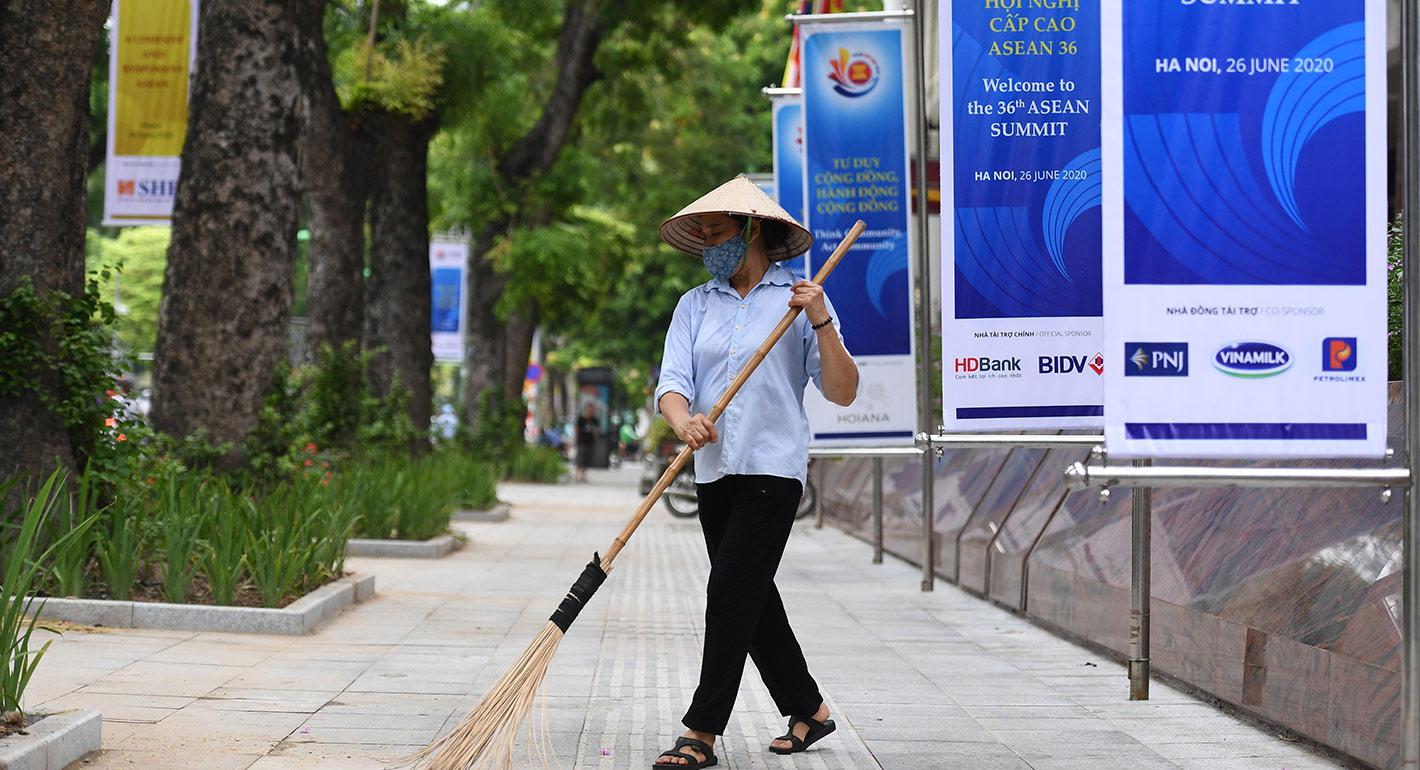
Source: Getty
Sitting on China’s doorstep, Southeast Asia initially seemed especially vulnerable but is so far coping comparatively well with the coronavirus pandemic. Yet this resilience—long a hallmark of the region’s politics—comes with some grim downsides.
For over fifty years, governments across Southeast Asia have been collectively obsessed with their own resilience: both as individual nations and as a region. The coronavirus pandemic and its economic impact are testing this resilience in ways not seen since the Asian financial crisis of the late 1990s. Can Southeast Asia’s governments and societies withstand this toughest of tests?
As a motley collection of countries, Southeast Asia cannot offer any singular story of failed or successful pandemic response. Government authorities in Malaysia, Thailand, and Vietnam deserve great credit for their strong public health performance thus far, while Indonesia and the Philippines have responded far more arbitrarily and far less effectively.
The jury will be out for a long time on how to assess Southeast Asian governments’ overall response to the coronavirus. The data are unreliable, and the course of the pandemic is uncertain.
Yet thus far, Southeast Asia has proven relatively—and characteristically—resilient. Especially considering that the region sits right beside China and was initially considered one of the world’s most vulnerable regions, Southeast Asia’s comparatively low infection numbers thus far are laudable. In some cases, especially Indonesia and Cambodia, this might be due to underreporting and insufficient testing. But overall, resilience is seeming to hold across most of the region.
This resilience is grounded in Southeast Asia’s long history of pragmatism. Southeast Asia constantly frets about its survival and does whatever it takes to survive—or at least whatever its leaders think it takes to survive. The outcome may be resilience, but it is resilience of a grim variety.
Resilience became Southeast Asia’s watchword in the late 1960s. The region was being torn apart along multiple fault lines. Communists were battling anticommunists, separatists were scuffling with nation-building armies, neighbors were squabbling over borders, and the two global superpowers—the Soviet Union and the United States—were gaining stronger regional footholds. Just a few short years after most Southeast Asian countries won independence from their colonial masters, weak governments and divided societies were painfully exposing the region to external intervention and manipulation.
The solution was resilience. Its diplomatic cornerstone was the Association of Southeast Asian Nations (ASEAN), founded in 1967. By focusing their energies on handling their own internal economic and political challenges and by pledging not to interfere with their neighbors, ASEAN’s five founding members (Indonesia, Malaysia, the Philippines, Singapore, and Thailand) sought to avoid the terrible fate of Vietnam: ripped apart by ideological warfare and split by U.S. and Soviet meddling. By 1999, ASEAN had expanded from five members to ten, essentially encompassing the entire region.
Resilience ASEAN-style leaves much to be desired. Growth is prioritized over equality and the environment; order is prized over liberty and minority rights; diplomatic smoothness comes at the expense of collective problem-solving substance. But—taken on its own terms as a shared agenda among sovereignty-sensitive, most often authoritarian leaders—this quest for resilience has generally been a fifty-year success story.
This is especially evident on the international front. Unlike in the Middle East or South Asia, Southeast Asian states do not undermine each other with armed proxies or spar over contested borderlands. China and the United States both play major roles in Southeast Asia, but neither can dominate. ASEAN has not become deeply divided over how to respond to worsening U.S.-China rivalry. The organization and its members boast friendly and fruitful relations with Australia, Japan, South Korea, and Europe’s global players. Southeast Asia is nobody’s sphere of influence. It is no longer the grass that superpower elephants trample when they fight.
If the outward face of resilience is collective noninterventionism, its internal foundation has been national economic development. For decades, most Southeast Asian economies have climbed the ladder from low-income toward middle-income status. The region has no foreign aid–dependent basket cases.
The key has been pragmatism. Southeast Asian economies are all closely tied to each other and to the global economy by sheer necessity. Market forces play a leading role everywhere. Yet no Southeast Asian country rejects state intervention when capitalist growth falters. Ideology is no obstacle. When crises come, Southeast Asian states adjust.
The Cold War–era theme of resilience might seem outdated as a way of understanding Southeast Asia today. Yet in some ways, the resilient ideal has been even more fully fulfilled in the past decade than over the past half-century. While most of the world saw less regime stability in the 2010s than the 2000s, Southeast Asia actually grew more stable.
From 2000–2010, Southeast Asia looked less stable than the rest of the world. Newborn democracies in Indonesia and Timor-Leste were still struggling to find their feet. Southeast Asia’s oldest democracy, the Philippines, suffered a lost decade of democratic decline and malaise. Thailand’s seemingly healthy democracy careened into instability and polarization under the leadership of former prime minister Thaksin Shinawtra, culminating in his removal by coup in 2006. Myanmar was badly rattled both by the Saffron Revolution led by Buddhist monks in 2007 and the brutal crackdown that followed it. In Cambodia, the regime of Prime Minister Hun Sen began visibly teetering in the face of a strengthened opposition and civil society. Even rocksteady Malaysia began trembling, experiencing the end of over four decades of stable authoritarian dominance with the ruling coalition’s shocking loss of its seemingly permanent two-thirds majority in 2008.
In the 2010s, the tides turned—the world’s regimes got less stable while Southeast Asia stabilized. But because the region was overwhelmingly unfree to begin with, the stability of the 2010s had a grim quality. Indonesian democracy is surviving but hardly thriving. The Philippines is more stable under President Rodrigo Duterte, but also more illiberal. Thailand’s military has used unfair elections to bring back a power-sharing arrangement with pro-military and pro-monarchy party politicians. Only tiny Timor-Leste is clearly a healthier democracy in 2020 than in 2010.
Malaysia may seem like a shaky exception to the resilient rule. The democratic opposition scored its first-ever victory in 2018, seemingly ushering in Southeast Asia’s only decisive regime removal of the decade. But the new ragtag ruling coalition quickly collapsed, and the old regime slinked back into office. The big picture in Malaysia is not instability but the grim stability of shattered hopes for a more liberating brand of politics.
Before the coronavirus pandemic struck, therefore, Southeast Asia was practically on cruise control. The region was chugging along at modest levels of economic growth and with minimally generous welfare states, forever balancing the need for global integration with social stability at home. Every regime in the region was stable, stagnant, or less dynamic than a decade before.
Then came the coronavirus. The region is getting hammered economically by the virus, even in countries where infection rates are still tiny. But the severity of a beating is not the same thing as one’s strength to withstand it. No matter how much worse the beating gets, Southeast Asia’s grim resilience appears likely to persist.
The main reason is pragmatism. Unprecedented crises demand flexibility. Southeast Asian states will show zero hesitation about increasing state intervention and supporting private businesses to cope with the economic and epidemiological impact of the coronavirus. There will be no hypernationalism and slamming of national borders. Neither the United States nor China will be chucked overboard as external partners to rally political support and distract from internal failings.
Perhaps the biggest long-term concern, beyond the immediate and terrible health and economic impacts, is the role of the state in Southeast Asia, in both its protective and coercive guises. Preserving public health in a new age of pandemics—for more global viruses are likely to follow—will mean a much larger state presence in Southeast Asian citizens’ lives. Individualism and liberalism have never found fertile soil in Southeast Asia. This might be good news for public health, but grim news for personal liberty.
Herein lies the real question the pandemic raises for democracies and dictatorships. The issue is not whether democracies or authoritarian regimes are responding better to the pandemic. It is whether the stronger, bigger states emerging from the pandemic will be entirely authoritarian and unconstrained, or whether citizens will enjoy any democratic protections against this expanded state power.
There can be little doubt that Southeast Asian societies will have stronger states in place to protect them in the wake of this pandemic. Whether those societies will be able to protect themselves from those stronger states is a different matter entirely.
Former Nonresident Scholar, Asia Program
Dan Slater was a nonresident scholar in the Asia Program at the Carnegie Endowment for International Peace. He specializes in the politics and history of enduring dictatorships and emerging democracies, with a regional focus on Southeast Asia.
Carnegie does not take institutional positions on public policy issues; the views represented herein are those of the author(s) and do not necessarily reflect the views of Carnegie, its staff, or its trustees.

Before the next wave of EU enlargement takes place, the union needs to grapple with thorny questions of how power is distributed among its members.


Emil Sondaj Hansen, Ditte Brasso Sørensen

The European far right might fail to steer EU policy in the direction Russia wants, but they will create enough chaos inside Europe to benefit the Kremlin.

Dimitar Bechev

If the Russian-speaking community in Latvia cannot articulate their interests without being seen as disloyal, they could end up embracing a pro-Kremlin agenda.

Sergejs Potapkins

Russia’s ruling party would have benefited from Putin appearing as its distant patron, but as an active frontman imposing his views on the public, he has done nothing but harm both the party’s election campaign and the ruling system overall.

Andrey Pertsev

Despite myriad challenges and occasional stumbles, the new Hungarian government is moving ahead with energy and conviction to uproot years of illiberalism and corruption and rebuild Hungarian democracy.

Thomas Carothers