

Paper
Ahmed Nagi
{
  "authors": [
    "Ahmed Nagi"
  ],
  "type": "commentary",
  "centerAffiliationAll": "dc",
  "centers": [
    "Carnegie Endowment for International Peace",
    "Malcolm H. Kerr Carnegie Middle East Center"
  ],
  "collections": [],
  "englishNewsletterAll": "menaTransitions",
  "nonEnglishNewsletterAll": "",
  "primaryCenter": "Malcolm H. Kerr Carnegie Middle East Center",
  "programAffiliation": "MEP",
  "programs": [
    "Middle East"
  ],
  "projects": [],
  "regions": [
    "Yemen",
    "Middle East"
  ],
  "topics": []
}
Source: Getty
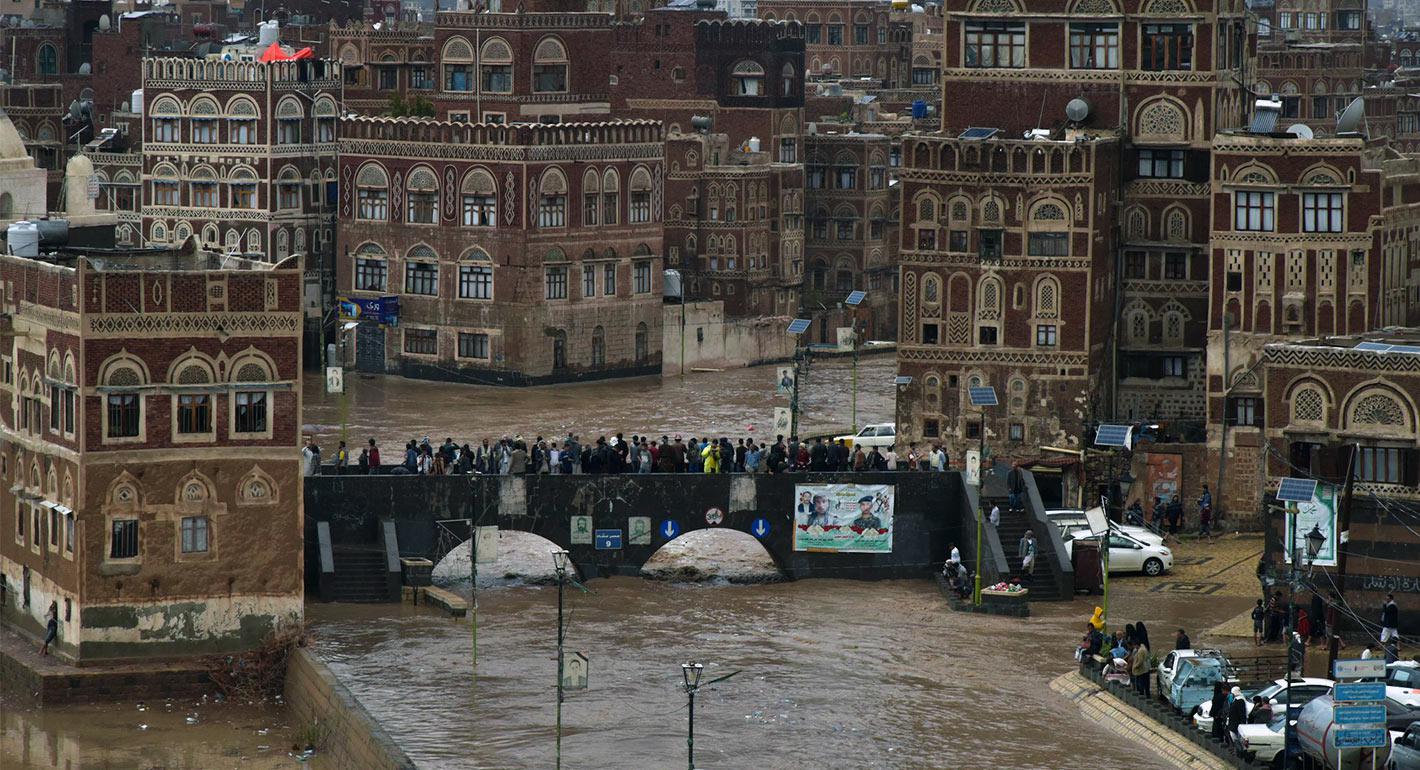
The floods in Yemen have ravaged one of the world's oldest cities, but what underlies the catastrophe is largely man-made.
While the devastating human and economic costs of crises plaguing countries such as Lebanon and Yemen are highly visible, there’s another cost that hits at the heart of their people—the loss of identity. Just as the August explosion in Beirut has further chipped away at the old city’s quarters, the unprecedented floods in Sana’a have brought breathtaking, ancient towers to their knees. And for many Yemenis, this symbolizes yet another attack on their national identity. Old Sana’a has been a significant historical icon for generations.
As a native Yemeni, I used to travel there often. Walking down the winding, narrow paths of one of the oldest cities in the world is an experience no one forgets. Its clay walls would pull you in and refuse to let go, keeping what’s around the corner a secret. Even as a regular visitor, I frequently lost my way, mesmerized by the magic of the ancient architecture, traditional markets, neighborhood cafes, and welcoming Sanani people. It’s not a surprise that UNESCO named the old city a world heritage site in 1986.

Located in a mountain valley, Old Sana’a dates back about 2,500 years. Over 6,000 houses were built before the eleventh century—largely using rammed earth (pisé). Its religious and political heritage is rich, with 103 mosques and fourteen bathhouses (hammams). And for a long time, it was a commercial center for Yemenis, with dozens of traditional markets.


For Sananis, the old city’s architecture is part of their identity and familial history. But, over the last decade, much of this history has been lost, and what remains is gradually slipping away. In July 2015, UNESCO added the historic city to the list of world heritage sites in danger. Damage caused by the floods last month is just the latest and most visible evidence of this. It symbolizes and adds injury to years of destruction from forces of conflict, abandonment, and neglect.


The heavy rains hit Old Sana’a particularly hard because of the already miserable posture of the war-torn city. According to initial UNESCO reporting, torrents besieged 111 houses either entirely or partially. One local news report now puts the number of damaged buildings and homes at around 1,000. While some residents have become homeless, fleeing the rising waters, others have refused to leave despite knowing that unstable walls and roofs could collapse on them at any moment.
And the worst is to come if the rainy season continues on the current trajectory. The number of ravaged buildings and affected families will increase dramatically. Given the poor economic conditions in Yemen, most inhabitants will be unable to rebuild their homes, adding to the hundreds of thousands of Yemenis already displaced by the war and at risk of disease.


Underlying the crisis are actually five other factors—none of which are environmental: the bombing of several areas inside the city, a complete lack of attention to building maintenance and restoration, the spread of new construction replacing the ancient architecture, economic hardship, and the religious policies of Sana’a’s de facto authorities.
Since the Saudi-led coalition began its military campaign in March 2015, several airstrikes have battered Old Sana’a—and not just the buildings. “Since the city’s houses are made from clay, the bombing has affected them very heavily. We have seen several UNESCO-listed houses among the damaged places,” said Mohammed al-Hakimi, an environment journalist and editor of Holm Akhdar website.1 In June 2015, heavy bombing targeted Miqshamat al-Qasimi, a famous urban garden and one of the most beautiful areas in the city. In addition, airstrikes on the Ministry of Defense and National Security buildings have significantly damaged several areas given the buildings’ proximity to the old city.


Yet even before the current conflict began, successive governments were turning a blind eye to the plight in front of them. According to locals, no building maintenance has been done since 2004, when Sana’a was announced as the Capital of Arabic Culture.2 “Even then, restoration work was centered on the front sides of the city. The most important parts that need urgent and continuous maintenance are the internal areas,” according to Hashim, a city resident.3 Currently, “the city is lacking the simplest things such as a conservation scheme, which is a cornerstone to preserving a city since it contains the technical and legislative aspects, in addition to a regular maintenance plan,” said Yassin Ghalib, a city engineer (author translation).
When the Houthis took over Sana’a in September 2014, the situation only got worse—indifference turned into desecration. The Houthis began coating many of the ancient buildings with propaganda slogans and chants.


Moreover, the sprawl of modern-style construction began to invade the old city. “Many inhabitants sell their homes to market merchants who reconstruct them or turn them into commercial centers—dealing with them as normal properties, not ancient buildings needing to be taken care of. We have seen new markets emerge, new premises built, while white-brown buildings disappear,” said Mohammed, a merchant who had worked in the city’s old market for more than twenty years. Ironically, “there is a law prohibiting people from constructing new buildings in the city, but with bribes you can do whatever you want,” one resident mentioned. There are no official statistics on the volume of new modern construction, but given how crowded Sana’a is today, the evidence of urban expansion is obvious.
Without the needed assistance to maintain their homes and buildings, many struggling Sanani inhabitants have been pushed to abandon or sell their houses and close their businesses. Exacerbating the problem are certain Houthi policies. For instance, some owners of traditional cafes and motels inside the old city have had to shut their doors and look for other income because the Houthis—from a religious standpoint—have prohibited the mixing of unrelated men and women in public spaces like cafes and restaurants.

Many Sananis see the floods as the death knell for an old city already in danger of disappearing. The rains just revealed the reality. Those people most affected found themselves helpless against the gushing water: “We just shifted from collapsed rooms to less damaged ones, hoping the heavy rain would stop soon,” said one local.4
While it appears that the city’s authorities have done little to reduce the floods’ damage except exchange accusations, some community-based initiatives have begun a campaign to help people in need and mitigate the destruction. Ali Alsonidar and his friends launched an effort called Fik Al Khair (the good in you): “We are a group of ten people from almost all areas of the city. We began our voluntary work to provide basic support to people whose homes are damaged the most. The idea is to distribute plastic covers to install on the building roofs in order to protect them from rain water creeping in.”5 Even though their intervention is modest, Ali and his team were able to protect several houses. “We are happy to see several initiatives inspired by our work helping contribute to save the city,” Ali added.

According to Yemen’s permanent delegate to UNESCO, Mohammed Jumeh, “Sanaa is under the Houthis’ control. The government plays an indirect role in the city through coordination with UNESCO and international supporters. We hope that the UNESCO Emergency Fund will provide urgent support, as well as our ongoing communications with the European Union regarding restoration projects with the support of UNESCO.”
The Houthi-controlled General Organization for the Preservation of Historic Cities in Yemen (GOPHCY) is the governmental body responsible for safeguarding the old city, but it has also largely appealed to UNESCO and other international bodies for help.
For its part, UNESCO is working hard to mobilize funds and expertise to safeguard the city. Through an EU-funded program, the Social Development Fund has begun rebuilding collapsed houses. However, this attempts to address only one part of the problem. Without resolving the other major causes of destruction, the old city and its inhabitants will remain at risk.
Yemen’s increasingly severe rainy season—likely an effect of climate change—is playing a significant role, but what underlies the catastrophic situation is man-made. The war, its economic repercussions, and particularly the ongoing neglect threaten the historic city of Sana’a, a foremost symbol of Yemen’s national identity.
The fact that yet another crisis looms over the country provides additional clear evidence of the Houthis’ indifference to Yemen’s destruction. Off the west coast lies an abandoned oil tanker, Safer, which is loaded with explosive materials. Despite recent urgent calls to deal with the aging vessel, little is being done beyond making accusations and denying responsibility. With roughly 1.1 million barrels of oil on board, an explosion of the tanker would “trigger the world’s worst-ever oil spill,” destroying massive areas of the maritime environment.
Without adequate preventive and mitigation efforts, Old Sana’a and many other areas of Yemen will continue to suffer immeasurably from flooding and other disasters in the making such as an oil spill. In the face of immense humanitarian needs, protecting the history and cultural identity of Yemen might seem unimportant, but the long-term effects of neglect are serious. For example, economically, internal tourism will continue to decline as Yemen’s old city areas disappear, and more residents will be forced to abandon their homes and businesses, adding to already stressed urban areas.
The key ingredient to fortifying Old Sana’a and restoring its unparalleled beauty—in a well-managed, coordinated manner—is a responsible authority in Yemen. But this seems to be elusive in the war-torn country. When the conflict finally comes to an end, what will Yemen offer its people and the world?

1 Author interview with Mohammed al-Hakimi, via phone, August 26, 2020.
2 Author interview with three residents, via phone, August 25 and 26, 2020.
3 Author interview with Hashim Ahmed, via phone, August 25, 2020.
4 Author interview with a resident, via phone, August 23, 2020.
5 Author interview with a Yemeni photographer, Ali Alsonidar, via phone, August 26, 2020.

Senior Analyst at the International Crisis Group
Ahmed Nagi is a senior Analyst at the International Crisis Group.
Recent Work
Ahmed Nagi
Carnegie does not take institutional positions on public policy issues; the views represented herein are those of the author(s) and do not necessarily reflect the views of Carnegie, its staff, or its trustees.

Understanding the climatic pain points is necessary for policymakers hoping to minimize the war’s negative environmental consequences.



Alejandro Martin Rodriguez, Joy Arkeh, Sarah Yerkes

Huawei pushed hard to enter the Egyptian data centers market, until the Americans made a better offer.

Angie Omar

The books, podcasts, and films that explain the world it made.

Andrew Leber

Amid celebrations of bilateral ties was a deeper focus on stability in the Middle East.

Amr Hamzawy

Can economic ties help contain conflict between Egypt and Israel, or do they simply postpone confrontation? Drawing on the German-Russian experience, the article examines how the gas deal creates mutual dependence, keeps channels of cooperation open, and raises the cost of conflict, without necessarily delivering lasting peace.

Nourhan Hefzy