

Commentary
The Bureau of Industry and Security needs to adjust its focus and practices to maintain its position as the U.S. government’s primary champion of international technological competition.
Geoffrey Irving
{
  "authors": [
    "Andrey Kortunov"
  ],
  "type": "commentary",
  "centerAffiliationAll": "",
  "centers": [
    "Carnegie Endowment for International Peace",
    "Carnegie Russia Eurasia Center"
  ],
  "collections": [],
  "englishNewsletterAll": "",
  "nonEnglishNewsletterAll": "",
  "primaryCenter": "Carnegie Russia Eurasia Center",
  "programAffiliation": "",
  "programs": [],
  "projects": [],
  "regions": [
    "Russia"
  ],
  "topics": [
    "Economy"
  ]
}
Source: Getty
If Moscow believes that the main security threat it faces is NATO military infrastructure moving closer to Russia’s western borders, it would make sense to focus on the infrastructure itself rather than the theoretical possibility of NATO expansion.
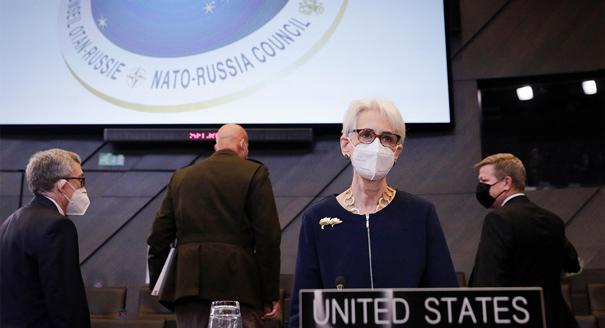
Few can have been surprised by the outcome of the recent talks between Russia and the West, in which the latter, represented by the United States and its European allies, rejected Russia’s demands to close NATO’s doors to new Eastern European members and restore its military infrastructure to where it was at the end of the twentieth century. A number of strategic, political, legal, ideological, and even psychological impediments prevent NATO from complying with Russia’s tough demands.
So what steps should Moscow take next, now that its ostentatious diplomatic blitzkrieg has come to nothing? Russian experts are full of proposals for how to retaliate against the intransigent West, including deploying new missile systems in close proximity to NATO member states, creating military threats to the United States in Cuba and Venezuela, increasing the presence of Russia-affiliated private military companies in unstable African regions, expanding military cooperation with China, and escalating propaganda and cyber attacks in the West.
There are also calls to punish the West on the diplomatic front. Russia could, for instance, withdraw from the 1990 Charter of Paris for a New Europe, as well as from the Organization for Security and Cooperation in Europe and the Council of Europe. It could denounce the Founding Act on Mutual Relations, Cooperation, and Security signed by Russia and NATO in 1997; officially recognize the self-proclaimed Donetsk and Luhansk separatist republics; halt U.S.-Russian strategic arms reduction negotiations; or take any number of similar steps.
The implementation of some of these proposals would certainly generate serious new security threats for Russia’s Western adversaries, but it is unclear how they would enhance Russia’s security. On the contrary, stoking up confrontation in Europe and across the globe increases the risk of a head-on military collision that could result in a nuclear war. Global security cannot be compartmentalized in the modern world, and nor can its absence.
Russia, therefore, needs to establish its priorities. It can either try to inflict maximum damage on what it sees as an intractable and hypocritical West, taking revenge for the defeats and unilateral concessions of the 1990s, or it can try to strengthen its own security as far as possible amid the limitations of the current geopolitical situation.
To find a way out of the impasse of uncompromising stances being taken by both sides, it would first seem reasonable to disentangle the U.S.-Russian strategic weapons agenda from issues of European security. Negotiations between Moscow and Washington on nuclear issues follow their own logic and dynamics. They are too important to both sides and the international community to link them to any other problems, including security in Europe. Russia and the West separated the nuclear agenda from other aspects of their relations for many decades, and it makes no sense to revisit this principle now.
Besides, even though Russia and the West realize that their animosity runs deep and their positions on European security are poles apart, they can still take specific measures to make their confrontation more stable and predictable. Moreover, being resigned to the fact that their fundamental differences cannot be bridged should make the parties more amenable to steps that will bring the situation under greater control.
Any confidence-building measures, however modest—creating a buffer zone limiting military activity along the line of contact between Russia and NATO, resuming the work of the NATO-Russia Council and including a military component, possibly reviving the Open Skies Treaty in some form—would help to stabilize the volatile situation on the ground. That would be a great accomplishment for Russia, presuming that preserving strategic uncertainty and teetering on the brink of war are not, in fact, its real objectives.
If Moscow believes that the main security threat it faces is NATO military infrastructure moving closer to Russia’s western borders, it would make sense to focus on the infrastructure itself, rather than the theoretical possibility of NATO expansion. Let’s not forget that NATO institutional expansion eastward is not among Brussels’s short- or even medium-term goals. In any case, as France has shown, a country can be a NATO member for over forty years without participating in the organization’s military bodies.
Specific issues of NATO’s geographical expansion could be negotiated within the framework of a new Treaty on Conventional Armed Forces in Europe (CFE 2), which could become legally binding for Moscow and Brussels. CFE was once a historic breakthrough that made it possible to dramatically reduce the degree of confrontation in the center of Europe. Of course, CFE 2 cannot be a copy of the thirty-year-old treaty, as both the geopolitical situation and military technology have changed dramatically over time. Preparing a new treaty will require serious efforts from all of its signatories, but it can be done, provided the parties have the political will to do so.
Russia should also be working with other neighbors that have been eyeing NATO membership. It is often said in Russia that Ukraine and Georgia are “being drawn into NATO,” creating the impression that the countries in question would like to resist but are being forced to slowly yield under pressure from Brussels. In reality, nothing could be further from the truth. It’s the former Soviet republics that have been desperately trying to join NATO security bodies for years, while the West has to somehow respond to that pressure while knowing full well that the new members would likely weaken the organization. Hence, Moscow should focus on finding alternative security mechanisms for those countries to reduce their interest in coveted NATO membership.
As for Ukraine, it is hard for Moscow to press Kyiv to fully comply with the Minsk agreements aimed at ending the conflict in eastern Ukraine. Without taking this issue off the table, it would be useful to concentrate on the first three points of the agreements, which call for stabilizing the situation along the line of contact in Donbas (complying with ceasefire agreements, withdrawing heavy weapons, and strengthening the OSCE mission). This would be an important factor in reducing tensions both in Donbas specifically and in Russian-Ukrainian relations as a whole. This approach would not exclude possible negotiations between Russia and the West on the scale and—most importantly—the specifics of Western military aid to Ukraine.
Some experts are of the opinion that Moscow’s hardline, radical, and inflexible demands of the United States and its NATO partners were a form of shock therapy. They believe the idea was to draw the West’s attention to legitimate Russian security interests that had been virtually ignored by the West for a long time. If that was Russia’s goal, it was accomplished: Moscow’s voice has been heard loud and clear.
But shock therapy alone won’t be enough to cure the numerous ailments plaguing relations between Moscow and the West. A long course of conservative treatment is in order here. In the medical field, conservative treatment primarily aims to stem the deterioration of a patient’s condition and anticipates full recovery or slowing the disease to a point where other intervention will no longer be necessary. The course of treatment generally calls for bed rest and minimal physical exertion.
This material is part of the Russia-EU: Promoting Informed Dialogue project, supported by the EU Delegation to Russia.
Andrey Kortunov
Kortunov is director general of the Russian International Affairs Council.

The Bureau of Industry and Security needs to adjust its focus and practices to maintain its position as the U.S. government’s primary champion of international technological competition.

Geoffrey Irving

European Commission President Ursula von der Leyen is about to give her annual address on the state of the EU. Here’s what she won’t—but should—say.

Rym Momtaz

Depleted financial reserves and a shrinking tax base mean it is no longer possible to simultaneously deliver high defense spending, price stability, and economic growth.

Alexandra Prokopenko
Blurring the line between humans and animals is a long-standing tradition in social utopian prose. In his latest novel, Leonid Bershidsky reminds us that in social experiments, people are often treated no differently than animals.
Alexander Baunov
U.S. trading partners in Asia are closely watching the dispute for signs of how it may affect their own interests.

Barbara Weisel