

Commentary
Despite its flop at the box office, the film raises important questions for the climate community to answer.
Leonardo Martinez-Diaz
{
  "authors": [
    "Yukon Huang",
    "Genevieve Slosberg"
  ],
  "type": "commentary",
  "centerAffiliationAll": "dc",
  "centers": [
    "Carnegie Endowment for International Peace"
  ],
  "collections": [
    "China and the World",
    "Dynamic Security Risks in Asia"
  ],
  "englishNewsletterAll": "asia",
  "nonEnglishNewsletterAll": "",
  "primaryCenter": "Carnegie Endowment for International Peace",
  "programAffiliation": "AP",
  "programs": [
    "Asia"
  ],
  "projects": [],
  "regions": [
    "North America",
    "United States",
    "East Asia",
    "China",
    "Western Europe"
  ],
  "topics": [
    "Economy",
    "Trade",
    "Technology"
  ]
}
Source: Getty
Washington can’t decouple from China without Europe’s help, while China hopes to soften Europe’s stance and has focused its diplomacy there. This has put Brussels in a pivotal position.
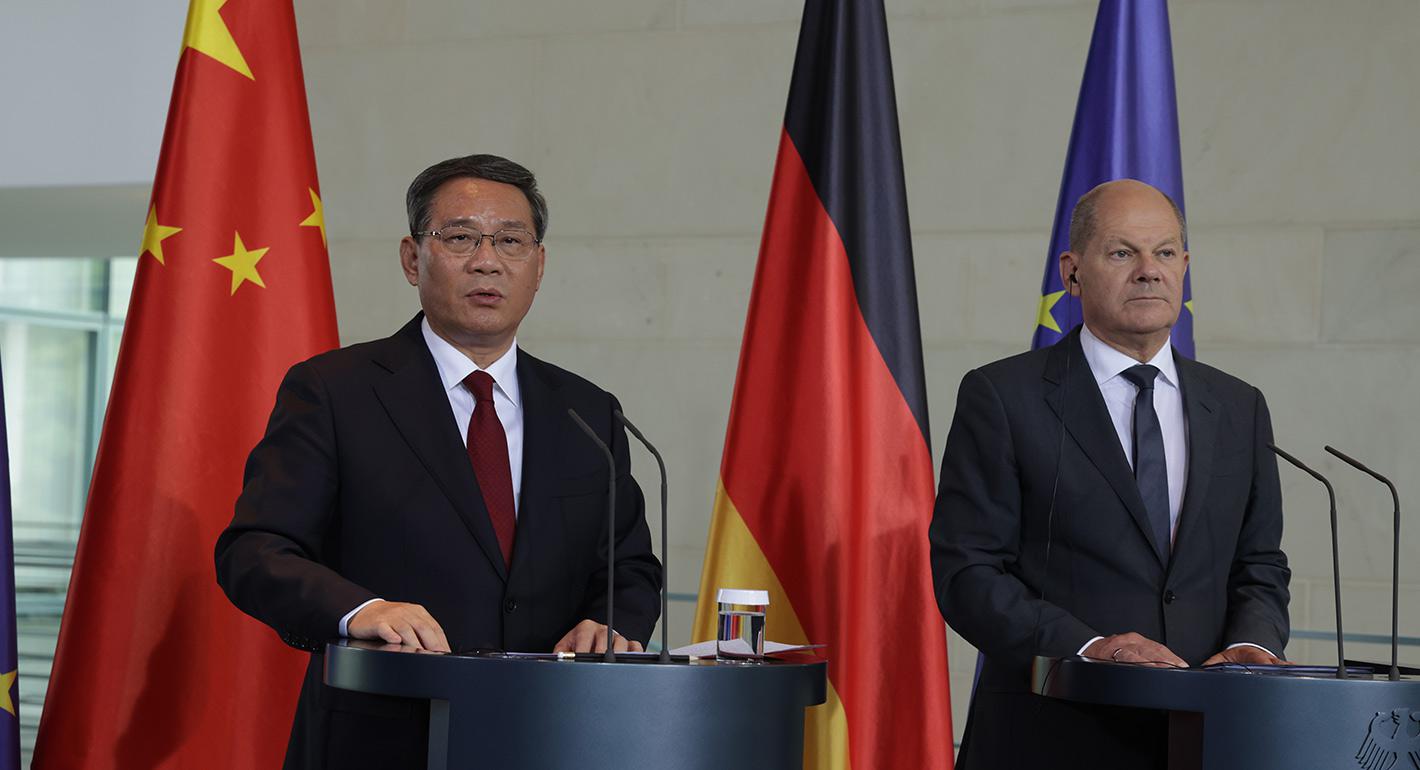
Amid escalating tensions between the United States and China, Europe finds itself vigorously courted by both sides. For Washington, decoupling or de-risking from China, however defined, cannot succeed without Europe’s support. Meanwhile, Beijing has largely given up negotiating directly with the United States and hopes that softening Europe’s stance will thwart Washington’s intentions. Against this background, Chinese Premier Li Qiang recently visited Germany and France to argue against a security-first approach.
Europe holds this pivotal position thanks to the strong economic and trade links among the three primary actors. Measured in terms of purchasing power, the United States, Europe (encompassing the EU plus the UK), and China command equal shares of about 16 percent of global GDP. They are also roughly equal in terms of shares of world merchandise trade. Both China and Europe typically run trade surpluses, with exports exceeding imports. The United States, however, has been incurring trade deficits for decades, which explains why Washington views trade relations more negatively than Beijing or Brussels.
Washington sees China as a rival first and foremost, so de-risking presents a way to make U.S. supply chains more diverse, resilient, and secure. Beijing sees Washington’s unwillingness to acknowledge China as a global power, with legitimate interests in international affairs, as the main problem. De-risking, therefore, is seen in China as cover for economic and technological containment.
U.S. foreign policy has been strongly influenced by negative public perceptions of China over concerns about economic competition, security, and human rights. Pew surveys indicate that 82 percent of the American public now has unfavorable views on China, compared with less than 40 percent just a decade ago. Negative sentiments increased slowly under U.S. president Barack Obama, then ratcheted up sharply during former president Donald Trump’s trade war with Beijing. China’s unfavorability recently spiked again when President Joe Biden characterized the U.S.-China rivalry as a battle between autocracy and democracy.
Over much of the past decade and a half, European perceptions of China stayed relatively neutral. In recent years, however, they have soured dramatically. France, Germany, and the UK now report that between 68 and 74 percent of their citizens hold a negative view of China. Among Central and Eastern European countries, unfavorability toward China hovers around 50–55 percent.
But there are major differences in how negative perceptions translate into policy. A recent European Council on Foreign Relations poll found that most Europeans want to remain neutral in any U.S.-China conflict and are reluctant to de-risk from China—despite recognizing the dangers of its growing economic presence in Europe. These views are more in line with the softer approach taken by French President Emmanuel Macron and German Chancellor Olaf Scholz than the harsher sentiments expressed by European Commission President Ursula von der Leyen. Europeans generally do not see China as a power that wants to undermine Europe, and they do not buy into Biden’s “democracy versus autocracy” framework. Despite Beijing’s refusal to condemn Russia’s aggression against Ukraine, the prevailing view is that China is still a “necessary partner” for Europe.

Differences in trade relations explain why Europe favors a more nuanced approached than the United States. As illustrated in figure 1, Trump’s trade war with China, which began in 2018, led to a decline in U.S. merchandise imports from China followed by a modest recovery. Meanwhile, U.S. imports from the rest of the world—including the other countries in East Asia—surged. China’s share of total U.S. imports declined to 16.5 percent by 2022, compared with 21.6 percent at the beginning of the trade war. As the United States relied increasingly on trade with other East Asian counties, China’s share of U.S. imports from East Asia fell from 54 percent to 43 percent.
In contrast, Europe’s imports from China have increased steadily. By 2022, they had nearly doubled since 2018. Over this period, China’s share of European imports from East Asia rose from 56 percent to 62 percent, cementing China as the heart of Europe’s economic links with East Asia. However, as the effects of the war in Ukraine more than doubled the costs of Europe’s energy trade, the United States—at least temporarily—became Europe’s primary trading partner once more in 2022. This combination of surging energy costs and increasing imports from China led to Europe’s first significant trade deficit in more than a decade.
Despite Europe’s financial difficulties, it remains more supportive of “free trade” than the United States because of its reliance on China for imported intermediate goods (components and raw materials), which are needed to produce manufactured European exports. In contrast, China’s exports to the United States are driven more by the consumption demands of U.S. households and firms. This feeds into Washington’s presumption that trade with China runs counter to creating more domestic jobs, while Europe believes that trade with China contributes to its economic capabilities.
The implications based on foreign investment are more mixed. Until recently, Europe’s annual foreign investment flows to China were much larger than the United States’. Similarly, China was investing much more in Europe than in the United States. But a combination of geopolitical tensions, the COVID-19 pandemic, and financial pressures has led to decreased foreign investment between Europe and China.
Whether foreign investments will rebound to past levels depends on Europe’s approach to de-risking. During Li’s European trip, he addressed the concerns of business leaders by cautioning that “not co-operating is the biggest risk, not developing is the biggest insecurity.” This message resonates well with some companies, such as German chemical giant BASF and carmakers Volkswagen and Mercedes, that depend heavily on China for both sales and key inputs. But a recent DZ Bank survey of 1,000 German companies on supply chain dependencies indicated a wide range of intentions, with some firms likely to expand supply links with China and others planning to cut back.
Both political and economic factors will shape future outcomes. European views of China will remain broadly negative as long as the Ukraine war continues and if other concerning issues, such as human rights and security, persist. But at some point, Europe will have to decide whether it wants to strengthen trade and investment links with China to offset a diminished Russian market. For many firms, China’s attractiveness depends on its growth prospects. If China’s current slowdown turns into a long-term structural decline, than de-risking becomes a more realistic option. But China could continue to grow robustly for another decade; if so, European firms will find China’s unique combination of market size, labor skills, and supportive services hard to replicate elsewhere.
The U.S.-China contest for economic and technological leadership centers on a set of strategic products and services, including green technologies, advanced semiconductors, AI, and rare earth minerals. In some of these areas, such as solar energy, China holds a commanding lead. Europe lacks the financial resources to compete on the level of Biden’s signature initiatives, such as the Inflation Reduction Act or the CHIPS and Science Act. The war in Ukraine means that Europe is also facing acute economic vulnerabilities. However, Europe is not without its advantages. The Dutch firm ASML has a near monopoly on equipment for producing advanced semiconductors, and European firms—specifically Ericsson and Nokia—are the only companies that can compete with China’s Huawei in providing 5G communication services. These and other capabilities offer the potential for Europe-China collaboration.
The most likely vehicle for signaling a more constructive approach would be to revive the EU-China Comprehensive Agreement on Investment. That agreement, negotiated in December 2020, would have provided a framework for strengthening links, but ratification was shelved amid reciprocal sanctions tied to Beijing’s human rights policies and handling of the protests in Hong Kong. Reviving discussions seems unrealistic in the current environment, but it could offer an attractive path for both Europe and China in the future.

Senior Fellow, Asia Program
Huang is a senior fellow in the Carnegie Asia Program where his research focuses on China’s economy and its regional and global impact.
Genevieve Slosberg
Former James C. Gaither Junior Fellow, Asia Program
Genevieve Slosberg was a James C. Gaither Junior Fellow in the Carnegie Asia Program.
Carnegie does not take institutional positions on public policy issues; the views represented herein are those of the author(s) and do not necessarily reflect the views of Carnegie, its staff, or its trustees.

Despite its flop at the box office, the film raises important questions for the climate community to answer.

Leonardo Martinez-Diaz

Russian strikes are weakening the economy sustaining Ukraine’s war effort. Closing the growing funding gap will require more European support and politically contentious reforms in Kyiv.

Balázs Jarábik

In an interview, Rozina Ali discusses her new book on the rise and manifestations of Islamophobia in the United States.

Michael Young

While the EU and European governments are embracing the much-lauded middle-power moment, this entails three difficult conundrums.

Richard Youngs

Europe is facing rising populism internally as well as external pressures from Russia, China, Turkey, and the United States.

Dimitar Bechev