

Commentary
Oliver Stuenkel, Adrian Feinberg
{
  "authors": [
    "Oliver Stuenkel"
  ],
  "type": "commentary",
  "centerAffiliationAll": "dc",
  "centers": [
    "Carnegie Endowment for International Peace"
  ],
  "collections": [],
  "englishNewsletterAll": "democracy",
  "nonEnglishNewsletterAll": "",
  "primaryCenter": "Carnegie Endowment for International Peace",
  "programAffiliation": "DCG",
  "programs": [
    "Democracy, Conflict, and Governance"
  ],
  "projects": [],
  "regions": [
    "North America",
    "South America"
  ],
  "topics": [
    "Economy",
    "Security"
  ]
}
Source: Getty
After a candidate’s assassination before the first-round vote, security concerns became even more of a pressing issue.
In August, Ecuador’s presidential election captured international headlines after the assassination of presidential candidate Fernando Villavicencio, just eleven days ahead of the first-round vote. The attack reflects a deepening security crisis in what was once one of South America’s safest countries but where transnational criminal groups exert increasing control. Due to the worsening security situation and the threat it poses to democracy across Latin America, Ecuador’s runoff on October 15 is highly relevant for both the country and the region as a whole.
In May, beleaguered conservative President Guillermo Lasso invoked an unprecedented constitutional mechanism—the so-called crossed death—that triggered presidential and congressional elections on August 20. The past year of Lasso’s tenure saw mass protest, economic stagnation, low approval ratings, and corruption allegations—alongside his near-certain impeachment, which he avoided by calling early elections. Both Lasso’s successor and the elected legislators will serve out the current term, and new elections will be held in early 2025. But the runoff remains a tossup.
The left-wing candidate and lawmaker Luisa González—protégé of former president Rafael Correa, who governed from 2007 to 2017 and who was convicted of corruption charges in absentia in 2020 and is now in exile in Belgium—entered the race as the favorite and took 33.5 percent of the vote. Many of her supporters have fond memories of Correa’s time in office, shaped by a commodity boom and economic growth, but critics point to excessive public spending, corruption scandals, and clear authoritarian tendencies.
González will face Daniel Noboa, the thirty-five-year-old son of banana tycoon Álvaro Noboa, who unsuccessfully ran for president five times (making it into the runoff on three occasions). A liberal-leaning centrist who defines himself as a center-left progressive, Daniel Noboa had polled in the single digits and received very little public attention before the first-round vote but seems to have benefitted from a strong performance at a presidential debate, capturing 23.4 percent of the first-round vote.
Noboa, a former assembly member who leads the pro-business National Democratic Action Party, has been critical of both former leftist leaders such as Correa and outgoing conservative president Lasso, projecting himself as a candidate seeking to overcome the deep polarization that shaped Ecuadorian politics over the last years. Notably, Noboa has run a nonconfrontational campaign, though he may be forced to attack his opponent more directly during the runoff. Noboa is reportedly considering Jan Topic, another presidential candidate who defended radical policies against organized crime—somewhat akin to those of Nayib Bukele in El Salvador—as minister of the interior. However, González has also promised to take a mano dura approach against criminal gangs, proposing the creation of a new security service to manage the prison system.
Fixing the country’s deteriorating security situation is a top priority for voters—particularly since the assassination of Villavicencio, who had made fighting the growing political influence of organized crime his central campaign promise. Since 2018, Ecuador’s murder rate has quadrupled and is now higher than that of either Colombia or Mexico. Ecuador’s location between the world’s two largest cocaine producers, Colombia and Peru, make its ports a prime spot to export cocaine to international markets. The coronavirus pandemic, during which schools in Latin America were closed for longer than in any other region of the world, was a boon to cartels: they recruited economically vulnerable youth, which may have contributed to the expansion of some groups. Furthermore, the country has used the U.S. dollar as its currency since 2000, which makes the country attractive for money launderers.
Ecuador’s next president may be able to implement domestic policies to address portions of the security crisis to some extent, but he or she will have a little more than a year to implement his or her ideas before the 2025 election. Even addressing challenges such as overcrowded prisons, which facilitate cartels’ recruiting efforts, can hardly be completed before the next vote. Prison riots have repeatedly claimed the lives of inmates—in one case more than one hundred—reflecting the government’s loss of control over part of the penitentiary system. And unless the region’s governments can work together and adopt a unified strategy, Ecuador will be unable to tackle many of the root causes of the security crisis, which are located outside of its borders.
Neither candidate has a clear path to victory in the October runoff. Exiled former president Correa’s Citizen Revolution party had a strong performance in congressional elections and will occupy 52 of 137 seats—the largest bloc, yet lacking a majority. Noboa’s party, on the other hand, will have a mere twelve seats. This may actually help Noboa in the runoff, as some voters may be wary of handing too much power to the correista camp. Another dynamic that is likely to work in Noboa’s favor is González’s campaign strategy to focus on mobilizing Correa’s base, which may irk centrist voters. Yet it also remains to be seen how Noboa will react to the national spotlight, which he has largely been able to avoid, given his low polling figures.
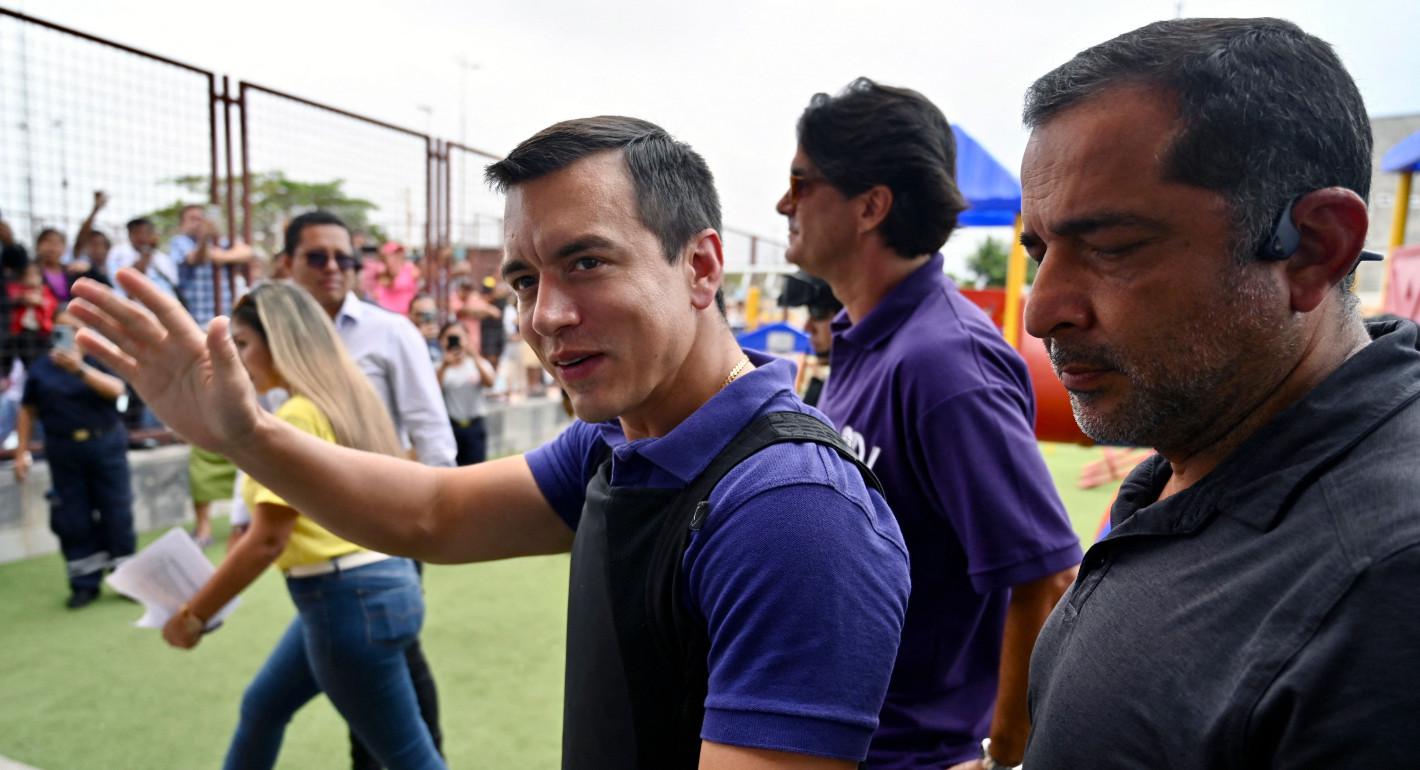
The presidential campaign’s exceptional circumstances also make it difficult to predict the runoff. Since Villavicencio’s assassination, candidates have taken extra precautionary measures, such as using bulletproof vests when appearing in public. The first round of elections took place under the aegis of 100,000 police and soldiers spread out across the country. It is unclear how these dynamics affect both candidates, but they certainly will limit the amount of large-scale events that candidates have organized in past elections.
Villavicencio, a former lawmaker and investigative journalist who often criticized Correa, had been fiercely attacked by Correa himself over the past years. “You’re a shameless coward,” Correa said in a video directed at Villavicencio late last year, adding “Soon your party will be over.” These statements led critics to argue that Correa needlessly fanned the flames of polarization, possibly hurting González’s first-round vote.
This does not mean that voters will completely ignore other concerns, such as slow economic growth, corruption, and unemployment. They will have a choice between two different economic models: correísmo, which envisions a strong state that plays a significant role in the economy, and Noboa’s more centrist and liberal strategy, even though he may opt for a heavy-handed approach to fighting crime. Another interesting difference between the two candidates’ positions is on the environment: González favors new oil drilling in the Amazonian Yasuní National Park, while Noboa is opposed to it. The majority of Ecuadoreans supported the latter position in a referendum on new oil drilling that was held on the day of the first-round elections.
Provided that Noboa can unite the anti-Correa vote, he stands a good chance to win, thus repeating the dynamic of Ecuador’s last elections, when anti-Correa candidate Lasso narrowly defeated pro-Correa candidate Andrés Arauz. Should Gonález win, she may organize a constituent assembly that could be used to facilitate the return of Rafael Correa to Ecuador.
Senior Fellow, Democracy, Conflict, and Governance Program
Oliver Stuenkel is an associate professor at the School of International Relations at Fundação Getulio Vargas (FGV) in São Paulo, Brazil. He is also a senior fellow affiliated with the Democracy, Conflict, and Governance Program at the Carnegie Endowment for International Peace.
Recent Work
Oliver Stuenkel, Adrian Feinberg
Oliver Stuenkel, Adrian Feinberg
Carnegie does not take institutional positions on public policy issues; the views represented herein are those of the author(s) and do not necessarily reflect the views of Carnegie, its staff, or its trustees.

It signals a new era of tech diffusion and warfare.

Steve Feldstein

With its public finances in shambles, the far right polling at 35 percent ahead of the 2027 presidential election, and a growing protest movement, is France’s crisis a threat to the EU’s geopolitical awakening?

Rym Momtaz, ed.

Russia’s AI-driven propaganda campaigns operate in a fragmented, chaotic, and often illogical manner. That’s not necessarily a problem for the Kremlin, though: It’s much easier to mimic genuine public debate that way.

Ilya Klishin

Russian strikes are weakening the economy sustaining Ukraine’s war effort. Closing the growing funding gap will require more European support and politically contentious reforms in Kyiv.

Balázs Jarábik

Europe is facing rising populism internally as well as external pressures from Russia, China, Turkey, and the United States.

Dimitar Bechev