

Paper
- +2
Ian Klaus, Mark Baldassare, Rachel George, …
{
  "authors": [
    "Mark Baldassare"
  ],
  "type": "commentary",
  "centerAffiliationAll": "dc",
  "centers": [
    "Carnegie Endowment for International Peace"
  ],
  "collections": [
    "Democratic Innovation"
  ],
  "englishNewsletterAll": "ctw",
  "nonEnglishNewsletterAll": "",
  "primaryCenter": "Carnegie Endowment for International Peace",
  "programAffiliation": "CC",
  "programs": [
    "Carnegie California"
  ],
  "projects": [],
  "regions": [
    "North America",
    "United States"
  ],
  "topics": [
    "Foreign Policy"
  ]
}
Source: Getty
The state’s democracy innovations will be front and center, and some races will be closely watched as early indicators of possible November outcomes.
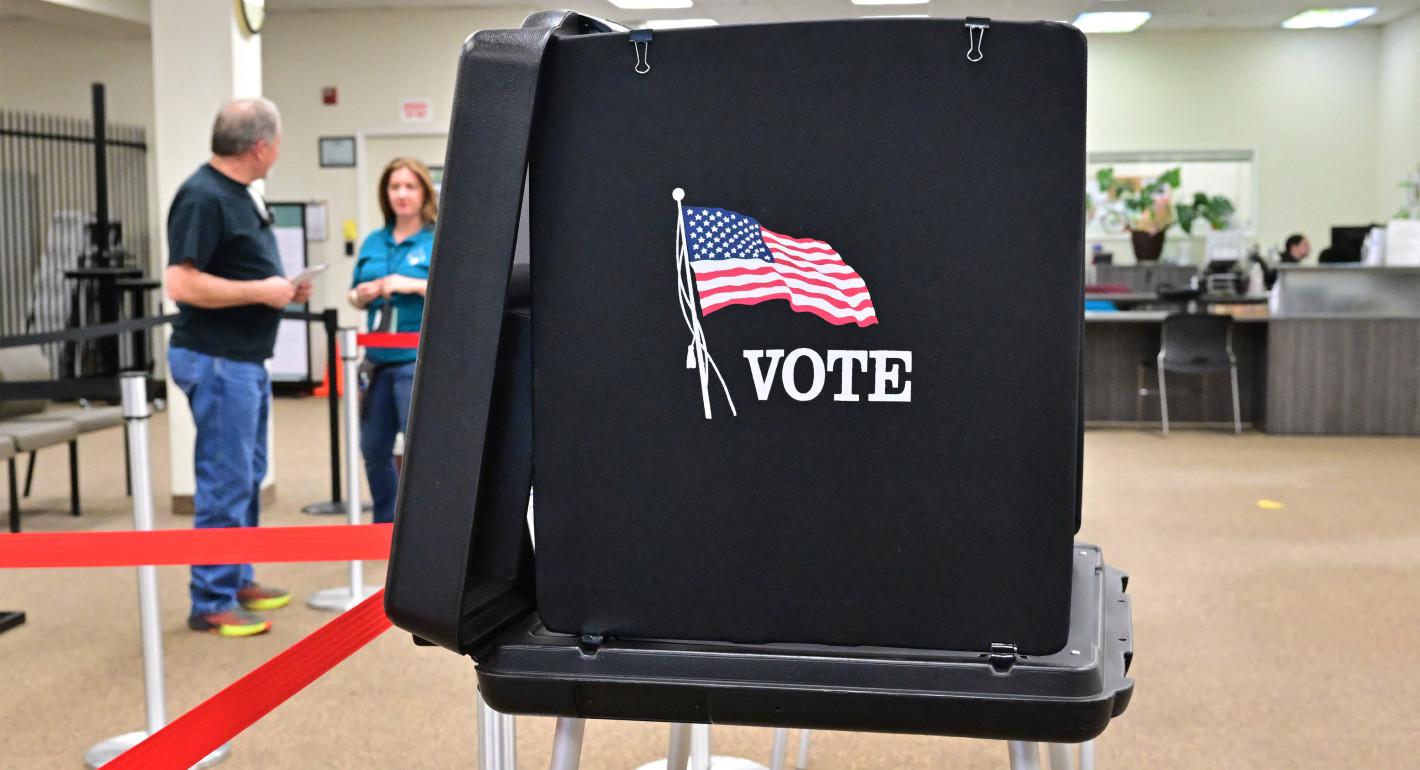
Many experts are describing the 2024 U.S. elections as the most consequential in decades. These stakes are on Californians’ minds as they head to the polls on March 5—also known as Super Tuesday, when voters in fifteen states and one territory will cast ballots in presidential primaries. California voters will also weigh in on a U.S. senate race, federal and state legislative races, and a state proposition, along with local races and ballot measures. Here are some of Californians’ context-setting attitudes and what to watch for in their voting in the primary.
First, how are California’s likely voters thinking about the upcoming election? In a February survey by the Public Policy Institute of California (PPIC), which I have directed since its launch twenty-six years ago, 84 percent say that voting in elections in 2024 is “very important,” 13 percent say it is “somewhat important,” and 3 percent say it is “not too important” or “not at all important.” Majorities across demographic and partisan groups and regions think that voting in elections in 2024 is “very important.”
Yet only 40 percent are satisfied (5 percent very, 35 percent somewhat) with the way that democracy is working in the United States. In contrast, 37 percent are not too satisfied, and 24 percent are not at all satisfied. Fewer than half across partisan and demographic groups and state regions are satisfied. Moreover, 68 percent say the way that democracy is working in the United States has gotten worse compared to five years ago.
Californians’ views of U.S. democracy are tied to their perceptions of polarization. Seventy-six percent think that President Joe Biden and the U.S. Congress will not be able to work together and accomplish much in the next year. Majorities across partisan and demographic groups and regions are pessimistic.
California’s democracy innovations will be front and center in the March primary. California voters approved a top-two primary system so that all voters can cast ballots in a statewide race regardless of party affiliation. The voters also approved a citizens’ independent redistricting commission to end gerrymandering, which has resulted in more competitive legislative races. The California legislature enacted automatic voter registration and vote-by-mail ballots sent to all registered voters to increase registration and turnout. Finally, California has a direct democracy system in which voters decide on public policies through ballot initiatives. Likely voters said they have a “great deal” (40 percent) or “quite a lot” (25 percent) of confidence in their state’s electoral process, according to a September PPIC Statewide Survey.
California is a blue state, with 47 percent of its 22 million voters registered as Democrats and 24 percent as Republicans. GOP candidates have not won a statewide race since 2006. But California has distinctly red regions in the rural north and inland that run counter to this image. The state also has several regions where no party has a stronghold—notably in parts of the Central Valley, the Inland Empire, and Orange County–San Diego. Primary outcomes will be closely watched in these purple areas where the competitive House races are clustered.
There were 6 million ballots cast for former president Donald Trump in California in 2020—more than in any other state. According to the February PPIC survey, 64 percent of Republican likely voters say they will vote for the former president in the closed Republican presidential primary. Trump’s support has increased in the wake of candidates leaving the race, and with more than 50 percent support, Trump would win all of the state’s Republican delegates on Super Tuesday. When asked about the possible November rematch between Biden and Trump, California likely voters say they would choose Biden by a wide margin (55 percent to 32 percent). That finding is consistent with the 2020 election results.
In the U.S. Senate primary, Representatives Adam Schiff and Katie Porter (both Democrats) and Steve Garvey (a Republican) are in the lead for the seat once held by Dianne Feinstein, with 24 percent, 19 percent, and 18 percent of the vote, respectively. The top two vote-getters will face off on the November ballot. Democratic voters favor Schiff, while Republicans support Garvey. Independents are divided.
Whether the primary outcome in this close top-two contest is a single-party race or a partisan one will be closely watched. And although this U.S. Senate seat is likely to remain in Democratic hands, the race has partisan turnout implications for November that may impact downballot races. As an indicator that California’s top-two primary is viewed favorably, 62 percent are satisfied with the candidate choices in the Senate primary, including majorities across demographic groups and regions.
Forty of the fifty-two House seats belonging to California are currently held by Democrats. The outcomes in a few competitive districts may help to determine control of a closely divided Congress. Sixty-one percent of voters say that they would vote for or lean toward the Democratic candidate in their local House election in November, compared with 36 percent for the Republican candidate. In the ten competitive districts named by the Cook Political Report, the margin narrows to 54 percent for the Democratic candidate and 43 percent for the Republican candidate. The Thirteenth Congressional District in the Central Valley is currently held by a Republican, and the Forty-Seventh District in Orange County is currently held by a Democrat. Both are among the most competitive races in the state. The outcomes in these primary races will be closely watched as an early indicator of how many House seats could flip this fall.
On Super Tuesday, California voters will also weigh in on policy solutions to homelessness—one of the state’s most serious challenges. Fifty-nine percent of likely voters say they will vote yes on Proposition 1, which includes more than $6 billion in bonds to build mental health treatment facilities and provides state funding to build “supportive” housing to help address homelessness and addiction. As an indicator that California’s direct democracy system is viewed favorably, three in four say that the outcome of the vote on Proposition 1, which requires a majority vote to pass, is important to them.
Voter turnout is the political wildcard in 2024—in California and across the country. Both have signs of a so-called enthusiasm gap. About 40 percent of California likely voters say they are “not too” or “not at all” enthusiastic about voting for president and Congress this year. How many votes are cast and by whom will give the entire country an early read on voter engagement from a state with a concerted effort to increase voter registration and turnout.
Nonresident Scholar, Carnegie California
Mark Baldassare is a nonresident scholar at Carnegie California. He is an authority on elections, voter behavior, and political and fiscal reform.
Recent Work


Ian Klaus, Mark Baldassare, Rachel George, …
Mark Baldassare, Ian Klaus
Carnegie does not take institutional positions on public policy issues; the views represented herein are those of the author(s) and do not necessarily reflect the views of Carnegie, its staff, or its trustees.

The EU can impose sanctions but struggles to enforce them without the United States. With Washington increasingly disinterested in backing European interests, the bloc must now fend for itself.


Nicu Popescu, Tiago Antunes

Global and rising powers will need to engage with Africa’s priorities and agency in order to secure the continent’s increasingly attractive partnerships.
Fonteh Akum

Rubio’s recent visit brought welcome attention, but more capital requires governance changes that may be a hard sell for regional governments.

Jennifer B. Murtazashvili

America’s foreign-policy objectives have grown more demanding while Americans have demanded greater focus on their own affairs.

Stephen Wertheim

Japan’s long-term security policy is driven by concerns about China, and there is little appetite for (or interest in) pursuing a confrontation with Moscow.

James D.J. Brown