

Commentary
Despite its flop at the box office, the film raises important questions for the climate community to answer.
Leonardo Martinez-Diaz
{
  "authors": [
    "Shana Tabak",
    "Alejandro Martin Rodriguez"
  ],
  "type": "commentary",
  "centerAffiliationAll": "dc",
  "centers": [
    "Carnegie Endowment for International Peace"
  ],
  "collections": [
    "Climate Mobility"
  ],
  "englishNewsletterAll": "ctw",
  "nonEnglishNewsletterAll": "",
  "primaryCenter": "Carnegie Endowment for International Peace",
  "programAffiliation": "SCP",
  "programs": [
    "Sustainability, Climate, and Geopolitics"
  ],
  "projects": [],
  "regions": [],
  "topics": [
    "Climate Change",
    "Global Governance",
    "Migration"
  ]
}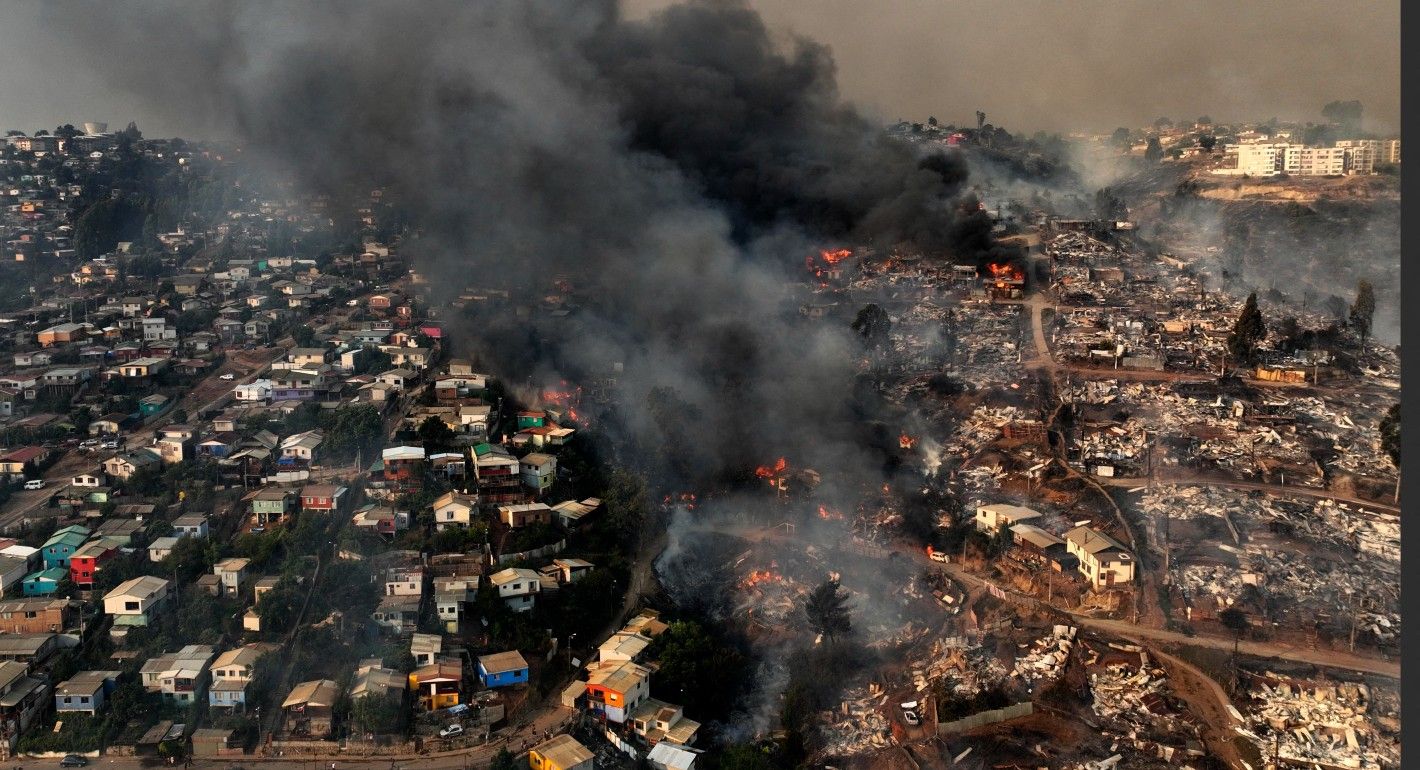
A 2024 wildfire in Viña del Mar, Chile. (Photo by Javier Torres/AFP via Getty Images)
With the Fund for Responding to Loss and Damage scheduled to make its first distribution in 2026, countries and members of the fund’s board have an opportunity to prioritize human mobility.
On January 13, Carnegie will host an event on financing climate mobility via the loss and damage fund. Register here.
In San Javier, a small rural town in Chile, climate-exacerbated droughts, higher temperatures, and wildfires have severely impacted the lives of inhabitants. Resident Carlos Medel recalls his experience leaving his home behind after the latest fires: “We took nothing with us. We closed our eyes and left. Life is more important.”
Carlos and his town are not alone. Communities all over the world have been forcefully displaced due to wildfires and other climate-related events in recent years.
In 1990, the Intergovernmental Panel on Climate Change first argued that the biggest impact of climate change was likely to be human displacement, as climate change radically transforms where and how people live. Nearly three decades later, after a campaign led by civil society organizations and developing countries, the member parties of the United Nations Framework Convention on Climate Change established the Fund for Responding to Loss and Damage (FRLD) during the Conference of the Parties (COP27) in 2022. The fund aims to provide financial support to vulnerable developing countries whose populations, despite being the least responsible for contributing to climate change, are irreversibly impacted by it.
Yet a gap exists between the lived reality of human displacement and attempts to assess and address climate impacts through finance. The FRLD opened its first call for funding requests from developing countries in December 2025, creating a unique opportunity for countries to include one of the most cross-cutting impacts of climate in their funding proposals: human mobility. As the fund assesses these proposals, it has the chance to support loss and damage associated with displacement and could help unlock funding for badly needed efforts to support communities grappling with the first-hand impacts of climate change on their lives, such as Carlos’.
Carlos’ story is one of many that captures the impacts of a changing climate on human mobility. In 2024, more than 45 million weather-related disaster displacements were recorded globally—the highest figure since the Internal Displacement Monitoring Centre (IDMC) started tracking data in 2008. In the United States in 2022, more than 3 million Americans lost their homes to climate-related disasters. Prospects for the future remain challenging, with the World Bank estimating more than 200 million climate-related displacements by 2050.
Climate mobility encompasses displacement, migration, planned relocation, and even immobility in the midst of climate hazards. Although migration can sometimes be a successful means of adaptation to climate impacts, it can also be a loss for those who move. When people leave their homes—voluntarily or not—due to climate-exacerbated impacts, they endure economic hardships, including loss of income, housing, and savings. They also may endure noneconomic losses, including access to traditional or sacred lands, cultural assets, and mental health support. Developing countries often have limited budgets to address these effects of climate mobility, which may lead to incomplete responses that fail to meet the needs of affected populations.
Still, assessing and quantifying the costs of mobility-related losses and damage is not a simple task, yet it’s a necessary one for accessing the crucial funding provided by the FRLD. For people affected by climate change, displacement is both a form of loss and damage as well as a driver of loss and damage. Leaving home or being pushed from home is typically a measure of last resort and can be considered a form of adaptation to climate change, occurring when the risks become intolerable. Additionally, displacement can result from both rapid-onset and slow-onset climate events. Hurricanes, floods, or wildfires displace people directly, whereas droughts, coastal erosion, or extreme heat affect livelihoods and food security that in turn compel people to move. These different climate impacts shape the mobility experienced by populations, who may experience temporary or permanent displacement. Each of these different scenarios carry their own kind of irreversible impacts and require funding to be addressed properly.
This raises a critical question: Who pays for the damages suffered by those impacted by climate change? This concern prompted countries to establish the FRLD at COP27 in 2022 to address “the urgent and growing needs of vulnerable communities in developing countries facing the irreversible impacts of climate change.” As of November 2025, a total of $817 million has been pledged to support the fund—far short of the estimated $580 billion that experts believe vulnerable nations may require to address climate-related effects by 2030. Efforts to increase the number of pledges to the FRLD seem to be stagnating, with Spain making the sole new pledge at COP30.
Yet as it begins to disseminate funds, the FRLD is poised to have a major impact on climate finance. During its pilot phase, the fund will distribute $250 million to support projects in the field and provide insights to shape its long-term policies. The successful implementation of these funds, especially if they employ rigorous methodology and demonstrate impact to stabilize communities on the precipice of climate disaster, could serve to incentivize deeper commitment from donor countries.
Policymakers, scientists, and analysts know that climate change influences mobility patterns of populations around the world and that many developing countries have limited funds to address the fallout. But quantifying the impacts on human settlement is difficult—and will be a major challenge for the FRLD. The FRLD board will be looking for clear and compelling evidence of what can reasonably be considered “loss and damage” to make funding decisions, so governments and the fund itself must have concrete indicators to understand and quantify the losses and damages inherent in particular instances of human mobility.
Some parties might prioritize more easily quantifiable economic aspects of loss and damage over the inclusion of a transversal, difficult-to-assess aspect such as human mobility. The cascading effects of climate, however, impact virtually every aspect of human life, from food security to cultural preservation and professional development. Ignoring the impact of human mobility on loss and damage risks overlooking a central component of human existence: where we live.
And although critics could rightly argue that quantifying the impact of climate impacts on human settlement is challenging, this only reiterates the value of novel methodologies aimed at better understanding and assessing concrete indicators to calculate the impacts of loss and damage associated with mobility.
A diverse network of actors has committed to ensuring that the question of where people live does not become a marginal issue for the FRLD. Civil society organizations, international organizations, and local and state governments have invested in research, reports, and methodologies to give the fund the tools needed to accurately assess human mobility. For example, recognizing that displacement is underreported and overlooked in loss and damage assessments, the IDMC published a policy brief in 2024 advocating for the inclusion of financial mechanisms and access modalities that account for displacement.
Undertaking the challenge of quantification of noneconomic loss and damage, the International Organization for Migration and the nongovernmental organization La Ruta del Clima developed a tool to quantify loss and damage in the context of human mobility. That tool enables governments in Latin America and the Caribbean to comprehensively estimate both economic and noneconomic costs. Their pilot efforts in Costa Rica and Chile—including an assessment of the impact of wildfires in San Javier—calculated that to address the losses and damages experienced in the assessed communities, governments would need to invest around $65,384 per household.
Creating a one-size-fits-all way to assess the “cost” of movement may be difficult. But whether movement occurs within borders or across borders, whether it is long term or temporary, it has critical impacts on a society seeking to recover and live with dignity in the context of the climate crisis.
The FRLD has an opportunity to rigorously examine how climate affects where people can live, integrating human mobility into their analysis of loss and damage, and aiming to help impacted communities access the financing they need to recover from climate change impacts. With the pilot phase of the FRLD, an opening exists to support projects that fully capture the human dimensions of climate change, including displacement. And governments have tools at their disposal to advocate for funds distribution that integrates the impact of climate-related human mobility, building greater capacity to avert, minimize, and reduce the drivers of displacement, and preparing communities for a more resilient present and future.

Senior Fellow and Director, Climate Mobility Project, Sustainability, Climate and Geopolitics Program
Shana Tabak is senior fellow and director of the Climate Mobility Project at the Carnegie Endowment for International Peace.

Fellow, Sustainability, Climate, and Geopolitics Program
Alejandro Martin Rodriguez is a fellow in the Sustainability, Climate, and Geopolitics Program at the Carnegie Endowment for International Peace. His research focuses on the social dimensions of climate change, and he manages projects on climate mobility, peace, and security.
Carnegie does not take institutional positions on public policy issues; the views represented herein are those of the author(s) and do not necessarily reflect the views of Carnegie, its staff, or its trustees.

Despite its flop at the box office, the film raises important questions for the climate community to answer.

Leonardo Martinez-Diaz

While the EU and European governments are embracing the much-lauded middle-power moment, this entails three difficult conundrums.

Richard Youngs

Europe is facing rising populism internally as well as external pressures from Russia, China, Turkey, and the United States.

Dimitar Bechev
Policy proposals on sovereign debt must both match the scale of the challenge and be implementable within existing political constraints.
David McNair

The acknowledgment has sparked fears of a new arms race with China and Russia.

Chris O’Meara