

Paper
Sarah Yerkes, Natalie Triche, Amr Hamzawy
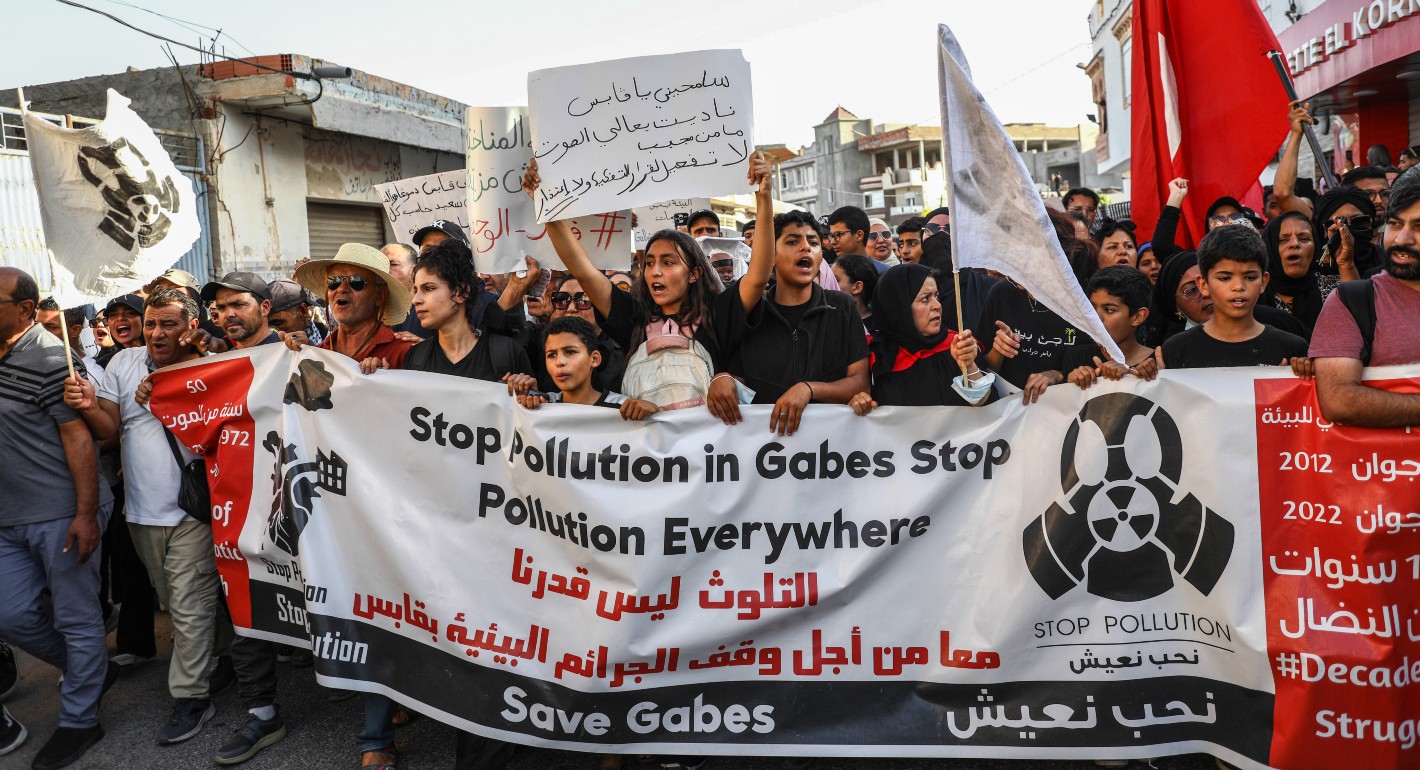
Teenagers hold a large banner during a mass protest in Gabes, Tunisia, on October 15, 2025. (Photo by Chedly Ben Ibrahim/NurPhoto via Getty Images)
For climate-focused civil society in countries like Morocco, Algeria, and Tunisia to be most effective, organizations should work together to develop networks that extend their reach beyond their local area and connect across borders to share best practices and amplify each other’s work.
Civil society organizations (CSOs) in western North Africa (defined here as Morocco, Algeria, and Tunisia) face a variety of restrictions that limit their ability to impact policy change. Climate-focused CSOs are, at times, able to navigate these restrictions when they are perceived as development- rather than activist-focused and when they complement rather than challenge their governments. This article begins by discussing the civil society landscape in North Africa—the types of CSOs that exist today and what restrictions are in place for civil society in North Africa. It also describes the tactics used by CSOs and informal networks to circumvent government restrictions and the ways that climate-focused CSOs, in particular, are able to navigate the civil society space in each North African country.
North African governments face serious governance challenges ranging from inadequate healthcare and education to poor air quality and water scarcity, which are directly tied to climate change. CSOs have traditionally attempted to fill the gaps left by government inadequacy. However, following the Arab Spring, when civil society groups and informal networks rose up in protest against their governments across the Middle East and North Africa, Arab leaders have been more thoughtful and thorough in their repression against civil society, forcing CSOs to adapt their tactics.
Climate-focused CSOs (in other words, organizations that work on addressing the causes and consequences of climate change) operate in a somewhat liminal space. They are not as overtly threatening as human rights–focused CSOs, but they often highlight government inadequacy in a way that is uncomfortable for incumbent regimes. For example, climate-focused CSOs might call out local or national governments for their inability to deliver adequate water supplies to households. Or organizations that monitor air or water quality or desertification might publish data that contradict the official government narrative. Furthermore, climate-focused CSOs often spotlight how climate change is impacting marginalized communities, highlighting how government policies have failed rural or minority populations. Nevertheless, climate-focused CSOs and governments often share the same goals of addressing acute governance challenges such as water, energy, and food scarcity. CSOs can therefore market themselves to governments as partners rather than adversaries to both avoid repression and improve the lives of their fellow North Africans.
Civil society has been active in North Africa for decades across a variety of issue areas. Since the 1980s, the civil society landscape has grown dramatically in size, scope, and reach. Prior to the 2011 Arab uprisings, civil society organizations primarily focused on service delivery, development work, cultural preservation, and—where permitted—limited advocacy on issues like women’s rights, labor conditions, and environmental protections. Organizations working on sensitive political issues such as human rights, democratization, and government accountability faced severe restrictions and operated primarily in exile or underground.
Following the Arab uprisings, civil society experienced different trajectories across North Africa, fundamentally reshaping the relationship between states and societies in all three countries. Tunisia underwent the most dramatic transformation, experiencing a rebirth of civil society during its short-lived democratic transition when civic space opened up and formal CSOs, informal networks, and individual activists were given relatively free rein to operate. Post-uprising, Tunisian civil society expanded beyond service delivery to embrace advocacy and human rights work, environmental justice campaigns, anti-corruption efforts, and direct policy engagement, which had all been impossible under Zine El Abidine Ben Ali’s authoritarian rule.
In Morocco and Algeria, civil society did not experience such a dramatic opening, but the uprisings nevertheless forced significant changes in state-society relations. Morocco’s regime responded with constitutional reforms in 2011 and expanded space for certain types of civil society activity, particularly in environmental and development sectors, while maintaining tight control over explicitly political organizations. Civil society shifted toward more decentralized, community-based activism and increasingly used environmental and social issues as entry points for broader governance critiques. Algeria saw the rise of new social movements, particularly around unemployment and regional marginalization, though the regime maintained strict control through its restrictive 2012 associations law. The people in both countries realized they had power to force change, and governments became acutely aware of this potential, leading to a pattern of limited tactical concessions combined with continued repression of direct challenges to authority.
However, in the fifteen years since the uprisings, as organizations—whether formal social movements or loose networks—have evolved, so have the hybrid and authoritarian governments in North Africa in their responses to civil society activity. Across North Africa today, there are increased levels of repression against civil society, with regimes cognizant of the potential power of the people to mobilize and therefore more proactive in their attempts to prevent future uprisings.
Thus, in the years since the Arab uprisings, civil society has evolved from primarily service-oriented organizations to increasingly sophisticated advocacy networks working on environmental justice, anti-corruption, and human rights—often using cross-sectoral approaches that blend environmental, social, and governance issues—while simultaneously facing escalating repression and prosecution. The result is a paradox: Civil society is more experienced, more networked, and more strategic than before 2011, yet it operates in environments that are in many ways more restrictive than the ones that sparked the uprisings.
Civil society in North Africa can be divided into two primary camps: development civil society, defined as “organizations that deal primarily with issues of human development such as poverty alleviation, education and health” and democracy-promotion civil society, defined as “advocacy organizations that deal with issues like human rights, political rights and representation.”1 Most of the literature on civil society in North Africa is focused on democracy-promotion civil society rather than development civil society, under the false assumption that the main goal of all types of civil society is to bring about democracy or political reform. However, development civil society (which scholars often refer to as apolitical) faces the same challenges as democracy-promotion civil society in the region, including “harassment, intimidation and extra-legal and arbitrary punishments by the government agencies that oversee their activities.”2 Climate-focused CSOs fall under the category of development civil society as they are not advocating for democratic reform.
Some of the more prominent and successful civil society organizations in the early postindependence period in North Africa were focused on gender or religion—issues that have broad, global resonance, are adjacent to global movements, and represent less of a threat to the incumbent regimes than more overtly political organizations. Today, the civil society sector in North Africa encompasses a wide variety of organizations, including:
In Morocco, the most prevalent types of organizations are climate and environmental, development and service delivery, and women’s rights. In Algeria, the most prevalent types are labor unions and workers’ organizations, climate and environmental organizations, and cultural organizations (usually Amazigh). In Tunisia, the most common organizations are climate and environmental, advocacy and human rights, women’s rights, and development and service delivery.
Furthermore, civil society encompasses a wide variety of organizations and networks of varying sizes and structures. While there are hundreds of thousands of registered CSOs in North Africa, there are also many unregistered organizations, informal networks, online-based communities, and other nontraditional types of civil society organizing.
Civil society in North Africa faces a variety of de facto and de jure restrictions including strict NGO laws, bureaucratic hurdles, censorship, intimidation, and arrests and prosecutions of CSO members. Furthermore, CSOs struggle with insufficient funding, public apathy, and poor communication and coordination with other CSOs, which all limit their reach. The media sector, which is one aspect of civil society and works to amplify the voices of CSO actors and raise awareness of government corruption and malfeasance, has been facing growing restrictions across North Africa over the past few years. While independent media were common in Morocco, Algeria, and Tunisia up until a few years ago, today nearly every independent media outlet has disappeared, and few independent journalists remain in the region. In each of the three countries, governments have increased their crackdowns on journalists and other voices critical of the government over the past few years.
North African governments also employ strict CSO registration procedures that make it challenging and expensive to register an organization. Governments in Morocco, Algeria, and Tunisia use legal loopholes to hold up registration processes and prevent CSOs from accessing their funds. A dependence on external donors also complicates the work of CSOs, as governments impose restrictions on foreign funding of civil society. While in Morocco there are few restrictions on foreign funding, in Algeria, foreign funds require prior government approval. In Tunisia CSOs are legally allowed to receive foreign funds, though such organizations must notify the government of the source, value, and purpose of any foreign funds and publish this information both on their website and in a print media outlet within a month of the decision to accept the funds. Furthermore, according to the International Center for Not-for-Profit Law, since the 2022 Constitution,
There has been an increase in harassment against associations that receive foreign funds. Activists working with these organizations are often accused of being agents for foreign countries. Several CSOs report harassment, public accusations of “foreign agendas,” and pressure during financial audits or administrative inspections.
Each North African country has taken a slightly different approach toward the civil society sector. In Morocco, despite the 2011 constitution guaranteeing freedom of the press and freedom of expression, authorities regularly intimidate CSO activists and journalists and sometimes arrest and punish government critics. Generally, if CSOs avoid Morocco’s redlines (the monarchy, Islam, and the territorial integrity of Western Sahara), they can navigate at least some space to operate. However, Morocco has used a creative technique—accusing critics of sexual crimes such as rape and human trafficking in order to silence and humiliate them, rather than accusing them of a political offense. Furthermore, Morocco’s well-known, sophisticated online surveillance systems act as a constraint on freedom of expression.
In Algeria, civic space is tightly controlled with what the International Center for Not-for-Profit Law calls “legislation restricting the exercise of civil and political rights.” CSOs are limited to operating a proscribed set of activities, including “professional, social, scientific, religious, educational, cultural, sports, environmental, charitable and humanitarian domains.” One of the outcomes of the 2019 Hirak movement, a popular uprising against a fifth mandate for then president Abdelaziz Bouteflika, was the institutionalization of even more restrictive laws than in the past, which further shrank civic space ahead of the 2020 presidential elections. As a result, today the Algerian government has a wide variety of tools at its disposal to silence critics. These include travel bans and the use of anti-terrorism laws to target activists who criticize the government. Additionally, a highly restricted media environment directly impacts the ability of civil society to operate, preventing reporting on civil society activity and hampering CSOs from raising awareness around the different issues they work on. While in Morocco and Tunisia the media can help CSOs reach a wider audience by publicizing their work, this is far more challenging in Algeria.
Tunisia, on paper, is the best performing of the Arab states in the civil society sphere, with a liberal NGO law (Decree No. 88 of 2011) that was put in place during the decade of democracy. The law does provide government oversight of foreign funding, in line with the way democratic governments police their civil society spheres, but it generally gives CSOs and individual activists the space for operational capacity—whether as government watchdogs or as charitable organizations that help fill in governance gaps. However, following President Kais Saied’s self-coup in 2021, CSOs have faced increasing restrictions including regular arrests of government critics, bans on demonstrations, and a 2022 law punishing anyone who “deliberately uses communication networks and information systems to produce, promote, publish, or transmit false information or false rumors” with five years in prison (or ten years if the target is a public servant). Furthermore, the Saied government and Parliament have threatened repeatedly to introduce a new, far more strict NGO law that could curtail foreign funding and significantly diminish the civil society sector beyond existing constraints.
Because of the level of repression against civil society across the region, CSOs have traditionally adopted one of three strategies to achieve their goals, which I have previously outlined: “allowing themselves to be fully captured by the regime, choosing to confront the state, or choosing to be partially co-opted, while maintaining some level of autonomy.”3 The choice a CSO makes is shaped by the interaction of three main factors: the level of perceived threat the CSO presents to the regime, the amount of foreign funding the CSO has access to, and the level of non-domestic rhetorical support the CSO receives.4
Today, civil society often operates less formally than in earlier decades, through online communities and informal virtual networks as a matter of practicality as social media has largely replaced traditional news as an information source for youth in North Africa and globally. Social media access has greatly expanded over the past few years in the region. According to a 2024 study, 88 percent of Algerians, Moroccans, and Tunisians are online every day, and 90 percent have at least one social media account. Furthermore, informally organized civil society activity can be an effective tactic to avoid some government repression against activism that is seen as threatening to the state, as it allows CSOs to circumvent funding rules and cumbersome official registration.
Civil society in North Africa often adopts a hybrid approach. The 2019 Hirak movement in Algeria, in which the Algerian public succeeded in preventing Bouteflika from seeking a fifth term in office, is one example of a mass public movement that used traditional methods of street protest but was organized largely online.
The fall 2025 GenZ 212 movement in Morocco was another example of a leaderless movement that was organized on the Discord app but utilized in-person protest to push back against what it perceived as lavish government spending on football stadiums and other infrastructure for the 2025–2026 Africa Cup of Nations and 2030 World Cup amid inadequate healthcare and education investment. The leaderless nature of the movement was an intentional choice by youth both to democratize the movement and to prevent the Moroccan security services from targeting any one or group of individuals, as they had done in the Rif protests in 2017 with the arrest of protest leader Nasser Zefzafi, who remains in prison today.
Similarly, in Tunisia, the protests that have targeted the Saied government remain leaderless and largely decentralized. While the main labor union (the Tunisian General Labour Union, or UGTT) has been at the forefront of some of the larger protests, the opposition has generally not rallied around one specific leader or group.
The shift toward more informal civil society activity also reflects a growing disinterest among youth, who often dominate the civil society sphere, in formal politics and civic engagement more broadly. Contributing to this lack of engagement in public activism and political activity is the growing repression against civil society that post–Arab Spring governments have used to prevent future uprisings. In both the Algerian Hirak and the Moroccan GenZ 212 movements, despite the deliberate use of peaceful tactics by protesters, security forces employed violence and intimidation against protesters, prosecuting hundreds and resulting in the deaths of some individuals.
Climate-focused civil society organizations are a more recent phenomenon, one that has proven both resilient and, at times, effective in the face of restrictive civil society conditions. While a range of organizations operate in the environmental and climate space, in general, climate-focused CSOs have chosen a less confrontational path than other types of CSOs. One reason is that climate-focused CSOs are often local, community-based movements involved in targeted campaigns to address a localized problem. While climate change’s impacts span borders, often climate issues require hyperlocal solutions. Thus, small, local CSOs can pop up in communities to address the particular climate challenge faced by that community. However, the most effective approaches are locally led initiatives that can leverage external resources strategically while maintaining community ownership, rather than foreign-designed projects that attempt to incorporate local participation as an afterthought.
The most effective approaches are locally led initiatives that can leverage external resources strategically while maintaining community ownership.
Climate-focused CSOs in North Africa fall into ten thematic categories, with some organizations covering multiple themes:
These organizations can operate at the local, regional, national, or cross-border level. Local organizations are the most prevalent in the region and focus on climate issues specific to their communities such as local agricultural practices or local factory emissions. Regional organizations work across multiple localities and tend to focus on regional issues such as coastal zones or mining basins. National-level organizations tend to focus on broader issues with a national appeal and are often involved in policy advocacy. Cross-border organizations focus on coordination across the region, such as between Algeria and Tunisia, and can include regional climate networks or shared resource management systems that focus on issues such as water and air quality.
While these types of movements can operate more nimbly than larger, more formalized organizations, they face the same legal and security barriers as other CSOs and, if they draw the attention of the government, can be confronted with surveillance and repression. Furthermore, smaller, local groups—which characterize CSOs in the climate space—often struggle with consistent, sustainable funding, and can be stuck relying on foreign donors. The reliance on foreign funding has become a more acute problem in the wake of the second Donald Trump administration, when much of the U.S. funding infrastructure for global civil society has been decimated. In both Morocco and Tunisia, the Trump administration has made 100 percent cuts to prior nonmilitary assistance, under which funding for civil society falls. And regionally, the administration fully cut all programming related to the environment as well as democracy and governance. Furthermore, North African governments traditionally scrutinize foreign funding of civil society and can enact bureaucratic hurdles that make it difficult for organizations, particularly smaller ones, to access their funding. Such hurdles can include prior approval requirements, lengthy registration processes, vague criteria for approval or denial of registration or funding, and complex reporting and monitoring requirements.
In Algeria, the Ministry of Interior must preapprove all foreign donations, and there are no clear criteria under which the government can deny approval. Additionally, CSOs have no legal recourse to contest such a denial. In all three countries, organizations must preregister with the government in order to conduct financial transactions, open bank accounts, access government funds, legally accept contributions, hire staff, or rent offices in their organization’s name. In both Algeria and Tunisia, the governments operate with wide discretion as to the criteria to approve or deny both CSO registration and funding access. And in all three countries, governments have legal oversight and supervision over CSOs, which are subject to monitoring and auditing requirements as well as surveillance. This can include several layers of mandatory registration and authorization requirements for funding and for holding meetings and events outside of the organization’s headquarters. Furthermore, CSOs in Morocco have reported that the government uses administrative delays to suppress their activities.
Climate-focused CSOs also face the problem of fragmentation, with limited coordination and collaboration among them. While the climate issues facing North Africa are not unique to any one country or locality, because CSOs often form at the local level and tackle problems locally, they can miss opportunities to expand their reach through coordination with other like-minded CSOs. This is a challenge both within individual countries in North Africa and between them.
The climate CSO landscape is also hampered in its effectiveness by its lack of inclusion in the policy process. CSOs in general, and climate-focused CSOs in particular, are rarely involved in policymaking discussions, limiting the reach of their voices. The exception to this is Tunisia, which has emerged as a model for other North African countries in its commitment to engaging youth voices, in particular, in the climate policy conversation. Tunisia, which saw an explosion of CSO creation in the wake of the 2011 revolution, also saw more than 1,000 environmental organizations formed, but only around fifty remain today and are actively engaged in climate issues. Nevertheless, there remain some examples of effective climate-focused CSOs in Tunisia, particularly groups that are youth-led such as Youth for Climate Tunisia, which has succeeded in mobilizing thousands of young Tunisians in campaigns targeting some of Tunisia’s most pressing climate challenges by training youth on how to engage in policymaking and activism. The Tunisian Young Climate Change Negotiators Initiative also works on youth capacity building by integrating youth voices into the official UN Climate Change process and has become a model for other countries. Other organizations are more targeted and focus on local issues such as the environmental impact of tourism in the island of Djerba or water management and protection at the Shatt al-Salam Oasis.
The Moroccan climate CSO movement is also relatively substantial, but some of the largest organizations are co-opted by the monarchy. Like other CSOs sectors such as women’s rights groups and healthcare-focused CSOs, individuals close to the monarchy form quasi-independent organizations that are protected by their affiliation with the monarchy and are not seen as confrontational or threatening. One example is the Mohammed VI Foundation for the Protection of the Environment, which is funded by the monarchy. Morocco also has a formal mechanism to engage youth in climate negotiations, the Youth Negotiators Council. Additionally, Morocco also has a history of local community initiatives, particularly around water scarcity and water management, including women-led water rights protests.
Algeria has far fewer independent groups working on climate activism, and most of those that exist are less developed than the CSOs in Morocco and Tunisia. The Algerian Environmental and Sustainable Development Association is a professional association engaged in green energy and renewable energy forms more broadly. Others, such as the Citizen Environment Project, have few public details about their work. Like its neighbors, some of Algeria’s most effective CSOs are community-based groups working on specific issues such as water access and desertification. Locally based projects have several benefits, including local ownership, solutions that take contextual knowledge into account, capacity building of local participants, and scalability. However, community-based projects can also have their disadvantages, including a limited scale and reach, particularly when a project is hyperlocal, as it becomes more difficult to replicate elsewhere; resource limitations; limited coordination with other localities that makes the project less impactful; knowledge gaps; difficulty addressing long-term or complex challenges; and risks of dependency and co-optation.
Civil society organizations in North Africa—including climate-focused CSOs—have developed a series of tactics to allow them to operate under what have become increasingly challenging circumstances. First, organizations tend to be more successful when they complement the government’s existing agenda. For example, a climate-focused CSO that provides food, water, or agricultural assistance to parts of the population that the government has been unable (or unwilling) to reach can be useful to the government. Meanwhile, organizations that challenge the government or intentionally shed light on governance failures (such as human rights organizations) represent a direct threat to the government and often face harsher pushback and pressure, including violence. Groups that have been more successful have been more narrowly focused on their demands and have sought to work with, rather than against, local governments to achieve their goals. One example in Algeria is the Beekeeping Development Association of Blida Metidja, which brings together the local beekeeping cooperative, agricultural and forestry service, Chréa National Park, and the University of Blida to help the Blida area develop its beekeeping industry in order to contribute to the preservation of biodiversity in the region and generate new income for beekeepers. This project is funded by international donors, while government agencies provide technical expertise and institutional support. The project has been successful in part because of its focus on noncontroversial issues of biodiversity, employment, and the economic benefit it provides the local community. It is also largely focused on scientific and technical capacity rather than advocacy or policy change, thereby complementing government efforts.
Climate-focused CSOs can fall in a variety of places along the spectrum of complementing or challenging the government, depending on their tactics and issue areas. North African governments need climate-focused CSOs to address the growing and increasingly urgent challenges of climate change at home, but climate-focused CSOs operate within the wider civil society context in the region, which presents a mix of liberalization and coercion. A second tactic, therefore, is the use of foreign funding and regional or global partnerships. Climate-focused CSOs are buttressed by a high amount of outside rhetorical support due to the nature of the global climate movement, which both cooperates with and amplifies the work of North African climate-focused CSOs. Additionally, climate-focused CSOs benefit from access to large amounts of foreign funding. This, however, is a double-edged sword in that foreign funding can be crucial in an environment where local actors are either unable or unwilling to provide civil society funding, but it can also be detrimental in countries where foreign funding faces severe bureaucratic restrictions and invites claims of external meddling. One example of a successful international partnership in Morocco is the High Atlas Foundation’s international partnerships for agroforestry, which focuses on restoring native plants and trees to rehabilitate Moroccan biodiversity. This project addresses multiple climate challenges facing Morocco including desertification, rising temperatures, and irregular rainfall. The project brings together international NGOs, businesses, and donors to fund tree nurseries across the High Atlas. Through the international partnerships, the project has managed to scale its work across multiple regions in Morocco while focusing on community-led projects.
A third tactic is the use of informal networks or other alternative legal structures rather than formally organized CSOs. Some CSOs have changed their registration status to operate as a law firm, research center, or commercial company, where the bureaucratic procedures are more friendly than they are for CSOs. Others, such as the Hirak or GenZ 212 groups, operate as informal movements rather than formal organizations. There are fewer climate-focused CSOs that make use of alternative legal structures; however in Tunisia there are several examples of ad hoc climate campaigns including the Gabes Anti-Phosphate Pollution Movement. The informal movement has mobilized multiple protests since 2012 targeting industrial pollution from the Gabes region’s phosphate plants. In 2017, protesters succeeded in securing a government commitment to reducing emissions. The movement has been successful, in part, due to its loose structure as a coalition of environmental groups, labor unions, and human rights organizations rather than as a single organization. Another example is the Agareb Anti-Toxic Landfill Campaign, which used community mobilization to draw attention to pollution and public health impacts of a waste management facility. As another informal movement, this effort carried out direct action protests and was not formally organized.
Climate-focused CSOs in North Africa have improved their reach and effectiveness over the past several years. Today, North African governments largely acknowledge the human causes and impacts of climate change and are seeking to address some of the more acute climate-related challenges such as water scarcity, rising sea levels, desertification, food insecurity, and extreme weather events. However, there is still significant work to be done to both educate the North African public about appropriate climate adaptation and mitigation strategies and to improve communication channels between climate-focused CSOs, the public, and their governments.
For climate-focused civil society in North Africa to be most effective, organizations should work together to develop networks that both extend their reach beyond their local area and connect across borders to share best practices and amplify each other’s work. Networks exist at the global level, and the increasing participation of North African climate-focused CSOs in international climate conferences such as COP can help build connections between CSOs and prevent duplication of efforts.
An additional way that climate-focused CSOs can be more effective is in their marketing. The policy changes climate-focused CSOs advocate for benefit the public and the government. Thus, climate CSOs in North Africa can do a better job of selling themselves to their governments—whether local or national—as important players in addressing myriad governance challenges.
Governments for their part should ease some of the restrictions—particularly the bureaucratic hurdles—facing climate (and other) CSOs. Governments should consider climate-focused CSOs as partners, rather than adversaries. While climate-focused CSOs can shed unwanted light on governance failures, they can also better identify local problems and help to craft more effective and efficient local solutions, given their connections to local communities. When climate-focused CSOs and governments see each other as beneficial partners, they can forge a path forward that benefits all of the people of North Africa.
Thank you to Kathryn Selfe for her research assistance with this article.

Acting Co-Director and Senior Fellow, Middle East Program
Sarah Yerkes is acting co-director and a senior fellow in the Middle East Program at the Carnegie Endowment for International Peace. Her research focuses on democracy and governance, U.S. foreign policy towards the Middle East and North Africa, and political and economic reform in Tunisia.
Recent Work

Sarah Yerkes, Natalie Triche, Amr Hamzawy
Carnegie does not take institutional positions on public policy issues; the views represented herein are those of the author(s) and do not necessarily reflect the views of Carnegie, its staff, or its trustees.

Without a ceasefire with Ukraine on attacking each other’s energy infrastructure—to which the Kremlin is unlikely to agree—the diesel agreement between Putin and Trump is largely for show, rather than representing a genuine increase in the volumes of Russian diesel on the global market.

Sergey Vakulenko

Despite its flop at the box office, the film raises important questions for the climate community to answer.

Leonardo Martinez-Diaz

A notable degree of participative democracy has firmly arrived in Europe. But to have more far-reaching impact, democratic deliberation needs to move into a radically new phase.

Richard Youngs
Fatima El Mansouri is the country’s first female prime minister. She’s also a privileged insider in a largely ceremonial position.
Sarah Yerkes

Sergei Kiriyenko used Russia’s parliamentary vote to further hone his strategy of corporate mobilization that is designed to maximize votes for United Russia.

Andrey Pertsev