

One is hopeful. One is realistic. One is cautionary.
Andrew Leber, Sam Worby
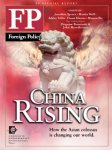
See what these leading experts have to say on such key questions as, are the United States and China on a collision course? And, what are the economic and strategic implications of China's transformation?
Source: Foreign Policy, January/February 2005

The report is based on the Carnegie conference, "China's Peaceful Rise?” held in the fall of 2004. Click here for speaker biographies, videos, and transcripts of that event.
The Once and Future China by Jonathan Spence
Clash of the Titans by Zbigniew Brzezinski and John Mearsheimer
Why is China Growing So Slowly by Martin Wolf
A Grand Chessboard by Ashley Tellis
Lifting All Boats by Homi Kharas
Dangerous Denials by Minxin Pei
Click on the link above for full text of this report.
Jonathan Spence
Zbigniew Brzezinski
Dr. Zbigniew Brzezinski served as national security adviser to President Jimmy Carter from 1977-1981. He is the author of several acclaimed books on foreign policy, most recently, Strategic Visions: America and the Crisis of Global Power.
John Mearsheimer
Martin Wolf
Former Senior Fellow
Ashley J. Tellis was a senior fellow at the Carnegie Endowment for International Peace.
Homi Kharas
Former Adjunct Senior Associate, Asia Program
Pei is Tom and Margot Pritzker ‘72 Professor of Government and the director of the Keck Center for International and Strategic Studies at Claremont McKenna College.
One is hopeful. One is realistic. One is cautionary.
Andrew Leber, Sam Worby
Military rule is now a defining political factor in South Asia. Here’s how analysts can understand and account for it.
Paul Staniland
Despite long-standing differences, China and Vietnam are reinforcing common ground for collaboration, especially in public security. This internal security–centered diplomacy offers a strengthened road map for how China moves forward with Southeast Asia.
Sophie Zhuang
Four Middle East experts analyze the region’s reactions and next steps.
Amr Hamzawy, Andrew Leber, Eric Lob, …
As the war between the United States, Israel, and Iran continues, Carnegie scholars contribute cutting-edge analysis on the events of the war and their wide-reaching implications. From the impact on Iran and its immediate neighbors to the responses from Gulf states to fuel and fertilizer shortages caused by the effective shutdown of the Strait of Hormuz, the war is reshaping Middle East alliances and creating shockwaves around the world. Carnegie experts analyze it all.