

Article
Thomas Carothers
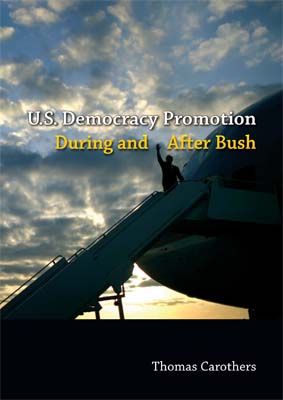
The main U.S. presidential candidates have voiced support for democracy promotion, but not yet outlined plans to put it back on track.
Source: Carnegie Endowment

Despite sweeping rhetoric about the global spread of democracy, the Bush Administration has significantly damaged U.S. democracy promotion efforts and increased the number of close ties with “friendly tyrants,” concludes a new report from the Carnegie Endowment for International Peace. Security interests, such as the war on terrorism, and U.S. energy needs have led the Bush Administration to maintain friendly, unchallenged relations with more than half of the forty-five “non-free” countries in the world.
Carnegie Vice President for Studies Thomas Carothers argues in his new report, U.S. Democracy Promotion During and After Bush, that the main U.S. presidential candidates have voiced support for democracy promotion, but not yet outlined plans to put it back on track. Carothers analyzes the Bush Administration’s record on democracy promotion and its effect on democracy worldwide, and then presents fresh ideas about the role democracy promotion can and should play in future U.S. policies.
Key Report Conclusions and Recommendations:
• Democracy promotion must be decontaminated from the negative taint it has acquired under President Bush by improving U.S. compliance with the rule of law in the war on terrorism, ending the close association of democracy promotion with military intervention and regime change, and reducing the inconsistency of U.S. democracy policy by exerting real pressure for change on some key autocratic partners, such as Pakistan and Egypt.
• Democracy promotion must be repositioned in the war on terrorism. The idea that democratization will undercut the roots of terrorism is appealing but easily overstated. The next administration should deescalate rhetorical emphasis on democracy promotion as the centerpiece of the war on terrorism while escalating actual commitment to the issue in pivotal cases where supporting democratic change can help diminish growing radicalization.
• U.S. democracy promotion must be recalibrated to account for larger changes in the international context. A host of ongoing developments, such as the rise of authoritarian capitalism, new trends in globalization, and the high price of oil and gas, have eroded the validity of a whole set of assumptions on which U.S. democracy promotion was built in the 1980s and 1990s. The next administration will need to respond in large and small ways, such as by drawing an explicit tie between energy policy and democracy policy, re-engaging internationally at the level of basic political ideas, reducing the America-centrism of U.S. democracy building efforts, and strengthening the core institutional sources of democracy assistance.
“More than ever, U.S. democracy promotion must square a daunting circle—it must embody strong elements of modesty, subtlety, and the awareness of limitations without losing the vitality, decisiveness, and creativity necessary for success,” the report concludes.
Click on the link above for the full text of this Carnegie report.
A limited number of print copies are available.
Request a copy
About the Author
Thomas Carothers is vice president for studies—international politics and governance at the Carnegie Endowment for International Peace. A leading authority on democratization and democracy promotion, he has researched and worked on democracy-building programs around the world for 20 years with many U.S., European, and international organizations. He has written numerous books on democracy promotion including most recently Confronting the Weakest Link: Aiding Political Parties in New Democracies and Promoting the Rule of Law Abroad: In Search of Knowledge.

Harvey V. Fineberg Chair for Democracy Studies; Senior Fellow, Democracy, Conflict, and Governance Program
Thomas Carothers, a senior fellow in the Carnegie Endowment for International Peace’s Democracy, Conflict, and Governance Program, is a leading expert on comparative democratization and international support for democracy.
Recent Work
Thomas Carothers
Thomas Carothers
Carnegie does not take institutional positions on public policy issues; the views represented herein are those of the author(s) and do not necessarily reflect the views of Carnegie, its staff, or its trustees.

Trump has promised Belarus a massive potash deal. But Minsk is seeking something greater: restored Western transit and greater room for maneuver from Russia.

Balázs Jarábik

Before the next wave of EU enlargement takes place, the union needs to grapple with thorny questions of how power is distributed among its members.


Emil Sondaj Hansen, Ditte Brasso Sørensen
The real test may come after the leaders leave the room.



Sheena Chestnut Greitens, Oriana Skylar Mastro, Yukon Huang, …

The Horn of Africa countries are among those facing a new security calculus.


Andrew Leber, Lesley Anne Warner

The European far right might fail to steer EU policy in the direction Russia wants, but they will create enough chaos inside Europe to benefit the Kremlin.

Dimitar Bechev