

In The Media
Minxin Pei
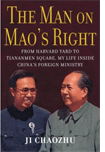
China’s capitalist revolution presents two divergent political paths for the country: autocracy or democracy. While the current strength of the CCP might suggest China is traveling down the first path, there are signs that citizen resistance on issues like growing economic disparities and environmental degradation may be on the rise and become more potent in the future.
Source: Book Review

The party has done well since 1989, but the legitimacy of outright repression is declining. The party may incarcerate those trying to set up an opposition party, but it cannot deploy brute force against ordinary citizens demanding clean air, drinkable water, and affordable health care. The Chinese citizenry today is becoming sophisticated enough to probe the soft spots (such as corruption, inequality, and incompetence) of the autocratic system and challenge it without taking excessive risks.

Former Adjunct Senior Associate, Asia Program
Pei is Tom and Margot Pritzker ‘72 Professor of Government and the director of the Keck Center for International and Strategic Studies at Claremont McKenna College.
Recent Work
Minxin Pei
Minxin Pei
Carnegie does not take institutional positions on public policy issues; the views represented herein are those of the author(s) and do not necessarily reflect the views of Carnegie, its staff, or its trustees.

The Plaza Accord was not an externally imposed punishment of Japan but part of a broader restructuring that Japanese economists and policymakers themselves recognized was necessary. Its effects were undermined, however, when Tokyo responded to the resulting slowdown with policies that exacerbated investment, credit expansion, and the very imbalances the adjustment was intended to resolve.

Michael Pettis

Before the next wave of EU enlargement takes place, the union needs to grapple with thorny questions of how power is distributed among its members.


Emil Sondaj Hansen, Ditte Brasso Sørensen

The real test may come after the leaders leave the room.



Sheena Chestnut Greitens, Oriana Skylar Mastro, Yukon Huang, …

The European far right might fail to steer EU policy in the direction Russia wants, but they will create enough chaos inside Europe to benefit the Kremlin.

Dimitar Bechev

The nuclear relationship between China and the United States is increasingly shaped by widening perception gaps rather than deliberate strategic design.

Tong Zhao