• Research
  • Emissary
  • About
  • Experts
Carnegie Global logoCarnegie lettermark logo
DemocracyIran
  • Donate
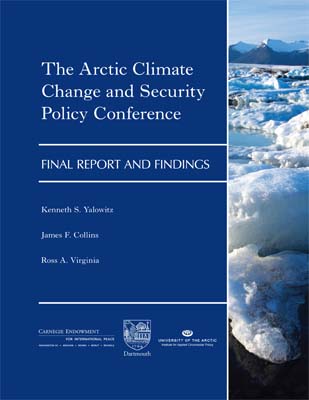
The Arctic Climate Change and Security Policy Conference: Final Report and Findings
Report

The Arctic Climate Change and Security Policy Conference: Final Report and Findings

Minimizing the environmental impact of climate change and resource development in the Arctic must be a top priority, if environmental disaster is to be avoided.

Link Copied
By Kenneth S. Yalowitz, James F. Collins, Ross A. Virginia
Published on Jun 24, 2009

Additional Links

Full Text
Program mobile hero image

Program

Russia and Eurasia

The Russia and Eurasia Program continues Carnegie’s long tradition of independent research on major political, societal, and security trends in and U.S. policy toward a region that has been upended by Russia’s war against Ukraine.  Leaders regularly turn to our work for clear-eyed, relevant analyses on the region to inform their policy decisions.

Learn More
Program mobile hero image

Program

Sustainability, Climate, and Geopolitics

The Sustainability, Climate, and Geopolitics Program explores how climate change and the responses to it are changing international politics, global governance, and world security. Our work covers topics from the geopolitical implications of decarbonization and environmental breakdown to the challenge of building out clean energy supply chains, alternative protein options, and other challenges of a warming planet.

Learn More

The accelerating pace of climate change, increasing competition over resources, and new territorial claims demand that greater attention be paid to the Arctic. As the most immediate and serious threat to the region, minimizing the environmental impact of climate change and resource development must be the top priority, according to a report from the Carnegie Endowment, the University of the Arctic, and Dartmouth College.

Key points:

  • An efficient and multilateral process for responding to environmental disasters is the Arctic’s most pressing need.
     
  • The Arctic is unlikely to be a security flashpoint in the short term. State-to-state negotiations and multilateral institutions have effectively handled territorial claims thus far, and neither Russia nor the United States is looking for a new source of tension.

As a major Arctic power, the United States has environmental, political, and security interests and responsibilities and should play a key role in preserving the Arctic ecosystem.

Recommendations for U.S. policy makers:

  • Create a sub-cabinet commission on global warming headed by the vice president to address the effects of climate change on the Arctic.
     
  • Promote the Arctic Council as the principal international forum for addressing Arctic issues.
     
  • Ratify the UN Convention on the Law of the Sea (UNCLOS) immediately. The UNCLOS provides a framework to adjudicate disagreements over borders and territory claims, which could become more heated as global warming facilitates access to resources. 
     
  • Support policy-relevant scientific research that can identify critical first steps for policy makers and identify the costs of inaction on the threat of global warming.

The report concludes:

“The environment and the management of natural resources are the most pressing security issues in the North. States are committed to addressing boundary and access issues through existing institutions, principally UNCLOS. Large-scale damage to the Arctic from transportation accidents, energy development, fishing, and pollutants from the South pose greater immediate threats than classic security issues. Existing emergency response systems and contingency plans are not up to the task.” 

About the Authors

Kenneth S. Yalowitz

Dartmouth College

James F. Collins

Nonresident Senior Fellow, Russia and Eurasia Program; Diplomat in Residence

Ambassador Collins was the U.S. ambassador to the Russian Federation from 1997 to 2001 and is an expert on the former Soviet Union, its successor states, and the Middle East.

Ross A. Virginia

Dartmouth College

Authors

Kenneth S. Yalowitz
Dartmouth College
James F. Collins
Nonresident Senior Fellow, Russia and Eurasia Program; Diplomat in Residence
James F. Collins
Ross A. Virginia
Dartmouth College
North AmericaUnited StatesCaucasusRussiaClimate Change

Carnegie does not take institutional positions on public policy issues; the views represented herein are those of the author(s) and do not necessarily reflect the views of Carnegie, its staff, or its trustees.
More Work from Carnegie Endowment for International Peace

  • Commentary
    Strategic Europe
    How to Join the EU in Three Easy Steps

    Montenegro and Albania are frontrunners for EU enlargement in the Western Balkans, but they can’t just sit back and wait. To meet their 2030 accession ambitions, they must make a strong positive case.

      Dimitar Bechev, Iliriana Gjoni

  • Fire damage is pictures as US President Joe Biden (out of frame) visits to an area devastated by wildfires in Lahaina, Hawaii on August 21, 2023.
    Article
    The United States Has an Internal Displacement Problem

    By reorganizing federal disaster policy around the rights of displaced people, the United States could unlock additional federal resources, accelerate the rebuilding of lives and livelihoods, and reduce suffering and economic disruption.

      • Kayly Ober

      Kayly Ober

  • flood wall
    Commentary
    Emissary
    BRIC Is Critical for U.S. National Security. After a Yearlong Legal Battle, It’s Back.

    Its reinstatement should be celebrated, but it retains some major shortcomings.

      Leonardo Martinez-Diaz

  • Aerial shot of island community
    Commentary
    One Year After the Great Aid Recession, Investments in Climate Mobility Offer Cost-Effective Returns

    Climate mobility interventions can vary, but they all present opportunities to unlock transformative results that mitigate costs associated with inaction.

      • Alejandro Rodriguez

      Alejandro Martin Rodriguez

  • Female farm labourers pick strawberries in the Kenitra province country side of Morocco as the world marks the International Women's Day on March 8, 2017.
    Article
    Climate Change, Gender, and Inequality in Morocco’s Souss-Massa Region

    For Morocco, integrating gender into climate governance is not simply a matter of social justice. It is a strategic imperative for effective adaptation.

      Fadwa Rajoauni

Get more news and analysis from
Carnegie Endowment for International Peace
Carnegie global logo, stacked
1779 Massachusetts Avenue NWWashington, DC, 20036-2103Phone: 202 483 7600Fax: 202 483 1840
  • Research
  • Emissary
  • About
  • Experts
  • Donate
  • Programs
  • Events
  • Blogs
  • Podcasts
  • Contact
  • Annual Reports
  • Careers
  • Privacy
  • For Media
  • Government Resources
Get more news and analysis from
Carnegie Endowment for International Peace
© 2026 Carnegie Endowment for International Peace. All rights reserved.