

Paper
Adam Baczko, Gilles Dorronsoro, Arthur Quesnay
Source: Getty
In Kabul many of the issues affecting Afghanistan – ineffective governance, the Taliban's expanding influence, and a massive foreign presence – are on stark display.
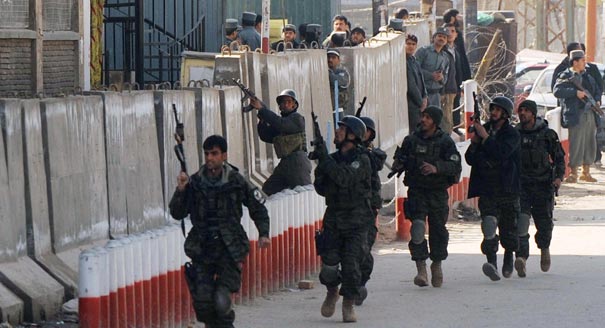
The attack earlier this week on Pul-i-Alam, only 50 kilometers from Kabul, exemplifies the next step in the Taliban’s winning strategy in Afghanistan: destabilizing the cities in the country’s Pashtun belt.
More than 10,000 foreigners live in or around this ancient and contested capital, enjoying a lifestyle as alien to most Afghans as that of a western city. But instead of securing the population, as the United States and its allies have attempted to do in Iraq, the international coalition has opted for providing limited protection to key administrative institutions and embassies—which took rocket fire from the Taliban last week. Around half the city center is off limits to regular citizens, causing frequent traffic jams and frustration among the Afghans.
The foreigners earn comparatively huge salaries, often do not pay taxes, and for the most part do not learn a local language. They are generally poorly trained to work in an Afghan context and are heavily reliant on local staff. Naturally, these characteristics exacerbate traditional Afghan suspicions of foreigners’ motives, and aid in promulgating rumors and conspiracy theories. Many Afghans are convinced that the international coalition secretly supports the Taliban.
For obvious reasons, the Taliban put a high value on controlling Kabul, and they are now moving to penetrate the provinces of Logar and Wardak, which is immediately southeast of the capital region. These areas are ripe for Taliban infiltration, with the Pakistani border—now under their undisputed control—only 90 kilometers away.
The Taliban have systematically destabilized Logar and Wardak, which (outside the towns) are now largely under their control. The nearby Musayi district of Kabul province is also under increasing Taliban influence, and hundreds of Taliban propaganda DVDs have been distributed there in Qala-i Niyazi, a strategic town a few miles from Kabul. To the east, the Taliban and the Hezb-e Islami have a built a strong presence in Kapisa province. They also have considerable strength in the north of the Sarobi district of Paktika province to the south, along the border with Pakistan.
The Taliban capitalize on the growing discontent of Afghans through a relatively sophisticated propaganda apparatus, employing radio, video, and night letters to devastating effect. Videos made in as-Sahab, the Taliban’s media center in Quetta, Pakistan, are readily available. Among the most popular are videos showing the seizure of NATO material in Khyber Agency in 2008, and the August 2008 ambush of a French military contingent in Kapisa province in eastern Afghanistan. The Taliban have also used the Internet, chronicling the advance of the jihad on various websites (with obvious exaggerations). Propaganda material, most often in the form of preachers calling for jihad against the international coalition, is often distributed by cell phone.
In the East and South where the Taliban are dominant, few roads are secure.
The U.S. reinforcements now being deployed to Afghanistan will, to the greatest extent possible, secure the road south of Kabul to Pul-i Alam and Gardez, but not necessarily the surrounding territory. The road is not secure at night, and in fact, in the east and south where the Taliban are dominant, few roads are secure at all.
NATO aims to block the advance of Taliban from Pakistan or the northeastern province of Nuristan toward Kabul, but it has so far had little effect. In Kapisa province, the French military became more cautious after the August 2008 ambush, and NATO has concocted a more global strategy to protect the area and the Sarobi district of Paktika to the south, along the border with Pakistan. In Kunar province, just south of Nuristan province, the border with Pakistan remains wide open, and U.S. forces have been deployed in a series of isolated posts, making it relatively simple for insurgents to infiltrate between them.
The Taliban are the dominant political force in numerous regions of Afghanistan, including Pashtun-majority provinces in the east and the south. Their strategy is to destroy the Afghan administration, isolate the international coalition, and build a parallel administration. In these provinces, the situation of the international forces is comparable to that of the Soviet Union in the 1980s, in that it is largely isolated at its posts, and operating with neither the support nor the acceptance of the Afghan population. The insurgents control the countryside and have a strong presence even inside important cities like Kandahar and Ghazni.
Outside the major cities, Afghan and coalition administration are nonexistent, and as is all too evident, even inside Kabul, they operate at a dangerous divide from the population.

Former Nonresident Scholar, South Asia Program
Dorronsoro’s research focuses on security and political development in Afghanistan. He was a professor of political science at the Sorbonne in Paris and the Institute of Political Studies of Rennes.
Recent Work
Adam Baczko, Gilles Dorronsoro, Arthur Quesnay
Gilles Dorronsoro
Carnegie does not take institutional positions on public policy issues; the views represented herein are those of the author(s) and do not necessarily reflect the views of Carnegie, its staff, or its trustees.
The real test may come after the leaders leave the room.



Sheena Chestnut Greitens, Oriana Skylar Mastro, Yukon Huang, …

The Horn of Africa countries are among those facing a new security calculus.


Andrew Leber, Lesley Anne Warner

The European far right might fail to steer EU policy in the direction Russia wants, but they will create enough chaos inside Europe to benefit the Kremlin.

Dimitar Bechev

The new U.S.–Denmark–Greenland agreement will help Washington exert political, economic, and financial dominance under the guise of security. Yet, it acknowledged Copenhagen’s and Nuuk’s sovereignty on the island.

Marc Pierini
Washington needs to recognize that influence in the Western Hemisphere comes from presence, delivery, and reliability. It also must recognize that while the United States remains the key external actor, it no longer operates in a permissive environment and cannot presume deference from regional players who have other options, namely China.
Juan S. Gonzalez