

Paper
Douglas H. Paal
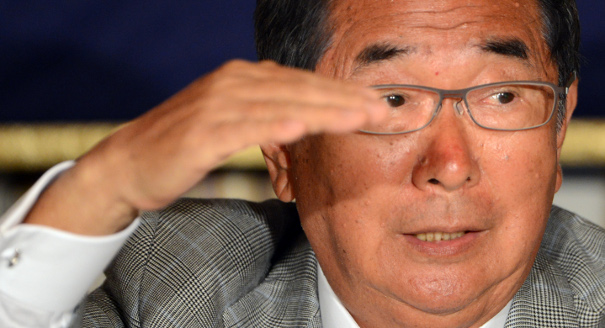
Source: Getty
Japan and China should defuse tensions over the disputed Senkaku/Diaoyu Islands in the East China Sea.
If ever a case were needed to illustrate reasonable intentions producing unreasonable consequences, the current Senkaku/Diaoyu Islands dispute is a strong candidate. Last April, Tokyo’s erratic governor, Shintaro Ishihara, long associated with causes intended to stir anti-China opinion in Japan, announced his intention to acquire three of the islands from their private owner. There is every reason to believe Ishihara wanted to turn them into a platform for activities to provoke the Chinese dragon and alarm the Japanese people into hostility toward Beijing and eventually rearming Japan. So far, Ishihara is moving Japan toward his objective, ironically with the help of China and without actually having to take over the islands.
The good intentions came from Prime Minister Yoshihiko Noda. Over the past five months he implemented a strategy for the national government to defuse tensions and acquire or “nationalize” the islands in place of Ishihara. Historians will look back on his leadership and find missteps and a failure to anticipate Chinese reactions accurately, but Noda’s general intent to contain the issue seemed obvious.According to a Japanese press report, he further decided on a policy option for maintaining the status quo on the islands in order to avoid provoking Beijing by rejecting options ranging from making beneficial improvements to the lighthouse to garrisoning self-defense forces, something Japan’s administration would entitle him to do.
Moreover, Noda approved a diplomatic reshuffle amid rising tensions and ugly, semi-organized anti-Japanese protests in over a hundred Chinese cities to promote seasoned, skillful diplomats to positions where they might provide adult supervision to the management of ties. (Most unfortunately, the new appointee to Beijing, Shinichi Nishimiya, a good friend and especially able diplomat, died suddenly only a few days after his appointment.)
Noda also dispatched a special envoy to explain to Beijing the background to his management of the issue. To be sure, Noda did not and should not bend to every Chinese demand, but his policy choices demonstrated general sensitivity to China’s concerns.
Nonetheless, Beijing has chosen to interpret the prime minister’s decisions as part of a conspiracy to change the status quo. The timing of the nationalization, close to the anniversary of the 1931 Mukden Incident starting the Sino-Japanese war and immediately after a personal warning not to do so by China’s President Hu Jintao, further inflamed the Chinese reaction.
Beijing insists, on the basis of its own records, that Japan agreed to “shelve” the dispute over the sovereignty of the islands in exchanges surrounding the normalization of Sino-Japanese relations in 1972 and their bilateral peace treaty in 1978. Japan insists there was no such consensus and that the islands are indisputably Japanese sovereign territory.
Both Tokyo and Beijing are in the midst of highly charged political seasons. China is coming to the conclusion of its decennial leadership transition, with plenty of hints of rough spots in replacing 70 percent of its top officials. Prime Minister Noda of the Democratic Party of Japan (DPJ) is coming to the end of his time in office. Former prime minister Shinzo Abe has just won election to the presidency of the Liberal Democratic Party (LDP) on the basis of tough talk about Japan’s neighbors, and he is well positioned to lead the next, likely coalition, government after nationwide elections that are expected “soon.” So leaders on both sides are guarding their patriotic flanks and sacrificing relations with each other to that end.
It is time for China and Japan to take stock of the changed environment and make plans for how they will climb down from the current confrontation. Official Chinese spokesmen have demanded a return to the status quo ante, but they have not so far specifically demanded that Noda undo the deal he made for the purchase of the islands. This may provide a small opening for a rhetorical compromise.
Japan has said that it never acknowledged officially that China has a claim on the islands, but rather rejected the notion. Past bilateral arrangements to return Chinese fishermen who were found in Japanese waters without trial were only about how to handle violations by fishermen after the fact, not an indication that Japan was acknowledging that its law did not apply in the island’s territorial waters. (In the previous flare-up in the islands in 2010, the Chinese became particularly irate that a ship captain was to be tried in a Japanese court, before the captain was released.)
An uncomfortable truth is that after returning the islands to Japanese “administration” in 1972, the United States has consistently stated that it takes no position on the ultimate disposition of the islands, but that since they are administered by Japan, the Mutual Security Treaty would apply to protecting them. Thus, Washington has implicitly endorsed the notion that there is a dispute—something Tokyo is now rejecting—even as it promises to help Japan hold onto the islands.
It is of course quite normal in territorial disputes for the party in control of the territory to deny that it is disputed. A case could be submitted to the International Court of Justice for arbitration, but usually the party in possession will not agree to do so out of concern it would imply doubt about the claim.
In the case of the Senkaku/Diaoyu Islands, there may be one more step a forbearing Noda can take to defuse the current tensions. A senior authoritative figure in the government can publicly reiterate that Japan’s claim and administration are beyond dispute, but note that Tokyo does not deny that others (China and Taiwan) dispute this. Or Japanese officials can assert that they do not believe the status quo has changed, and then conduct Coast Guard and other activity near the islands as they did before the crisis erupted. This may allow Beijing to step back from the daily barrage of tough rhetoric and admit that the status quo ante has been restored. If Beijing rejects the gesture in its direction, then the onus shifts to China.
China, once it is past the sensitive leadership conclaves about to occur, has good reason to stop damaging its relations with Japan through a bullying posture that is undermining its effort to develop “soft power,” and to calm relations in its neighborhood. Moreover, both Japan and China have rapidly expanded their economic interdependence in recent years and neither need to add to the opportunity costs of a deepening political chill, let alone drift into something hotter.

Distinguished Fellow, Asia Program
Paal previously served as vice chairman of JPMorgan Chase International and as unofficial U.S. representative to Taiwan as director of the American Institute in Taiwan.
Recent Work
Douglas H. Paal


Douglas H. Paal, Tong Zhao, Chen Qi, …

The books, podcasts, and films that explain the world it made.

Andrew Leber

U.S. trading partners in Asia are closely watching the dispute for signs of how it may affect their own interests.

Barbara Weisel
Chinese strategists are once again debating whether American power is declining and whether U.S. hegemony is experiencing irreversible decay.
Wu Xinbo

With the growth in points of friction between the great powers, organizations like the SCO will continue to play a role in the strategic adaptation of the smaller powers caught between them.

Temur Umarov

Amid celebrations of bilateral ties was a deeper focus on stability in the Middle East.

Amr Hamzawy