• Research
  • Emissary
  • About
  • Experts
Carnegie Global logoCarnegie lettermark logo
DemocracyIran
  • Donate
The China–India Nuclear Crossroads
Book

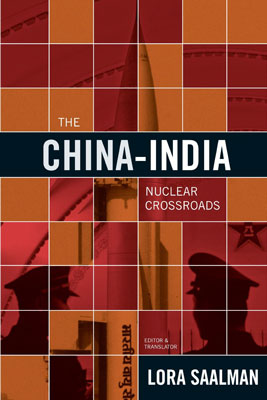
The China–India Nuclear Crossroads

Leading Chinese and Indian experts examine the political, military, and technical factors that affect Sino-Indian nuclear relations, providing a comprehensive framework through which China and India can pursue enhanced cooperation.

Link Copied
By Lora Saalman
Published on Sep 25, 2012

Additional Links

Kindle - $9.99Paperback - $19.95Hardback - $49.95Nook - $10.39iTunes - $9.99
Program mobile hero image

Program

Nuclear Policy

The Nuclear Policy Program aims to reduce the risk of nuclear war. Our experts diagnose acute risks stemming from technical and geopolitical developments, generate pragmatic solutions, and use our global network to advance risk-reduction policies. Our work covers deterrence, disarmament, arms control, nonproliferation, and nuclear energy.

Learn More

Source: Washington

Global power is shifting to Asia. The U.S. military is embarking on an American “pivot” to the Indo-Pacific region, and the bulk of global arms spending is directed toward Asian theaters. India and Pakistan are thought to be building up their nuclear arsenals while questions persist about China’s potential to “sprint to parity.” China remains by far the world’s largest market for new nuclear energy production, and India aspires to be on a similar trajectory.

Despite these trends, The China-India Nuclear Crossroads is the first serious book by leading Chinese and Indian experts to examine the political, military, and technical factors that affect Sino-Indian nuclear relations. In this book, editor and translator Lora Saalman presents a comprehensive framework through which China and India can pursue enhanced cooperation and minimize the unintended consequences of their security dilemmas. | 中文
 

Advance Praise

“The place to start for anyone interested in the atomic dimension of the China-India relationship and its profound impact on Asian security and the global nuclear order.”
—C. Raja Mohan, Member of India’s National Security Advisory Board and Distinguished Fellow at the Observer Research Foundation

“A first and crucial attempt to comprehensively compare Chinese and Indian nuclear perspectives.”
—Shen Dingli, Executive Dean of the Institute of International Studies and Director of the Center for American Studies at Fudan University

“Provides a better understanding of the security perceptions driving China and India’s nuclear strategies...a must read.”
—Shyam Saran, Senior Fellow at the Center for Policy Research and former counselor in the Embassy of India in Beijing, China

“Serves as a communication bridge between Chinese and Indian scholars.”
—Zheng Ruixiang, Senior Researcher at the China Institute of International Studies and China’s former consul general in Mumbai, India

About the Author

Lora Saalman

Former Nonresident Associate, Nuclear Policy Program

Saalman was a nonresident associate in the Nuclear Policy Program at the Carnegie Endowment for International Peace. Her research focuses on China’s nuclear and strategic policies toward India, Russia, and arms control.

    Recent Work

  • Paper
    Balancing Chinese Interests on North Korea and Iran

      Lora Saalman

  • In The Media
    Why Beijing Stands by Pyongyang

      Lora Saalman

Lora Saalman
Former Nonresident Associate, Nuclear Policy Program
Lora Saalman
South AsiaIndiaPakistanEast AsiaChinaTaiwanSecurityMilitaryNuclear PolicyArms Control

Carnegie does not take institutional positions on public policy issues; the views represented herein are those of the author(s) and do not necessarily reflect the views of Carnegie, its staff, or its trustees.

More Work from Carnegie Endowment for International Peace

  • Man standing next to a pile of burned cars
    Commentary
    Emissary
    The Myriad Problems With the Iran Ceasefire

    Four Middle East experts analyze the region’s reactions and next steps.

      • Andrew Leber
      • Eric Lob
      • +1

      Amr Hamzawy, Andrew Leber, Eric Lob, …

  •  A machine gun of a Houthi soldier mounted on a police vehicle next to a billboard depicting the U.S. president Donald Trump and Mohammed Bin Salman, the Crown Prince and Prime Minister of Saudi Arabia, during a protest staged to show support to Iran against the U.S.-Israel war on March 27, 2026 in Sana'a, Yemen.
    Collection
    The Iran War’s Global Reach

    As the war between the United States, Israel, and Iran continues, Carnegie scholars contribute cutting-edge analysis on the events of the war and their wide-reaching implications. From the impact on Iran and its immediate neighbors to the responses from Gulf states to fuel and fertilizer shortages caused by the effective shutdown of the Strait of Hormuz, the war is reshaping Middle East alliances and creating shockwaves around the world. Carnegie experts analyze it all.

  • Commentary
    Strategic Europe
    Taking the Pulse: Can NATO Survive the Iran War?

    Donald Trump has repeatedly bashed NATO and European allies, threatening to annex Canada and Greenland and deploring their lack of enthusiasm for his war of choice in Iran. Is this latest round of abuse the final straw?

      • Rym Momtaz

      Rym Momtaz, ed.

  • Commentary
    China’s Energy Security Doesn’t Run Through Hormuz but Through the Electrification of Everything

    Across Asia, China is better positioned to withstand energy shocks from the fallout of the Iran war. Its abundant coal capacity can ensure stability in the near term. Yet at the same time, the country’s energy transition away from coal will make it even less vulnerable during the next shock.


      • Damien Ma

      Damien Ma

  • Commentary
    Emissary
    Russia Will Be More Dangerous After the War with Ukraine

    Putin’s blunder has created new and enduring security challenges for Russia and Europe.

      • Eugene Rumer

      Eugene Rumer

Get more news and analysis from
Carnegie Endowment for International Peace
Carnegie global logo, stacked
1779 Massachusetts Avenue NWWashington, DC, 20036-2103Phone: 202 483 7600Fax: 202 483 1840
  • Research
  • Emissary
  • About
  • Experts
  • Donate
  • Programs
  • Events
  • Blogs
  • Podcasts
  • Contact
  • Annual Reports
  • Careers
  • Privacy
  • For Media
  • Government Resources
Get more news and analysis from
Carnegie Endowment for International Peace
© 2026 Carnegie Endowment for International Peace. All rights reserved.