

Commentary
Sarah Chayes
Source: Getty
Tunisia’s ruling Islamist Ennahda Party should resist the temptation to use violence to help ensure its grip on power.
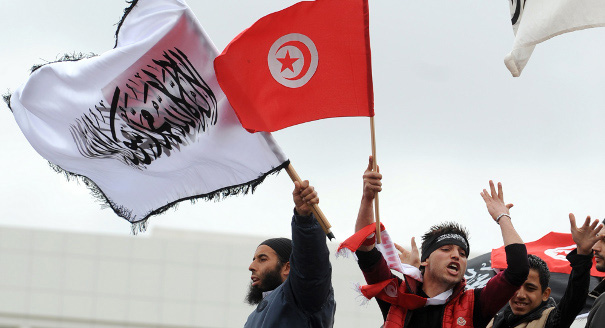
Protesters “were piled into pickup trucks with their black flags,” recalled two Tunisian eyewitnesses, the co-founder of a humanitarian group and a college professor. Both requested anonymity for security reasons. “I knew something would go wrong,” shuddered one. Although no loss of American life resulted, last month’s organized attack on the United States embassy in Tunisia—in which four locals did die—was at least as portentous as the sack of the Libyan consulate.
Unlike residents of Benghazi, Tunis-dwellers did not turn out to challenge the commandeering of their public space by well-marshaled extremists. And, whether through immaturity or latent connivance, the attitude of the Tunisian government has been equivocal. Further incidents, such as the roughing up of an elected official ten days ago, suggest that the ruling Islamist Ennahda Party may be flirting with violence to help ensure its grip on power.
But if Ennahda hopes to retain the credibility at home and abroad that its outwardly moderate approach to the Tunisian transition has reaped so far, it must resist this temptation. It must make a firm commitment to the inviolable safety and neutrality of the political arena. A good first step would be for Prime Minister Hamadi Jebali to ask for the resignation of several key ministers and to replace them with more neutral and experienced figures.To some outside observers, the situation in Tunisia may not look as critical as in some of its neighbors. Now that its role in sparking the Arab Awakening is fulfilled, little Tunisia has faded a bit from international attention, overshadowed by Egypt’s sheer mass and dynamism, and the bloody tragedy of Syria. Indeed, U.S. policymakers have regarded Tunisia with a measure of relief, as the one probable success story of the Arab transitions. “We think Tunisia is proceeding in the right direction based on what we are seeing,” said Secretary of State Hillary Clinton earlier this year. But she noted that questions will be raised with the government as they arise.
It would be a mistake to underestimate Tunisia. As many CEOs will attest, one of the best ways to effect dramatic transformation of a complex entity is to start small, in a promising corner, and then scale up. By the same token, if Tunisia veers in a radical direction, or if its almost family ties to Europe and the West are shattered, the implications for other transitioning Arab countries will be ominous.
Precisely this exemplary value may explain why radical forces, stimulated by a rebranded al-Qaeda conglomerate, seem to be focusing on secular Tunisia and grateful Libya. Of all the countries in the Arab Awakening, those are the two that show the most promise of positive development and strong relationships with the West.
The shrewdly targeted recent attacks in Tunisia may pale in comparison to Syria’s slaughter or even the ongoing crackdown in Bahrain. But in societies like Tunisia’s, where extreme brutality or airtight repression have schooled behavior, it may only take low levels of physical violence to make populations submit to desired norms. Sometimes the mere threat of violence sends a sufficiently explicit message. And so the details of recent episodes are worth examining.
The graceful, semicircular white mosque from which the September 14 embassy raid departed, Masjid al-Fath, is known as a spiritual headquarters of the extremist Salafi movement. It is situated downtown, some five miles away from the U.S. embassy. Numerous eyewitnesses describe organized preparations and police cordons protecting the whole, long route. September 14 was not, in other words, a spontaneous demonstration.
Extremist cleric Abu Iyad, who reportedly promulgated the call to protest, has avoided explicit references to al-Qaeda of late, but his past associations with Osama bin Laden and the al-Qaeda network are well known. The “Tunisian Combatant Group” he founded in Afghanistan in 2000 is believed to have colluded with al-Qaeda in the assassination of Taliban opponent Ahmed Shah Massoud by two Tunisians posing as journalists on September 9, 2001. The group he now heads is called Ansar al-Sharia, and is connected to the Libyan organization of the same name. Just days after the embassy attack in Tunis, Abu Iyad was back at al-Fath, firing up his followers. Somehow, he eluded dozens of police arrayed outside the building and is now in hiding. Perhaps equally grave, the titular imam of that same extremist mosque is none other than the Tunisian government’s minister for religious affairs, Noureddine Khadmi.
These appearances certainly suggest that Tunisia’s ruling party is dallying with hardline extremism. If Ennahda is truly as moderate as it claims, why not demonstrate it by appointing a broad-minded, learned, and creative religious thinker who could credibly embark upon the vast and exciting task of mapping out the shape of Islam in the modern world? That would be a way for Tunisia to regain its constructive role at the forefront of the historic changes engulfing its neighborhood.
But it is not just the minister of religious affairs whose actions are ambiguous. The key ministries of interior and justice have not lived up to their charge of ensuring a neutral and safe public sphere for political discourse. Late last month, a representative in the country’s Constituent Assembly was roughed up in the seaside town of Kelibia by a gang of toughs whom locals identified as Ennahda Party members. Earlier, sparking national outrage, policemen gang-raped a woman they said they found in an indecent posture with her boyfriend in a parked car.
The targets of such intimidation have been well chosen. The Constituent Assembly delegate is widely unpopular. Art exhibits that have been attacked over the past few months have pushed the boundaries of ordinary Tunisian sensibilities. And many in the country’s conservative heartland would not approve of sex before marriage.
Still, the police reaction to extremist violence has been lethargic at best, and the force’s own actions have been ambiguous. Investigations opened by the Justice Ministry have seemed to target secular behavior one-sidedly, while leaving undisturbed those who use violence to influence public debate. In sharp contrast to this apparent bias is the behavior of the Tunisian army, which rose quietly to the challenge of protecting last year’s elections with acclaimed neutrality.
October 23—the one-year anniversary of Tunisia’s first genuinely free elections—is a political deadline. Technically, it is the end of the terms of elected members of the Constituent Assembly. With a draft constitution still not complete, current representatives will doubtless continue to sit. Still, that date marks a propitious inflection point.
Ennahda should celebrate by recalibrating. There are good reasons to replace the ministers of justice, interior, and religious affairs. And a transitional justice process, which would systematically examine the crimes of the former regime to obtain reparation and closure, must be undertaken. Some Tunisians have begun predicting impending civil conflict in their increasingly polarized country. These steps would go a long way to prevent it.
Former Senior Fellow, Democracy, Conflict, and Governance Program
Sarah Chayes is internationally recognized for her innovative thinking on corruption and its implications. Her work explores how severe corruption can help prompt such crises as terrorism, revolutions and their violent aftermaths, and environmental degradation.
Recent Work
Sarah Chayes
Carnegie does not take institutional positions on public policy issues; the views represented herein are those of the author(s) and do not necessarily reflect the views of Carnegie, its staff, or its trustees.
By reminding the world that Lukashenko is a threat to NATO and Ukraine, Kyiv is trying to return the focus to why the Belarusian regime needs to be contained rather than rewarded.

Artyom Shraibman
If Indigenous land and water dispossession is ignored, climate adaptation strategies risk reproducing inequalities and worsening acute climate vulnerability.

Frederic Wehrey, Charles H. Johnson
China’s Ministry of Public Security is often portrayed as a domestic law enforcement agency, but it is also a global security actor. This paper explores how MPS has used international law enforcement and security cooperation agreements—over 200 since 2006—to advance China’s vision of security in a changing global environment.


Sophie Zhuang, Sheena Chestnut Greitens, Cameron Waltz
Strengthening U.S.-Africa trade and advancing U.S. interests aren’t conflicting goals.

Tyler Beckelman, Kholofelo Kugler
Between the United States’ market-driven approach and China's state-led industrial strategy, Europe is reckoning with how it can remain competitive in the global economy. But is Europe in danger of becoming a U.S. or China colony?
Noah Barkin, Anu Bradford