

Commentary
Fatima El Mansouri is the country’s first female prime minister. She’s also a privileged insider in a largely ceremonial position.
Sarah Yerkes
Source: Getty
Prime Minister Najib Razak has fundamentally repositioned Malaysia internationally. Regardless of the outcome of upcoming elections, the gains made must be preserved.
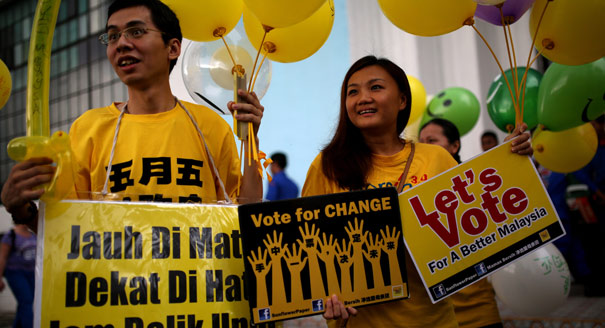
Malaysian Prime Minister Najib Razak has called national elections for May 5. This date is perilously close to the statutory deadline to hold the elections, suggesting he is concerned that the results may lead to his departure from office. Malaysia, the United States, and much of the world have a stake in the outcome.
The traditionally dominant party, the United Malays National Organization (UMNO), and its partners in the long-ruling Barisan Nasional coalition have experienced internal divisions. Ethnic preferences for Malays in government and the economy have alienated many Chinese, who are a minority (roughly 40 percent of Malaysia’s population) but economically dominant. Najib’s efforts at internal reform have threatened traditionalists associated with former prime minister Mahathir Mohamad. Younger, urban voters seem itching for change.
There is a strong challenge from an opposition coalition headed by former deputy prime minister Anwar Ibrahim. His Pakatan Rakyat coalition includes Chinese and Islamic parties and is close enough in some polls to win outright.But many longtime observers believe the real election is within UMNO, between old warhorses associated with Mahathir and the reformists surrounding Najib. The argument is that if Najib cannot bring in a result that preserves UMNO’s two-thirds majority and capacity to rewrite the constitution, old-line leaders, possibly current Deputy Prime Minister Muhyiddin Yassin, would displace Najib and stem reforms.
This is where the stakes need to be clearly stated. Under Mahathir, opposition to perceived residual Western colonialism was a rallying cry and a frequent and increasingly anachronistic theme. His successor, Abdullah Badawi, was less shrill but did not move significantly away from Mahathir’s policies. Najib has fundamentally repositioned Malaysia internationally. He has moved away from the old UMNO policy seeking to divide Asia from the United States and has seen the United States as an important partner for Malaysia and ASEAN.
Najib and his top officials have been forthright in speaking about democratic values in international forums such as the ASEAN Regional Forum. They have been critical of states such as North Korea and even Myanmar before reforms commenced there, something that would not have been countenanced in an earlier period when criticism was aimed solely at the West.
Najib has done all this as part of a strategy to retain domestic (Chinese) investment and attract foreign investment in order to accelerate Malaysia’s development. As a demonstration of his commitment to a more open Malaysian economy, he has joined the discussions on the Trans-Pacific Partnership trade agreement with ten other nations.
After economic contraction in 2009, Malaysia’s GDP growth has rebounded to a robust 5 percent, led by double-digit export growth in 2010 and large FDI inflows in 2010 and 2011. Gross investment for 2012 was up 9 percent over the last year, with the fastest growth in private and domestic investment (up 22 percent and 55 percent, respectively). The current account surplus is expected to narrow in the near term, and employment growth is expected mostly in domestic-oriented sectors such as services, in line with Najib’s New Economic Model that aims to create more sustainable, equitable, high-income growth. The Asian Development Bank forecasts that Malaysia’s GDP will grow by 5.3 percent in 2013, accelerating a little to 5.5 percent next year. Malaysia’s strong performance under Najib stands in marked contrast to the ethnic preferences and frequent allegations of corruption and cronyism under Mahathir.
Domestically, Malaysia remains an impressive Muslim-majority nation with a democratic system, pluralism, and generally good standards for human rights protection. Najib has given a number of speeches in international settings denouncing terrorism in the Islamic world and indeed has preached formation of a league of moderate nations to fight terrorism.
Under Najib, Malaysia also has moved to significantly tighten its previously porous export-control system, which had made the country a transit point for shipment and financing of dual-use products going to Iran. Defense cooperation with the United States and others has been normalized, and it has not remained a forum for grandstanding against the West.
Najib has moved to dismantle one of the instruments of repression, the Internal Security Act inherited from the British when Malaysia became independent. Under his guidance the legislature has replaced the law, which provided the basis for lengthy detention without trial.
These are not just achievements for Najib’s leadership, but they are gains for Malaysia, the region, and the world.
As the election campaign unfolds, it will be interesting to see what issues UMNO and its Barisan National coalition and Anwar with his Pakatan Rakyat coalition use against each other (see table 1).

Anwar has a mixed record. He earlier stood out as one of Malaysia’s leading progressive political figures and someone who creatively reconciled Islam and Western values. Since his imprisonment by Mahathir in 1998 on allegations of sodomy and a subsequent revival of similar charges in 2008 that was overturned in Malaysia’s courts, he has moved toward a closer alignment with Islamic politics. He has, for example, irritated women voters by suggesting that sharia law could be adopted by tradition-minded Malaysian states. Anwar nonetheless continues to be a strong public advocate of democracy and human rights and criticizes Najib as essentially continuing the more repressive policies of the Mahathir years.
Whether the winner is Najib or Anwar or the conservative forces within UMNO, Malaysians should consider seriously how to preserve the gains of the Najib era.
Jeffrey A. Bader is the John C. Whitehead Senior Fellow in International Diplomacy at the Brookings Institution.

Distinguished Fellow, Asia Program
Paal previously served as vice chairman of JPMorgan Chase International and as unofficial U.S. representative to Taiwan as director of the American Institute in Taiwan.
Jeffrey A. Bader
Brookings Institution
Carnegie does not take institutional positions on public policy issues; the views represented herein are those of the author(s) and do not necessarily reflect the views of Carnegie, its staff, or its trustees.
Fatima El Mansouri is the country’s first female prime minister. She’s also a privileged insider in a largely ceremonial position.

Sarah Yerkes

The domestic impacts of how long it is taking to end the war in Ukraine have pushed the French electorate to the political extremes and compromised the country’s diplomatic capacity.

Rym Momtaz

Sergei Kiriyenko used Russia’s parliamentary vote to further hone his strategy of corporate mobilization that is designed to maximize votes for United Russia.

Andrey Pertsev

Before the next wave of EU enlargement takes place, the union needs to grapple with thorny questions of how power is distributed among its members.


Emil Sondaj Hansen, Ditte Brasso Sørensen

The European far right might fail to steer EU policy in the direction Russia wants, but they will create enough chaos inside Europe to benefit the Kremlin.

Dimitar Bechev