

Commentary
Despite its flop at the box office, the film raises important questions for the climate community to answer.
Leonardo Martinez-Diaz
Source: Getty
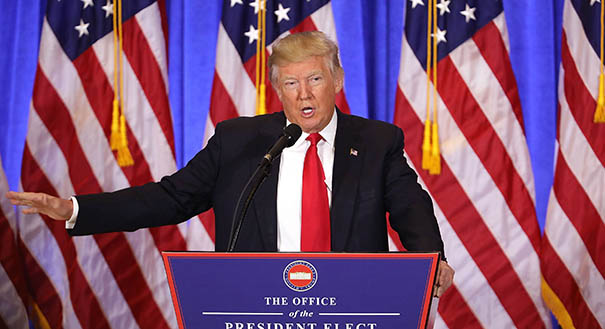
President-elect Trump will most likely be the single most important source of tensions—and potentially conflicts—between Beijing and Washington in the next four years.
When the next U.S. president takes office in January, he will not only have the prerogative to shape the United States’ China policy based on his own views and priorities but will also be required to react to Beijing’s diplomacy. What potential challenges does China pose to the presidency of Donald Trump?
A speech by Chinese Foreign Minister Wang Yi at the Symposium on International Developments and China’s Diplomacy in December 2016 provides a sense of Beijing’s foreign policy agenda in 2017. If Wang’s speech can be construed as a reasonably accurate description of that agenda, then there is little ground for U.S. policymakers and analysts to be pessimistic about bilateral relations, at least in the first year of the Trump administration.
Toward the end of the December 3 speech, Wang laid out a to-do list that includes seven items. Topping the list is his pledge to “make full efforts to serve the holding of the 19th CPC National Congress.” The next two items concern preparing for two summits that will be held in China in 2017: the Belt and Road Forum for International Cooperation in May and the ninth BRICS Summit in September.
The remaining four items pertain to China’s external environment, Beijing’s involvement in global governance, foreign policy support for domestic development, and protection of the increasing number of Chinese nationals abroad. As to how to secure a favorable external environment, Wang promised to “step up communication and coordination with the new U.S. administration to expand practical cooperation while properly managing differences, and to achieve sustained, sound, and steady growth of China-U.S. relations.”
Assigning top priority to the upcoming party congress appears to mean that between now and next fall, Beijing can hardly afford to be distracted by tensions or conflicts in its neighborhood. Furthermore, to make the two 2017 summits great successes—and they must be, given Beijing’s shining record on successfully organizing these high-profile events—Chinese leaders have to mobilize international public opinion, a task that will undoubtedly be more difficult if there are renewed tensions in the South China Sea or the Korean Peninsula.
Admittedly, Beijing may find such tensions or conflicts useful, because they are likely to lead to a surge in nationalism. But nationalism against the backdrop of massive overcapacity, a depreciated Chinese currency, and widespread frustrations about environmental degradations (for example, heavy smog in a number of cities)—to mention just the more salient issues—has the potential to lead to backlash against Chinese leaders. Thus they are expected to be extremely cautious in turning to nationalism to bolster popular support.
Finally, attaching great importance to communication and cooperation with the new U.S. administration suggests that Beijing is fully aware of the many unknowns about the Trump presidency. This awareness could lead Chinese leaders to be much more cautious in their actions and reactions when it comes to Washington. To borrow from Deng Xiaoping, they will most likely cross the river by feeling the stones.
A key phrase in the Chinese foreign minister’s speech is global governance; he mentions it nine times. On its face, this could be interpreted as a telltale sign of Beijing’s ambition to replace the United States as the leader of global governance.
However, a close look at the contexts in which global governance is mentioned reveals that Beijing envisions its expanding role in global governance almost exclusively in economic terms and through such existing channels as the G20, APEC, and the World Economic Forum. Because China is arguably the biggest beneficiary of globalization, and because its economy is heavily dependent upon exports, it is only natural for Chinese leaders to focus on global economic governance.
While Wang’s speech is not a blueprint for intense geostrategic rivalry with Washington, its emphasis on reform of global economic governance in the four major areas of finance, trade and investment, energy, and development could put Beijing on a collision course with the Trump presidency. Riding on the high tide of economic nationalism—that is, anti-free-trade and anti-globalization stances—Trump has strong electoral incentives to resist, and even to undermine, Chinese initiatives to expand trade and investment. Indeed, it would be un-Trump—in light of his campaign slogans of “Make America Great Again” and “America First”—if the first days of the new administration passed without major U.S. actions on issues like the Chinese currency, market access for U.S. companies, and Chinese exports to the United States.
So China’s foreign policy agenda for 2017 does not seem to be a major source of potential frictions in bilateral relations. On the contrary, the new U.S. president will most likely be the single most important source of tensions—and potentially conflicts—between Beijing and Washington in the next four years.
For starters, though Trump’s China policy preferences are largely unknown, one can make some inferences by examining his nominations for key posts that have major responsibilities for managing U.S.-China relations. Peter Navarro, a longtime harsh critic of China’s trade practices as well as the author of Death by China and producer of a sensational documentary with the same title, was named head of the newly created National Trade Council. Navarro’s appointment could be an indication, according to a Washington Post article, that “Trump is prepared to follow through on some of his toughest rhetoric regarding free trade during the campaign.”
Yet, one can point to Terry Branstad as evidence that Trump does not intend to set the bilateral relationship on a downward trajectory. The governor of Iowa and reportedly an old friend of Chinese President Xi Jinping, Branstad is nominated to be the next U.S. ambassador to Beijing.
Nevertheless, ambassadors are not cabinet appointments. As such, their influence on the United States’ China policy—or U.S. foreign policy in general—tends to be rather limited. Indeed, the only ambassador that played a crucial role in U.S.-Chinese relations was George H. W. Bush. But the circumstances under which Bush was stationed in Beijing were exceptional—he was tasked with making preparations for the normalization of bilateral relations. Besides, Branstad does not have foreign policy experience and he has not lived in China for an extensive period. He could be a valuable and effective channel to communicate with China’s top leader, particularly in times of crisis, but it would be unrealistic to expect him to play a significant role in shaping the administration’s China policy.
More importantly, the U.S. president-elect’s actions and comments in late 2016 regarding Taiwan have cast a long shadow over the future of U.S.-Chinese relations. Trump had a phone conversation with the Taiwanese leader, Tsai Ing-wen, a move “unpresidented” since 1972.1 Unruffled by the torrent of criticism from both Republicans and Democrats for creating tensions in the Taiwan Strait, Trump in a Fox News interview questioned the One China policy, the cornerstone of post-1972 U.S.-Chinese relations. Unsurprisingly, the phone call and the interview resulted in a formal protest from Chinese officials, inflamed Chinese public opinion, and generated harsh responses from some Chinese pundits.
Beijing has repeatedly made it unequivocally clear that Taiwan is the most important of its core interests. If the incoming U.S. administration actively challenges the One China policy, Beijing will certainly and resolutely strike back, leading to diplomatic confrontations or even military conflicts. If Trump would like to have a war with China to prove the United States is great again, then he should keep testing Beijing’s redline on Taiwan.
Perhaps after moving into the White House, Trump will change his mind and adhere to long-standing U.S. policy on Taiwan. After all, neither China nor the United States seems eager and ready to fight a war over the island, either now or in the near future.
Amid all the uncertainties about the U.S.-Chinese relationship, one thing seems certain: there is a bumpy road ahead.
Xie Tao is a professor at the School of English and International Studies, Beijing Foreign Studies University. He is also a senior fellow at the Center for China and Globalization.
1 This is a misspelling that Donald Trump used in a December 2016 tweet. See this news story: Antonio José Vielma, “Trump Faces ‘Unpresidented’ Moment on Twitter,” CNBC, December 17, 2016, http://www.cnbc.com/2016/12/17/trump-faces-unpresidented-moment-on-twitter.html.
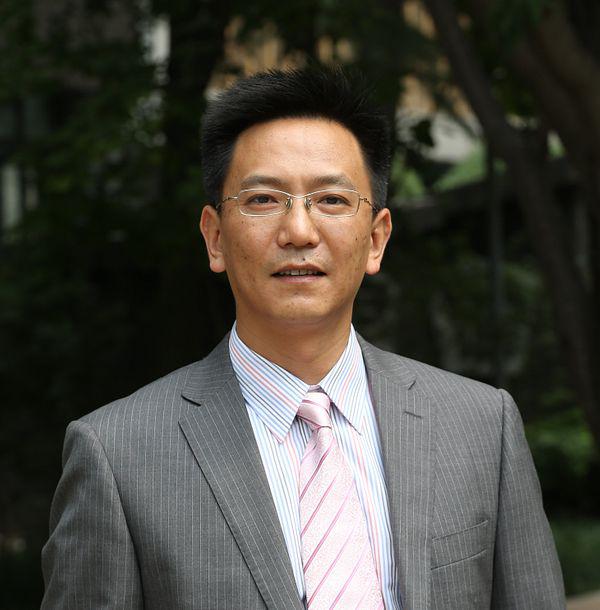
Xie Tao
Xie Tao is professor of Political Science and Dean of the School of International Relations and Diplomacy, Beijing Foreign Studies University. His research interests include U.S.-China relations, Chinese foreign policy, as well as American public opinion toward China.
Carnegie does not take institutional positions on public policy issues; the views represented herein are those of the author(s) and do not necessarily reflect the views of Carnegie, its staff, or its trustees.

Despite its flop at the box office, the film raises important questions for the climate community to answer.
Leonardo Martinez-Diaz

Funding Ukraine remains a priority for European leaders. As Russia’s war of aggression heads into another winter, two feasible options to mobilize support for Kyiv should be fast-tracked.


Vladyslav Rashkovan, Gregory P. Wilson

Russian strikes are weakening the economy sustaining Ukraine’s war effort. Closing the growing funding gap will require more European support and politically contentious reforms in Kyiv.

Balázs Jarábik

In an interview, Rozina Ali discusses her new book on the rise and manifestations of Islamophobia in the United States.

Michael Young

While the EU and European governments are embracing the much-lauded middle-power moment, this entails three difficult conundrums.

Richard Youngs