

In an interview, Hamidreza Azizi discusses how Tehran has adapted in real time to the conflict with the United States and Israel.
Michael Young
This book describes how China seeks to reshape the international system to serve its strategic aims.
Source: National Bureau of Asian Research
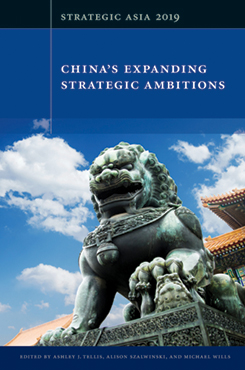
Co-edited and introduced by Ashley J. Tellis, Strategic Asia 2019: China’s Expanding Strategic Ambitions, the eighteenth volume in the Strategic Asia series, describes how China seeks to reshape the international system to serve its strategic aims. Each chapter assesses the country’s ambitions in a particular geographic or functional area and presents policy options for the United States and its partners to address the challenges posed by a rising China.
Order this book, or read the introduction by Ashley J. Tellis for free.
Ashley J. Tellis holds the Tata Chair for Strategic Affairs and is a senior fellow at the Carnegie Endowment for International Peace and Research Director of the Strategic Asia Program at the National Bureau of Asian Research (NBR).
Alison Szalwinski is Director of Political and Security Affairs at NBR.
Michael Wills is Executive Vice President at NBR.
Former Senior Fellow
Ashley J. Tellis was a senior fellow at the Carnegie Endowment for International Peace.
Alison Szalwinski
National Bureau of Asian Research
Alison Szalwinski is assistant director for political and security affairs at NBR.
Michael Wills
National Bureau of Asian Research
Michael Wills is senior vice president for strategy and finance at NBR.
Carnegie does not take institutional positions on public policy issues; the views represented herein are those of the author(s) and do not necessarily reflect the views of Carnegie, its staff, or its trustees.
In an interview, Hamidreza Azizi discusses how Tehran has adapted in real time to the conflict with the United States and Israel.
Michael Young
In the latest Five-Year Plan, the Chinese president cements the shift to an innovation-driven economy over a consumption-driven one.
Damien Ma
Japan’s response to U.S. pressure over Hormuz highlights a broader dilemma: How to preserve the alliance while remaining bound by legal limits, public opinion, and an Asia-centered security agenda. Tokyo gained diplomatic space through an alliance-embracing strategy, but only under conditions that may not endure.
Ryo Sahashi
U.S. agreements must contend with national data protection laws to make durable foreign policy instruments.
Jane Munga, Rose Mosero
The simple conclusion is that the scheme will bring neither peace nor prosperity, but will institutionalize devastation.
Nathan J. Brown











