

Commentary
A summer of escalation in the Black Sea has hurt Ukraine economically and is exacerbating world food security. A truce is needed—as is a broader reframing of Europe’s Ukraine strategy.
Thomas de Waal
Source: Getty
Facing acute threats, states in Northeastern Europe are pioneering a pragmatic model of defense-industrial cooperation that offers lessons for managing transatlantic dependencies in an era of uncertainty.
For much of the post–Cold War period, the transatlantic defense relationship rested on a stable but asymmetric bargain. The United States provided security guarantees and high-end military capabilities; Europe aligned its force planning, procurement choices, and industrial base accordingly. North Atlantic Treaty Organization (NATO) planning processes and U.S. Foreign Military Sales (FMS) mechanisms embedded U.S. platforms deeply into European militaries, reinforcing a logic in which “buying American” promised not only superior capabilities and faster delivery, but also political reassurance about U.S. security commitments to the continent. For decades, this arrangement reduced friction within the alliance by substituting dependence for coordination.
That model is now breaking down. Strategic divergence, industrial bottlenecks, and political uncertainty in Washington have made the old bargain untenable, without yet producing a viable replacement. A more balanced transatlantic defense-industrial relationship—one that would rest on equal cooperation rather than one-sided dependence—is possible. Achieving such an equilibrium will require political restraint and coordination to avoid destructive ideological confrontation, as well as recognition in Washington that a Europe investing heavily in its own defense-industrial capacity will expect—and merit—a more equal partnership. But it will also depend, above all, on Europe’s ability to strengthen its own defense-industrial base. Europe’s problem is not only how to spend more, but how to spend fast and efficiently without locking in dependencies and fragmentation.
A more balanced transatlantic defense-industrial relationship—one that would rest on equal cooperation rather than one-sided dependence—is possible.
The recalibration of the transatlantic defense-industrial relationship is unlikely to emerge from a single institutional breakthrough or a comprehensive redesign of Europe’s defense architecture. It is taking shape instead through a series of incremental, capability-level choices made under acute time pressure. Europe’s northeast offers an early illustration of how rebalancing can occur in practice. This region is demonstrating how to pool demand, standardize equipment, and integrate Ukraine on the path to effective rearmament. Faced with a shared and immediate threat environment, most governments in the Baltic Sea region (BSR)—the Nordics, Baltics, the United Kingdom (UK), Germany, and Poland—have little space for industrial jealousies or ideological positioning. Ministries of defense are weighing suppliers and partners pragmatically, judging options against concrete criteria: delivery speed, performance, cost, and the strategic risks of dependency. Procurement and production decisions are treated as questions of operational credibility—choices that may be tested sooner rather than later by a revanchist Russia.
The BSR is not a blueprint for Europe as a whole, but it does reveal a transferable logic: When defense-industrial choices are anchored in credible near-term contingencies, cooperation becomes easier, dependencies are scrutinized more rigorously, and transatlantic rebalancing advances through practice rather than proclamation.
Competing currents in the second administration of U.S. President Donald Trump generate strategic ambiguity for European defense planners. Some administration members, like U.S. Secretary of Defense Pete Hegseth, have emphatically encouraged their European counterparts to “[expand] your defense industrial base.”1 Others, like Secretary of State and National Security Adviser Marco Rubio, warn that excluding U.S. suppliers from European programs will be viewed negatively in Washington.2 Moreover, this version of Washington’s message on defense-industrial ties has also taken different forms. At times it is framed as an offer. As one State Department official summarized at the 2025 Prague Defence summit: “America is open for business.”3 At other moments, the same expectation is articulated more coercively. In December 2025, U.S. Deputy Secretary of State Christopher Landau accused European foreign ministers of “bully[ing]” U.S. firms out of participating in Europe’s arms build-up and blamed European “protectionist and exclusionary policies” in an official State Department statement.4
Competing currents in the second administration of U.S. President Donald Trump generate strategic ambiguity for European defense planners
At the same time, the U.S. industrial base is struggling to meet demand. Delivery delays across key systems—HIMARS, F-35s, Patriot missile systems, and infantry fighting vehicles—have worsened significantly since 2022. F-35 airframes and engines are now routinely delivered many months late.5 Contributing factors include supply-chain bottlenecks, workforce shortages, aging production infrastructure, and the long-term consolidation of the U.S. defense sector.6 In the words of retired NATO Supreme Allied Commander Europe General Christopher G. Cavoli, the FMS system has become “overly expensive, slow, and increasingly mistake prone.”7
On top of these delays, Europeans are also faced with the issue of use limitations and strict export controls under instruments like the U.S. International Traffic in Arms Regulations (ITAR). Through these regulations, the U.S. government is able not only to limit how, where, and when Europeans use specific U.S.-supplied weapons, but also to control defense exports between two or more countries outside the United States.8 As the United States’ commitment to European defense priorities and values is increasingly called into question, Europeans are growing uncomfortable with this arrangement. According to EU Commissioner for Defence and Space Andrius Kubilius, “ITAR is becoming a problem for American producers . . . many European firms are pitching their products to European governments [as] no China, no Russia, no ITAR.”9
The concern in Europe is not only commercial. Europeans increasingly worry that the United States might place use-restrictions on its arms that would limit Europe’s ability to act in a military contingency with Russia. The limitations that the United States has put on Ukraine’s use of U.S. weapons, including during Joe Biden’s administration, have made these risks more than theoretical.10 Together, these constraints make reliance on U.S. supply chains riskier, both politically and operationally, pushing Europeans to diversify and to rebuild capacity at home.
U.S. interests in Europe persist from the Arctic to the North Atlantic, but Washington has become less willing to engage with Europe’s defense and security community.11 Political polarization and a more confrontational alliance posture under the Trump administration have weakened assumptions about a coherent and reliable U.S. commitment to NATO. Yet these strains predate Trump. Over more than a decade, structural shifts—divergent strategic priorities, supply-chain vulnerabilities, and growing U.S. focus on the Indo-Pacific and homeland security—have steadily widened the gap between U.S. and European operational needs, timelines, and force requirements.
At the same time, both sides of the Atlantic face the shared challenge that their defense-industrial bases must expand faster than at any point since the Cold War. Defense spending is rising sharply, and procurement systems are under reform.12 In the United States, new entrants are beginning to challenge entrenched prime contractors; in Europe, established firms have benefited from the urgency to spend, though competitive pressure is emerging from new companies learning from battlefield experience in Ukraine. Crucially, however, these transformations are unfolding in parallel rather than in concert, as both Washington and European capitals increasingly prioritize domestic production and industrial protection.
Both sides of the Atlantic face the shared challenge that their defense-industrial bases must expand faster than at any point since the Cold War.
In principle, coordinated transatlantic investment could deliver substantial gains: shared innovation, interoperable supply chains, reduced duplication, and more efficient use of capital. In practice, transatlantic defense-industrial cooperation has rarely operated on equal terms. Historically, it has meant European subcontracting, licensing, or participation in U.S.-led programs. Only a handful of initiatives—notably the Naval Strike Missile and the Rolling Airframe Missile, both rooted in Northeastern Europe—come close to genuine co-design, co-development, and co-production.
A durable new bargain will require more arrangements of this kind. Industry is likely to move first: Prime contractors are pragmatic actors that respond to demand signals and credible financing. The open question is whether Europe can convert the political momentum generated by Russia’s full-scale invasion of Ukraine into a sustained effort to strengthen its own defense-industrial base—creating the conditions for cooperation at eye level rather than dependence by default.
European military forces continue to depend on U.S. platforms, technologies, and supply chains across aerospace, command-and-control, precision strike, missile defense, and advanced critical enablers.13 This asymmetry is anchored by an even deeper reliance on the U.S. nuclear umbrella. Europe’s response thus far has been to rapidly increase defense spending.14 EU member states spent €343 billion on defense in 2024—a 19 percent rise from 2023—and are projected to reach €381 billion in 2025.15 Most NATO members will exceed the old 2 percent of GDP benchmark; nearly all have signed on to the 5 percent by 2035 pledge (3.5 percent core defense plus 1.5 percent related expenditure).16 But Europe’s defense-industrial base is not where it needs to be.
Europe’s defense industry—with an annual turnover of €183 billion in 2024 and accounting for approximately 600,000 jobs—remains smaller than its U.S. counterpart, and the continent’s rearmament drive continues to run up against entrenched structural constraints.17 Three decades of underinvestment have hollowed out key industrial competencies, leaving firms with outdated production lines, high per-unit costs, and limited surge capacity compared to U.S. prime contractors.18 Fragmented supply chains and nationally segmented markets raise costs and slow delivery, while workforce shortages restrict any meaningful ramp-up.19 Unless these bottlenecks are addressed, Europe’s accelerating demand will continue to collide with the limits of its industrial base—and sustain, rather than mitigate, its reliance on external suppliers.
Europe’s defense industry . . . remains smaller than its U.S. counterpart, and the continent’s rearmament drive continues to run up against entrenched structural constraints.
A structural hindrance lies in Europe’s capital markets, which lack depth and liquidity. Startups and other innovative firms have often been forced to look to the United States for funding as a result.20 The fragmentation of Europe’s financial landscape poses additional problems for raising capital across the continent. European companies are generally over-reliant on bank funding, with EU companies raising approximately a third of what U.S. firms raise from capital markets.21 This is especially challenging for the defense industry, as European banks historically have been wary of investing in security and defense.22 Lessons from Ukraine have moved effective air defense; intelligence, surveillance, and reconnaissance; cyber defense; counter-drone systems; and electronic warfare broadly to the top of capability priorities.23 Yet, given these obstacles, even record defense budgets might not be sufficient for Europe to “unlock [its] innovative potential,” in the words of former European Central Bank president Mario Draghi, reinforcing dependence on non-European technologies in critical areas.24
For decades, the United States has played a quasi-hegemonic role in European defense, providing not only the bulk of high-end capabilities but also the strategic direction around which European defense planning cohered. That role is now receding, resulting in a growing leadership vacuum. Ideally, strategic guidance would flow through NATO, with the alliance’s defense planning process (NDPP) translating shared threat assessments into coherent force goals. In practice, however, NATO allies currently find themselves incapable of discussing either Russia or Ukraine inside the alliance. And the widening gap between NATO expectations of U.S. military capability contributions and the United States’ actual willingness to provide them is complicating long-term planning through the NDPP.
In the defense-industrial realm, the lack of Europe-wide leadership could have lasting detrimental consequences. Funding decisions that are being made now will determine the shape of the European defense-industrial base for the next decade or more. Yet Europe’s rearmament effort is not, so far, strengthening that industrial base in a targeted or integrative way. Instead of using new resources to build pathways for deeper European cooperation, consolidate demand, and reduce strategic dependencies, Europe’s decisionmakers are spending these resources in ways that reinforce fragmentation. Governments with large national defense industries are channeling the bulk of new funds toward domestic producers, prioritizing national champions and sovereign control over cross-border integration. As defense budgets rise, collaboration declines: The political and industrial incentives to pool demand weaken once countries have the fiscal space to go it alone. The result is a rearmament surge that risks entrenching parallel national industrial ecosystems rather than building a more coherent European one.
Instead of using new resources to build pathways for deeper European cooperation, consolidate demand, and reduce strategic dependencies, Europe’s decisionmakers are spending these resources in ways that reinforce fragmentation.
For European governments without defense primes, or major defense contractors, the pattern looks different—but no less problematic for integration. Rather than “buying European,” many are effectively buying wherever capacity is available. To manage the risks of overreliance on the United States and to circumvent Europe’s own production bottlenecks, governments have increasingly turned to third-country suppliers, including South Korea and Israel, who can often deliver systems more quickly and at greater scale than European competitors.25 But while such choices are pragmatic in the short term, they carry longer-term costs. Procuring rapidly from non-European suppliers can deepen external dependencies and divert demand away from Europe’s own industrial base at a critical moment. Additionally, those external suppliers might themselves prove unreliable if there were a new security crisis in, say, the Middle East or the Korean peninsula that diverted supplies.
The core dilemma of European rearmament is thus to balance the imperative of speed—given urgent capability gaps and Russian pressure—with the strategic objectives of sovereignty, efficiency, and effectiveness to build resilient European capacity, consolidate demand, and avoid new forms of dependence.26 For now, Europe’s spending surge is resolving that tension in ways that favor immediacy over integration, with lasting consequences for the future shape of its defense-industrial base.
Recognizing these challenges, the EU is attempting, more than at any point in its history, to shape defense-industrial outcomes by incentivizing member states to procure and produce together and in Europe.27 In its effort to shape these outcomes, the European Commission faces three structural limits: fragile political buy-in from member states wary of binding rules, uneven distributional effects that favor established defense producers, and governance constraints stemming from limited fiscal authority and slow decisionmaking. Together, these factors sharply circumscribe what EU-level instruments can realistically achieve in driving large-scale defense-industrial integration.
In response to sustained pushback from member states against rigid “buy European” provisions, Brussels has begun to soften its protectionist edge.28 To secure buy-in for its new instruments, the commission has had to signal flexibility and reassure governments that participation will not bind them to overly restrictive sourcing rules they view as operationally unrealistic or politically costly. In practice, the EU is now effectively funding coalitions of the willing through loans.29
The commission also faces the structural challenge that EU defense-industrial initiatives inevitably distribute benefits unevenly. Member states with mature defense industries are best positioned to capture EU funding, while smaller firms in peripheral states risk being crowded out. A recent report by the Research Institute of the Finnish Economy warns that EU funds “could concentrate orders among Europe’s largest military contractors, leaving smaller companies in peripheral states at a disadvantage.”30 At the same time, large producing states are often reluctant to cede decisionmaking authority to Brussels, particularly when they possess ample national resources. Germany illustrates this tension: Buoyed by new domestic funding, Berlin is increasingly inclined to bypass EU instruments in favor of national procurement channels.31
Buoyed by new domestic funding, Berlin is increasingly inclined to bypass EU instruments in favor of national procurement channels.
One area where the EU’s financial incentives could prove particularly consequential is the integration of Ukraine into the European defense market. SAFE, a €150 billion EU-backed loan facility intended to provide member states with low-cost financing for defense-industrial projects, is explicitly designed to mobilize large-scale investment in European production while allowing—and encouraging—the participation of Ukrainian firms.32 Most recently published national SAFE plans already include provisions for Ukrainian involvement.33 If implemented effectively, SAFE could become a powerful accelerator of defense-industrial integration between Ukraine and the EU, though realizing this potential will depend on overcoming substantial regulatory and market-access barriers.34
Europe’s push to expand its defense-industrial base is increasingly constrained by regulatory burdens. While there is growing recognition of the problem—and EU efforts such as the Defence Readiness Omnibus aim to streamline procedures—many of the most serious bottlenecks, from security clearances to administrative capacity, remain national.35 Even though national defense ministries are often happy to fault Brussels—without parallel reforms by member states, regulatory friction will continue to blunt the impact of rising defense spending and prevent collaboration.
The EU is improvising industrial policy in real time, but its emerging defense-economic role is incomplete. It is not a fiscal union, its budgetary authority is narrow, and several member states continue to oppose EU-level defense borrowing.36 Its fundamentally non-hegemonic governance model, based on negotiated compromise and limited delegation of sovereignty to the supranational level, has proven ill-suited to driving the kind of decisive coordination that effective defense-industrial integration now requires. In consequence, the EU is not yet able to solve the underlying structural constraints and governance challenge shaping Europe’s defense-industrial landscape.
One of the most promising models of new European defense governance centers on regional alliances. Regional frameworks—ranging from bilateral agreements to multilateral constellations—allow for faster coordination than EU mechanisms (many of which require unanimity). Such arrangements reflect geographical proximity, shared threat perceptions, and trust. They can be built around collective capability coalitions that jointly develop and procure weapons systems across specific priority areas or focus on a specific strategic goal, such as the “coalition of the willing” in support of Ukraine.37 Regional formats are not a substitute for European market integration—but they can deliver interoperability and scale faster than unanimity-based EU mechanisms.
Regional formats are not a substitute for European market integration—but they can deliver interoperability and scale faster than unanimity-based EU mechanisms.
The BSR offers a concentrated example of how European states—many of them small and on the front line with Russia—are navigating Europe’s uneven rearmament landscape, and uncertainties surrounding future U.S. reliability. Long anchored in transatlantic cooperation, the Nordics, Baltics, the UK, Germany, and Poland are being drawn closer together by shared contingency planning around Baltic Sea security, air and missile defense, long-range strike, and hybrid threats—and by a common effort to learn from and integrate Ukraine’s defense-industrial experience.38
The BSR’s capability mix reflects both innovation and vulnerability: cyber defense, unmanned systems, and underwater surveillance are growing niches, yet dependence on external suppliers for arms and ammunition remains high. The region’s experience also reflects a broader shift in industrial logic. Baltic and Nordic states emphasize rapid acquisition, modular contracting, and shared supply chains as the only viable route to defense readiness.
Despite increased turbulence in political and security relations between the United States and Europe, the BSR remains an intuitively transatlantic-minded region. For these frontline states, immediate combat credibility eclipses longer-term sovereignty considerations.
For . . . frontline states, immediate combat credibility eclipses longer-term sovereignty considerations.
In 2025, Poland devoted 4.7 percent of its GDP to defense—the highest share in NATO—and while it is set to be the largest beneficiary of SAFE funding (€43.7 billion of the total €150 billion), Warsaw has deliberately diversified its procurement portfolio.39 It buys from European, U.S., and South Korean suppliers, prioritizing quick delivery over industrial-policy purity. Polish leaders are also explicit that strategic diversification must not come at the expense of the transatlantic relationship. Even after the fractious February 2025 Munich Security Conference, Polish Prime Minister Donald Tusk warned against “introduc[ing] some kind of competitive game between the European Union and the United States,” arguing that maintaining both channels of supply is vital to Polish security.40
Estonia has adopted a similar calculus. Tallinn’s recently expanded HIMARS order demonstrates a continued reliance on U.S. air defense systems, and senior officials frame procurement as a pragmatic balancing act rather than a sovereignty project.41 Estonian Foreign Minister Margus Tsahkna has emphasized that “there is enough space” for U.S., South Korean, Turkish, and European suppliers in Estonia’s force modernization.42 Tallinn prefers European kit where feasible but is candid that Europe cannot yet supply all required capabilities at the necessary speed.43
Meanwhile, the region’s commitment to a continued transatlantic relationship is not without limits. Denmark is one of the most outspoken skeptics in the BSR regarding future security reliance on the United States, especially following Trump’s stated desire to take control of Greenland.44 Denmark recently chose the French-Italian SAMP/T over the U.S. Patriot air defense system—a decision that came after the chairman of the Danish parliamentary defense committee expressed “regret[ting] choosing the F-35 for his country,” and that “[Denmark] must avoid American weapons if at all possible.”45 Denmark’s military intelligence service has also for the first time labeled the United States as a potential security concern.46
With a far larger industrial base and a political priority to rebuild domestic capacity, Germany’s 2025–2026 procurement plan allocates only 8 percent of an $83 billion annual budget to U.S. systems, with the overwhelming bulk directed to national or European programs such as the F127 frigate, the Eurofighter Tranche 5, and the IRIS-T SLM air-defense system.47 Germany’s approach reflects a strategic choice to insulate procurement from U.S. volatility and direct increased funding toward domestic industries. At the same time, Berlin also broadly refuses to include the EU in its defense procurement thinking.48
Sweden is similarly skeptical of a strong EU role in European defense and in favor of U.S. integration. Stockholm did not apply for SAFE loans, with Defense Minister Pål Jonson noting “that Stockholm prefers defense buys to be steered through the NATO Support and Procurement Agency, the Organization for Joint Armament Cooperation, or the European Defense Agency.”49 Given that its defense firms are privately owned, the Swedish government often stresses the need for a competitive, innovative, and accessible defense market that can benefit Swedish companies.
While the region rejects a defense-industrial divorce from the United States and has little patience for the EU’s defense ambitions, Europe’s frontline states are also not indulging in nostalgia for the transatlantic status quo ante.
While the region rejects a defense-industrial divorce from the United States and has little patience for the EU’s defense ambitions, Europe’s frontline states are also not indulging in nostalgia for the transatlantic status quo ante. Instead, they are engaging in practical capability and mission-based defense-industrial cooperation that strengthens their security and defense outlook. Importantly, countries in the region are also forging new models of collaboration with each other that seek to avoid bureaucratic delays while also reducing dependencies on external suppliers.
No single country is leading the charge on regional defense cooperation. Equally, regional constellations, such as Nordic Defence Cooperation (NORDEFCO), the Council of the Baltic Sea States, the Joint Expeditionary Force, and the Nordic-Baltic Eight facilitate political coordination but have not produced deep industrial integration. Their mandates are either too broad or too narrow, and they rely on consensus-based decisionmaking. These regional groupings lack dedicated industrial-policy tools, substantial financing instruments, and the administrative capacity required to drive armaments cooperation.
Defense-industrial cooperation [in the Baltic Sea region] tends to emerge from the bottom up, around specific capability gaps, rather than through top-down frameworks.
Instead, public procurement patterns across the BSR show a consistent dynamic: Defense-industrial cooperation tends to emerge from the bottom up, around specific capability gaps, rather than through top-down frameworks. BSR countries have chosen to buy military equipment from and with each other. This collaboration is driven not only by geography and shared threat perceptions, but also by a similar sense of urgency and desire to act. A set of flagship, genuinely multinational capability programs are shaping Northeastern Europe’s emerging defense cluster.
The Common Armoured Vehicle System (CAVS) program, for instance, has rapidly become a model of practical Nordic-Baltic-German cooperation. In January 2025, Germany joined the CAVS Framework Agreement, which enables serial procurement of the Finnish company Patria’s 6x6 armored vehicle.50 Denmark joined the following April and the UK and Norway joined in September.51 The framework—previously limited to Finland, Sweden, and Latvia—now connects a critical mass of European states around a common wheeled mobility platform.
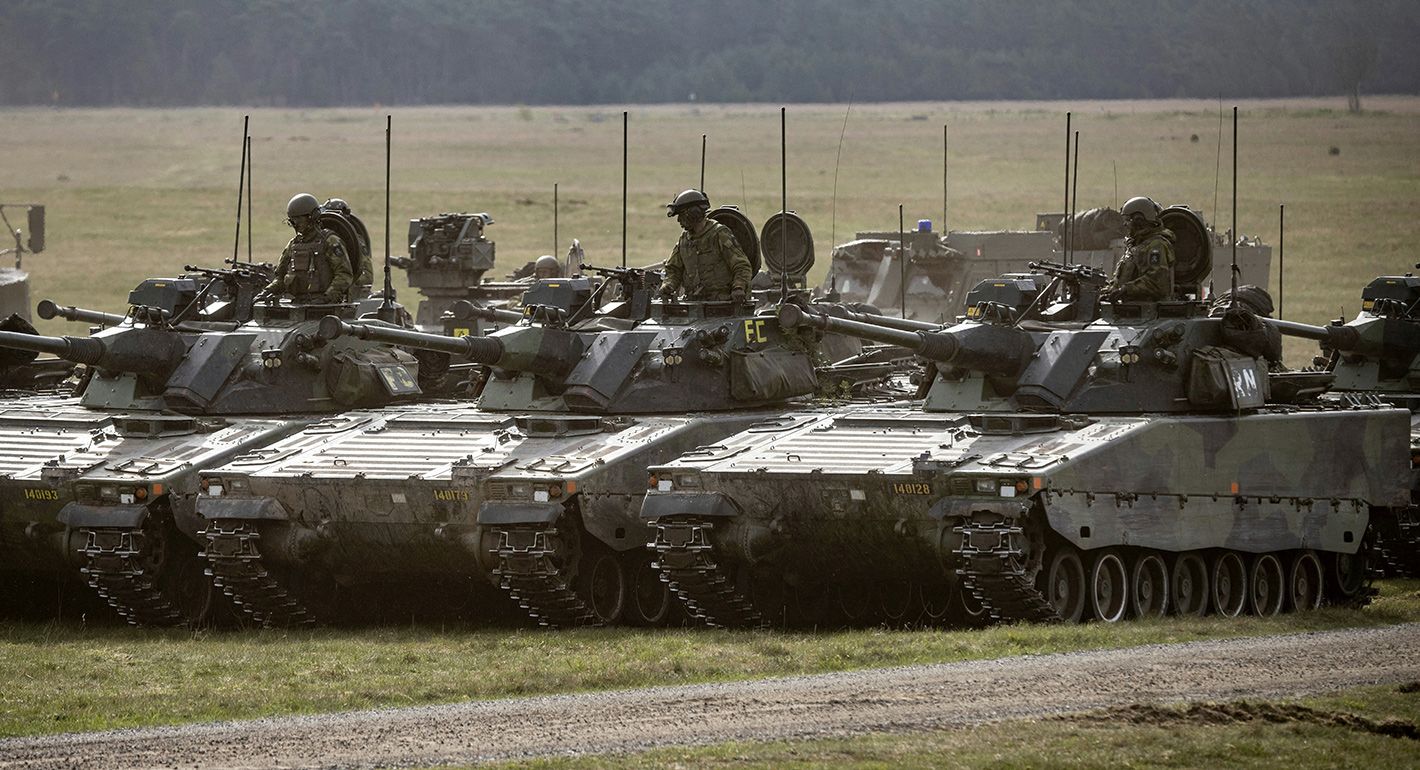
Similarly, six of the region’s ministries of defense (those of Estonia, Finland, Lithuania, the Netherlands, Norway, and Sweden) impressively succeeded in aligning capability requirements, procurement schedules, industrial participation, and sustainment arrangement to jointly procure the CV90 combat fighting vehicle—designed for Nordic subarctic climates and produced by Sweden’s BAE Systems Hägglunds—as well as CV90 training equipment, spare parts, and munitions.52
Integrated air and missile defense is being built through the European Sky Shield Initiative (ESSI). Estonia, Latvia, Lithuania, and Finland have been members since the German-led initiative’s launch in 2022.53 They were joined in 2023 by Denmark and Sweden, making ESSI another example of a regionally anchored framework that aligns procurement and operational concepts across the Nordic-Baltic space.54 ESSI gives these states access to layered air defense architectures, common procurement of interceptors, and shared training and radar integration—aiming to close one of the most acute vulnerability gaps on NATO’s northeastern flank. In June 2025, Sweden announced it would purchase seven IRIS-T SLM air-defense systems from the German manufacturer Diehl.55 ESSI designates IRIS-T SLM as the preferred medium-range layer of a common European air- and missile-defense architecture.
BSR countries are also entering bilateral security agreements with one another—further strengthening and integrating their defense industries. In November 2025, Poland announced it would select Sweden’s Saab to supply the Polish navy with three submarines, a move described by Swedish defense minister Jonson as “strengthen[ing] our common defence, security, and defence industrial base.”56 And in December 2025, Norway and the UK announced a “first-of-its-kind” naval security pact to counter suspicious Russian activity and protect critical undersea infrastructure in the North Atlantic.57 According to the British government, the £10 billion (approximately $13 billion) deal will result in an “interchangeable fleet” of British-built Type-26 frigates operated by the UK Royal Navy and the Royal Norwegian Navy.58 This announcement follows similar post-Brexit bilateral security agreements between London and both France and Germany in July 2025.
Northeastern Europe has taken a leadership role in defense-industrial collaboration and integration with Ukraine.
Finally, Northeastern Europe has taken a leadership role in defense-industrial collaboration and integration with Ukraine. Cooperation is most advanced in drones, electronic warfare, and other rapidly iterating technologies, where Ukrainian battlefield testing has become the gold standard and where European governments see partnership with Ukraine as a pathway to relevance, resilience, and faster rearmament. Denmark has emerged as a first mover with its direct-financing model, channeling funds straight to Ukrainian producers to deliver systems Ukraine is already using, while also anchoring longer-term industrial ties.59 Germany, with a strong domestic industrial base, has initially largely financed contracts with national firms but is now exploring deeper forms of cooperation—including maintenance, repair, and ammunition and drone production links with Ukraine.60 The UK has positioned itself as a key hub for joint production on NATO soil, launching licensing and co-production arrangements for Ukrainian-designed interceptor drones, offering Ukrainian firms safer conditions to scale.61
Europe’s current rearmament drive is heavily weighted toward procurement rather than innovation.
These integration efforts matter for the region’s defense innovation future. Europe’s current rearmament drive is heavily weighted toward procurement rather than innovation: Unlike the United States, which spends roughly as much on defense research and development (R&D) as on buying equipment, European governments have prioritized near-term deterrence over longer-term technological edge. Over time, this imbalance risks leaving Europe once again dependent on U.S. innovation even as it spends more on defense. Narrowing that gap will require rebuilding Europe’s own innovation capacity. To this end, the region’s defense-industrial integration with Ukraine can be a crucial accelerator.
The rebalancing of the transatlantic defense-industrial relationship will not be delivered by a single institutional reform, EU instrument, or grand bargain negotiated from the top down. Instead, it may emerge unevenly, through concrete procurement choices, capability coalitions, and industrial partnerships formed under pressure, which enable the effective buildup of Europe's defense industry. Nowhere is this dynamic more visible than in the Baltic Sea region. Faced with acute threat perceptions, limited strategic depth, and uncertainty about future U.S. engagement, countries in Northeastern Europe have prioritized speed, interoperability, and operational credibility over ideological purity. Their approach—rooted in joint off-the-shelf procurement, pooled demand, and mission-driven cooperation—has enabled tangible progress where broader European frameworks have struggled.
This regional model does not point toward transatlantic decoupling, nor does it offer a blueprint for European strategic autonomy in isolation. Instead, it suggests a more realistic path toward a new equilibrium—one in which Europe takes greater responsibility for generating capability, industrial capacity, and innovation, while remaining deeply embedded in transatlantic structures. The lesson for the rest of Europe is not to copy the region’s arrangements, but to adopt its decisionmaking discipline—treating defense-industrial cooperation as a function of operational urgency and credible threat, rather than as an abstract project of autonomy or alliance politics.
If sustained and scaled, the Nordic-Baltic experience could help anchor a more equal partnership—one that reduces Europe’s vulnerabilities without foreclosing cooperation, and that replaces inherited dependence with negotiated interdependence. In that sense, the Baltic Sea region is not only a front line of deterrence, but also a laboratory for the future of the transatlantic defense-industrial order.
The Baltic Sea region is not only a front line of deterrence, but also a laboratory for the future of the transatlantic defense-industrial order.
European rearmament and transatlantic defense-industrial rebalancing are still in their early phases, and key questions remain about how this process will evolve: Can Europe generate sufficient industrial capacity, demand aggregation, and political coordination to make co-design, co-development, and co-production with the United States viable at scale—rather than exceptional cases limited to a handful of programs? Can the United States accept a European defense-industrial base that is stronger, more autonomous, and less dependent—while remaining a close partner rather than a competitor? Will the European Union acquire the fiscal authority and borrowing capacity needed—through its next multiannual budget or new EU-level debt instruments—to translate its defense-industrial ambitions into sustained production and integration? If neither NATO nor the EU can currently offer coherent leadership on defense-industrial priorities, what mechanisms can provide strategic guidance for long-term planning? Can the Baltic Sea region’s bottom-up, capability-driven cooperation mature into a form of sustainable defense-industrial governance, or will it ultimately require stronger institutionalization through formats such as NORDEFCO or other regional frameworks?
Rearmament decisions taken now will shape Europe’s defense-industrial landscape for decades.
Nevertheless, the early trajectory of these processes offers a basis for several policy recommendations:

Former Senior Fellow, Europe Program
Sophia Besch was a senior fellow in the Europe Program at the Carnegie Endowment for International Peace. Her research focuses on European foreign and defense policy.

Nonresident Researcher, Europe Program
Erik Brown is a nonresident researcher in the Carnegie Europe Program. He was formerly a James C. Gaither Junior Fellow in the Europe Program.
Rafaela Uzan
Former James C. Gaither Junior Fellow, Europe Program
Rafaela Uzan was a James C. Gaither Junior Fellow in the Carnegie Europe Program.

A summer of escalation in the Black Sea has hurt Ukraine economically and is exacerbating world food security. A truce is needed—as is a broader reframing of Europe’s Ukraine strategy.

Thomas de Waal

If the Russian-speaking community in Latvia cannot articulate their interests without being seen as disloyal, they could end up embracing a pro-Kremlin agenda.

Sergejs Potapkins

Are Germany’s economic, industrial, and political struggles becoming a liability for the EU’s ability to rise to the geopolitical moment?

Rym Momtaz, ed.

China’s police training infrastructure construction projects provide benefits to recipient countries, promote China’s image as a major global security provider, and are likely to reinforce alignment between Beijing’s security priorities and those of countries in the Global South.


Cameron Waltz, Sheena Chestnut Greitens, Kim Nguyen, …
They face an uphill climb, but they could draw on a strategy that other diplomats have used in the past.


Shana Tabak, Alejandro Martin Rodriguez