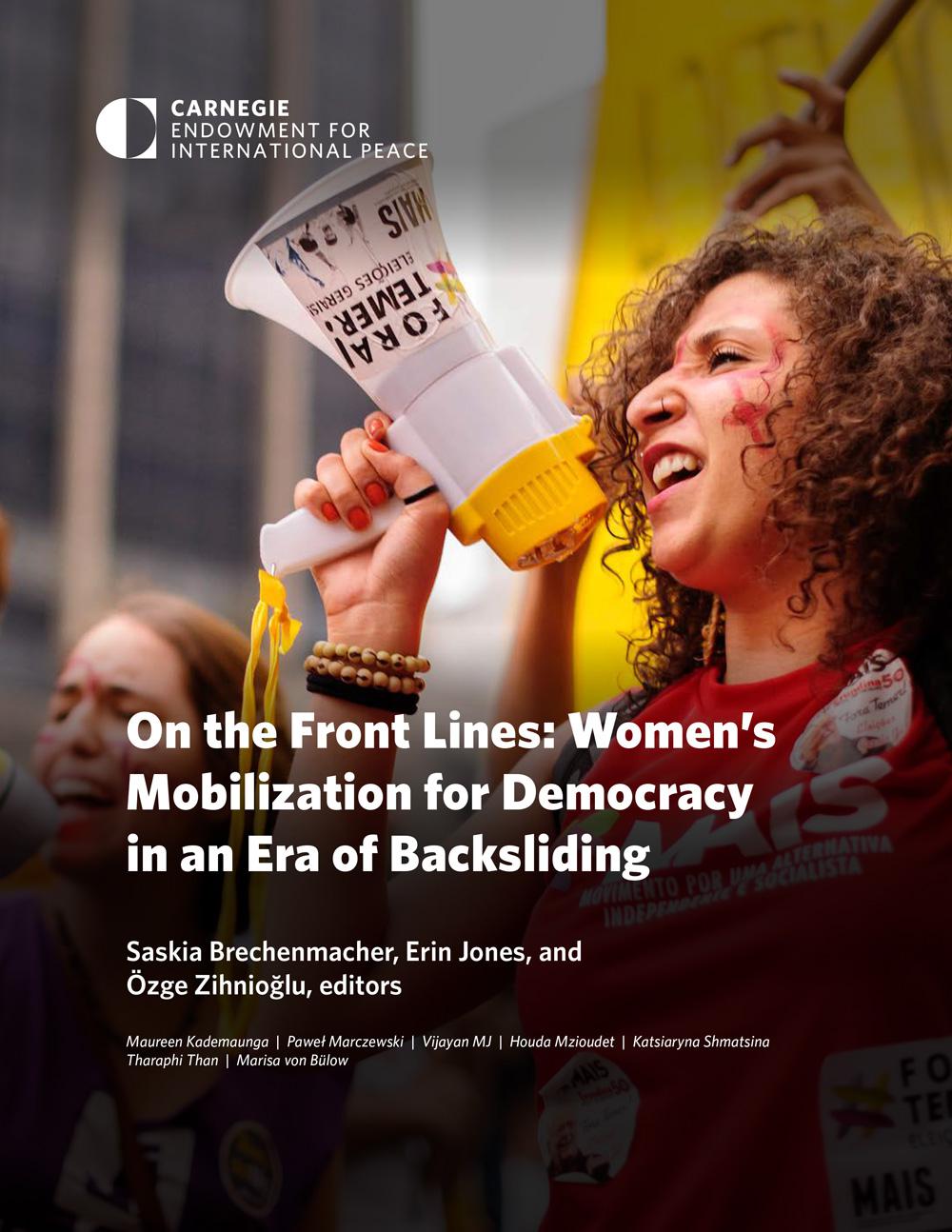
On January 21, 2017, the day after Donald Trump’s inauguration as U.S. president, hundreds of thousands of women poured onto the streets of Washington, DC, and cities around the country to voice their outrage at his election. Witnessing Hillary Clinton, the first female presidential candidate of a major political party, lose to a man known for his misogyny proved to be a galvanizing moment. One woman’s call to action on Facebook morphed into a national movement, drawing more than 400 organizational partners and over 2 million participants worldwide. The Women’s March became one of the most visible manifestations of resistance against the Trump presidency, ushering in a period of heightened political contention.1
Trump’s election was a wake-up call for many Americans who had trusted the resilience of the country’s democratic institutions. Since then, signs of democratic distress have multiplied.2 One of the country’s two main political parties—the Republican Party—has been captured by an increasingly far-right faction that challenges the legitimacy of the 2020 presidential election and seeks to entrench its power by limiting who votes and oversees elections. This extremist turn feeds on structural and institutional problems that have been developing for years, including increasingly minoritarian political institutions and rising political polarization.3 However, escalating threats to U.S. democracy have catalyzed new forms of action to defend democratic institutions, beginning during the Trump years and accelerating following the 2020 election and the January 6 insurrection.
As in many other parts of the world, women have often been at the forefront of this prodemocracy movement, pushed to action by overlapping attacks on democracy, women’s rights, and norms of equality. This article examines women’s diverse roles in the evolving U.S. democracy movement, highlighting several key patterns. First, women are driving prodemocratic mobilization at different levels: as grassroots organizers, Democratic-leaning voters, and leaders in politics and advocacy organizations. However, their engagement is shaped by cross-cutting partisan and ethnic identities, reflecting larger patterns of polarization. White women in particular are playing important grassroots organizing roles within illiberal networks. Second, the place of women’s rights—particularly reproductive rights—in the struggle to defend U.S. democracy remains contested. Although attacks on reproductive rights in the United States have pushed more women and women’s organizations to mobilize for democracy, they have revealed strategic divisions within the prodemocracy movement. Finally, women politicians and election officials standing up for democracy in the United States face disproportionate and gendered harassment and attacks.
Women’s Roles in the U.S. Prodemocracy Movement
In the United States, popular mobilization focused explicitly on defending democracy largely subsided after the height of the civil rights movement in the 1950s and 1960s. Although various actors continued to push for voting rights, campaign finance regulations, and broader institutional reforms, they were mostly professionalized nongovernmental organizations rather than membership organizations galvanizing mass participation.
Trump’s election in 2016 dramatically changed the political landscape. For one, the Trump administration fueled a significant spike in grassroots citizen mobilization, with analysts tracking more than 60,000 demonstrations during Trump’s years in office. Although many of these protests focused on racism, immigration, policing, and gun violence, some also revolved explicitly around threats to democracy and spawned new organizing efforts aimed at defeating Trump at the polls.4 Beyond this surge in protests, countless new organizations sprang up after the 2016 and 2020 elections to tackle democratic weaknesses that previously had received less attention, such as election subversion, political violence, and online disinformation. Efforts to build coalitions among these newer actors and older organizations, such as the NAACP and Issue One, also intensified.5 “In some ways, 2020 was a catalyst in creating a common sense of purpose and underlining the urgency for a prodemocracy movement that goes beyond single issues,” says Maria Stephan, chief organizer at the Horizons Project, an initiative focused on movement-building among social change organizations.6
What is striking about these new forms of mobilization is the central role that women are playing at different levels: as grassroots protesters and activists; as lawyers, advocates, and election officials; and as voters. The 2016 women’s marches were the first indication of this pattern. In their aftermath, thousands of loosely connected women-led volunteer groups formed around the country, often drawing on the online networks formed during the marches.7 Following outlines for action developed by the newly created Indivisible organization, they mobilized to help Democrats win back control of the House of Representatives in 2018, recruited hundreds of first-time women candidates to run for office, and rallied to protect healthcare reforms from Barack Obama’s presidency. Yet these volunteer groups were not simply extensions of the Democratic Party. Although many were motivated by anti-Trump partisanship, they often framed their work in terms of defending American democracy. Their efforts proved highly effective. The Democrats won back the House in the 2018 midterm elections, thereby weakening Trump’s political coalition; in addition, female candidates ran for office and won in record numbers, powered by women’s grassroots support as well as established organizations such as Emily’s List.8
Beyond the grassroots, women are well-represented in the leadership and staff of organizations fighting for democratic renewal. Women are currently at the helm of the States United Democracy Center, the Election Trust Initiative, Democracy Forward, Common Cause, FairVote, OpenSecrets, the NAACP Legal Defense Fund, and the Advancement Project, to name a few. Several women lawyers—such as Roberta Kaplan, Sally Yates, Stacey Abrams, and Vanita Gupta—played prominent roles in challenging Trump and his administration’s policies.9 Women are also organizing for democracy within religious communities, as leaders in organizations such as Sojourners and NETWORK that are confronting illiberal strands within faith communities. And they are deeply embedded in the management of U.S. elections, as more than 80 percent of the country’s election workers are women.10 Although these women may not necessarily describe themselves as democracy activists, they have found themselves on the front lines of ongoing struggles over democratic processes.
Finally, women have also emerged as an important electoral force opposing Trump and MAGA-affiliated candidates.11 Women in the United States have long voted at higher rates than men and have been more likely to identify as Democrats or Democratic leaning than men (particularly Black women, the most loyal Democratic voting bloc).12 This gender gap grew even more pronounced in the Trump years: In 2016, for instance, women were 13 percentage points more likely to vote for Clinton than for Trump. In 2018, women favored Democrats by 19 percentage points.13 Gender differences in support for Trump narrowed somewhat in 2020, with 42 percent of women voting for Trump compared to 53 percent of men.14 Yet in the 2022 midterms, battles over abortion rights once again brought many women out to vote against Republican candidates. Not only did women vote in larger numbers than men, but 53 percent voted Democratic; and in highly contested races, women’s support for Democrats increased relative to 2020.15 Of course, voting for Democrats should not necessarily be considered prodemocratic action: voting choices are strongly colored by partisanship, and concerns about democracy or Trumpism may only be a decisive factor for some voters. Yet in a political context in which attacks on democracy are emanating primarily from extremist factions of the Republican Party, women’s electoral choices repeatedly have had a moderating effect.
Beneath these overarching patterns, women’s roles in prodemocratic mobilization are deeply shaped by their cross-cutting identities, including race, partisanship, and educational attainment. For many women of color in the United States, current trends of democratic erosion represent not a radical break with the past but a revival of long-standing ethnonationalist and illiberal strands in American politics. Black women have mobilized for voting rights and against state-sanctioned, White supremacist violence throughout the twentieth century.16 Although few held formal leadership roles in the U.S. civil rights movement, they acted as critical “bridge leaders,” using their social networks to recruit new members and build ties between local communities and the organizational core of the movement.17 This legacy lives on today. Black women are one of the most active voting blocs in the U.S. electorate, as well as a leading force in the voting rights movement and in progressive politics more broadly, both as organizers and politicians.18 They also have played critical roles in increasing voter turnout in the face of concerted attacks on their voting rights.
For many White women, by contrast, Trump’s election and subsequent attacks on democratic rights and institutions were a shock to the system, triggering new forms of mobilization among women who previously had been less politically engaged. A 2019 study by Leah Gose and Theda Skocpol found that the grassroots resistance groups formed after Trump’s election were overwhelmingly led by White, suburban, college-educated women, mostly middle-aged or older.19 These women felt, perhaps for the first time, that the health of U.S. democracy was at risk and were repulsed by Trump as a public figure. At the same time, White women as a group have remained starkly divided by partisanship, which also colors their electoral support for antidemocratic candidates. Although White women since 2018 have swung toward Democrats, they have done so by a modest margin. Many conservative White women continue to support Trump and Trump-affiliated candidates.20 White women without college degrees have been key supporters of the election fraud lie, with one survey finding that a majority believe that Joe Biden did not legitimately win the 2020 election.21 Finally, grassroots women’s networks such as Moms for Liberty as well as individual women like Marjorie Taylor Greene have taken on key political roles in the Trumpist movement. Their success illustrates that women are effective organizers on both sides of the political divide—a trend described in more detail below.22
Attacks on Reproductive Rights and Divisions Over Strategy
The uptick in women’s mobilization for democracy has been driven in part by illiberal attacks on women’s rights, and on reproductive rights in particular. Trump and the illiberal movements associated with him (including extremist groups like the Proud Boys and the Oath Keepers) have relied on misogynistic rhetoric as a political mobilization tool. Misogyny runs through Trump’s commentary on prominent women leaders, and anti–political correctness and the politics of insult are key parts of his popular appeal. His voter base reflects these attitudes: studies have found that hostile sexism is a primary predictor of support for Trump.23
Over the past several years, democratic erosion in the United States has coincided with increasing legislative and judicial attacks on reproductive rights. At the federal level, the Supreme Court in 2021 overturned the long-standing precedent of Roe v. Wade, which had guaranteed the right to abortion nationally. This decision reflected a pattern of minoritarianism in U.S. politics: it was made by a court in which most justices had been appointed by presidents who lost the popular vote and approved by a Senate that disproportionately represented low-population states.24 At the subnational level, states implementing new voting restrictions often have been the same ones putting forward restrictive antiabortion laws or de facto abortion bans. This pattern is no coincidence: reproductive rights advocates note that voting rights restrictions and gerrymandering have produced legislatures that increasingly are out of sync with public opinion on abortion.25
Some state legislatures have openly attempted to restrict political participation in order to put forward unpopular abortion policies. In Ohio, for example, the state legislature in 2023 held a special election to try to increase the vote threshold required to pass constitutional amendments from 50 to 60 percent—an effort intended to thwart a ballot initiative that sought to enshrine reproductive rights in the state’s constitution. The election followed a 2022 law that included new voter ID requirements that made it more difficult to vote.26 Many other Republican-led state legislatures have taken or are trying to take similar steps to limit ballot initiatives on abortion, including in Arkansas, Florida, Idaho, Mississippi, Missouri, North Dakota, Oklahoma, and South Dakota.27 A similar convergence between antiabortion activism and antidemocratic action is evident in civil society. Antiabortion groups like Susan B. Anthony List have become more involved in advocating for voting restrictions since the 2020 election, and linkages have formed between groups pushing for harsh abortion restrictions and the White Christian nationalist movement.28 In one example, a White supremacist group showed up to a March for Life rally in Chicago, viewing it as a recruitment opportunity.29
U.S. women’s rights groups have long understood the right to bodily autonomy as an important building block to women’s equal political citizenship and freedom from state violence. However, most previously did not see themselves as part of the U.S. democracy movement. Instead, they focused their work on policy advocacy related to issues ranging from gender-based violence and sexual harassment to abortion access. The current political context has pushed many to reconsider their strategy. Observing the use of antidemocratic processes and institutions to advance harsher abortion restrictions, they increasingly are framing their work in terms of defending democracy.
At the state level, some women’s rights groups now focus on getting people out to vote and mobilize against voting rights restrictions, recognizing that functioning democratic processes are a precondition for achieving their other political objectives. In Ohio, for instance, the Ohio Women’s Alliance not only collected signatures for the state’s abortion rights ballot initiative but also collaborated with various democracy organizations to mobilize voters to turn out for the special election about the electoral threshold needed for constitutional amendments.30 These grassroots efforts resulted in a dual victory for democracy and reproductive rights advocates. Ohioans rejected raising the bar for constitutional amendments and in November 2023 voted to enshrine the right to abortion in the state’s constitution.31 Some democracy organizations also have started linking their work on elections to reproductive rights, often by arguing that citizens should have a greater say in deciding state-level abortion rules. In late 2023, the Public Rights Project, for example, filed an advisory opinion at the Florida Supreme Court contending that Florida voters should have the right to petition for a proposed state constitutional amendment to protect abortion rights.32
Despite these instances of state-level cooperation between women’s rights and democracy advocates, the broader prodemocracy movement remains split on how to handle polarizing social issues like reproductive rights. Some activists and organizations view the pushback against women’s rights—as well as racism and anti-LGBTQ mobilization—as key avenues for authoritarian actors to mobilize the support of socially conservative and religious voters, following the playbook pioneered by Russian President Vladimir Putin, Hungarian Prime Minister Viktor Orbán, and other illiberal leaders globally. Consequently, they argue that an effective response needs to overcome issue silos and foster stronger coalitions between different progressive movements—what political scientists Erica Chenoweth and Zoe Marks have termed “a united front for multiracial, cross-class, feminist democracy defense.”33 Key to this theory of change is the idea that attacks on democratic processes cannot be dealt with in isolation from restrictions on bodily autonomy and LGBTQ rights, as all of these efforts are rooted in a political vision built on sociopolitical hierarchies and exclusion.
Other groups have adopted a different stance. They may agree on substance. But strategically, they prioritize building a moderate political coalition that includes center-right voices as the most viable option for countering authoritarian threats. They argue that it is better to focus on defending democracy narrowly—by fighting for voting rights, fair elections, and institutional reforms—rather than tying these priorities together with divisive social issues like abortion and transgender rights. In this view, repairing democratic procedures and institutions would allow voters and politicians to tackle other contentious questions through a functioning democratic process.
In sum, among the different currents of the prodemocracy movement, there is general agreement on the urgent need to defeat Trumpist candidates, election deniers, and others mobilizing against democratic processes. But behind this near-term unity lies somewhat divergent visions of the movement’s path ahead, with some actors placing strategic emphasis on restoring democratic health by rebuilding the political center and other groups emphasizing the need to more fundamentally challenge the exclusionary power structures and ideologies running through American society and fueling authoritarian movements. According to this latter view, dismantling an unjust system may require adversarial advocacy in the pursuit of social transformation.34
Gender, Violence, and Countermobilization
As political polarization has worsened, those standing up for U.S. democracy are confronting new forms of countermobilization by illiberal political actors, right-wing extremist groups, and radicalized citizens. Far-right organizing efforts such as True the Vote have popularized narratives of election fraud and pushed Republican secretaries of state and attorneys general to pull out of ERIC, an election security mechanism that once had bipartisan support.35 Backlash has bubbled up against voter turnout efforts targeting youth, women, and other groups, and extremist groups have started forging alliances with sheriffs’ groups in preparation for challenging future election outcomes.36 Most alarmingly, political violence by far-right extremist actors has been on the rise, fueled by dehumanizing rhetoric from media personalities and political leaders.37
Such political violence is highly gendered. Sexism and political extremism are connected: those who hold hostile sexist views are more likely to justify the use of political violence.38 Moreover, politically active women have been disproportionately targeted. For example, because the vast majority of election workers are women, they have found themselves at the center of extremist attacks on the U.S. election infrastructure.39 A 2023 Brennan Center survey found that nearly one in three election officials had been harassed, abused, or threatened.40 Although the perpetrators of these attacks are difficult to trace, most appear to be men who are within the orbit of far-right websites and conspiracy theories.41 “When we talk about political violence and the impacts of the election denial movement, that burden is falling disproportionately on women,” says an associate at States United.42
From Michigan’s Attorney General Dana Nessel to Boise’s Mayor Lauren McLean, women politicians are also confronting rising threats of violence tied to election denialism and White supremacist movements.43 Although all politicians face intimidation, research suggests that women and other underrepresented groups are targeted at higher rates. One 2017 survey of mayors found that 23 percent of women respondents had experienced physical violence, compared to 10 percent of men.44 Another national survey of local elected officials found that almost half had been insulted verbally and a third had been harassed—though officials that identified as women or racial or ethnic minorities were much more likely to experience insults, harassment, and threats.45 These findings indicate that a more permissive environment for political violence has particularly severe consequences for those who challenge traditional gender and racial hierarchies.
Although many of the extremist groups that have gained in prominence in recent years are dominated by men and characterized by overt appeals to violent masculinity, women also play important roles within illiberal political movements and networks. Moms for Liberty, an organization created during the COVID-19 pandemic to oppose mask mandates in schools, has emerged as a particularly powerful vehicle for far-right mobilization, focused primarily on fighting progressive ideology in public education. In the legacy of White mothers’ associations that fought to uphold Jim Crow order in the South, the group’s members invoke motherhood to paint themselves as concerned parents.46 Yet Moms for Liberty has cultivated ties to right-wing extremist networks such as the Proud Boys, and local group leaders have been convicted for harassing and threatening neighbors and school officials.47 Women are also amplifying far-right ideas and conspiracy theories through social media, including ideas associated with the QAnon movement.48 By playing into gendered tropes about women’s inherent peacefulness and caregiving roles, women often contribute to making extreme political ideas and messages palatable to a broader audience.49
Conclusion
Women play a critical role in driving prodemocratic mobilization in the United States, owing to their strong presence as grassroots activists and professional advocates, their power as a voting bloc, and their overrepresentation among election workers. Yet their political engagement can only be understood through an intersectional lens. Among many White, suburban, and educated women, the Trump presidency spurred new forms of political action aimed at defending both U.S. democracy and progressive policy gains. At the same time, White women also play important organizing roles within illiberal and antidemocratic movements in the United States, often by tapping into traditional conceptions of femininity and motherhood. Women of color, by contrast, have a long history of mobilizing for voting rights and equal rights protections in the United States; for many, Trump represented a continuation of long-standing currents in American politics.
However, the place of women’s rights—and reproductive rights in particular—in the struggle to defend U.S. democracy remains contested. Trump’s misogynistic rhetoric and more recent right-wing attacks on abortion rights have made threats to democracy more salient to some women voters and activists. The fact that attacks on reproductive rights are emanating from the same legislatures and movements that are subverting democratic processes has also opened the door to new coalitions between democracy groups and those defending reproductive rights and gender justice. This is emblematic of a broader pattern: intensifying polarization and the authoritarian drift of the Republican Party are eroding the boundaries between policy issues and democracy issues. Yet some actors worry that bundling democratic activism together with progressive policy priorities will make it more difficult to build broad, bipartisan coalitions against political extremism. Struggles over abortion rights (as well as LGBTQ rights) thus surface deeper divisions over strategy in the prodemocracy movement. Some organizations and initiatives continue to focus fairly narrowly on the institutional dimension of democracy, setting aside divisive social issues to counter partisan polarization. Others adopt a broader definition of democracy that centers a longer list of nonnegotiable rights. They link the defense of democracy with movements for social, gender, and racial justice and emphasize coalition-building across these domains.
In some ways, these divisions reflect differences in time horizons. As the United States heads toward the next presidential election, defeating openly authoritarian politicians and minimizing risks of political violence are urgent priorities. Yet countering the illiberal and anti-women tendencies shaping American politics will require sustained mobilization long after November 2024.
The Carnegie Endowment thanks the Charles Stewart Mott Foundation and the Ford Foundation for generous support that helps make the work of the Civic Research Network possible. The views expressed in this publication are the responsibility of the authors alone.
Notes
1 Marie Berry and Erica Chenoweth, “Who Made the Women’s March?” in David S. Meyer and Sidney Tarrow, eds., The Resistance: The Dawn of the Anti-Trump Opposition Movement Get (Oxford: Oxford University Press, 2018).
2 Rachel Kleinfeld, “Five Strategies to Support U.S. Democracy,” Carnegie Endowment for International Peace, September 15, 2022, https://carnegieendowment.org/2022/09/15/five-strategies-to-support-u.s.-democracy-pub-87918.
3 Kleinfeld, “Five Strategies to Support U.S. Democracy”; and David Leonhardt, “‘A Crisis Coming’: The Twin Threats to American Democracy,” New York Times, September 17, 2022, https://www.nytimes.com/2022/09/17/us/american-democracy-threats.html.
4 Jeremy Pressman et al., “Protests Under Trump, 2017–2021,” Mobilization: An International Quarterly 27, no. 1 (2022): 13–26, https://doi.org/10.17813/1086-671X-27-1-13.
5 Interview with a staff member at the Carter Center, June 21, 2023.
6 Interview with Maria Stephan, Horizons Project, June 21, 2023.
7 Charlotte Alter, “How the Anti-Trump Resistance Is Organizing Its Outrage,” Time, October 18, 2018, https://time.com/longform/democrat-midterm-strategy.
8 Lauren Gambino, “‘Truly the Year of the Woman’: Female Candidates Win in Record Numbers,” The Guardian, November 7, 2018, https://www.theguardian.com/us-news/2018/nov/07/women-candidates-midterms-wins; and Kelly Dittmar, “Why & How Women Run,” in Unfinished Business: Women Running in 2018 and Beyond (New Brunswick, NJ: Center for American Women and Politics, Eagleton Institute of Politics, Rutgers University, 2019).
9 Dahlia Lithwick, Lady Justice: Women, The Law, and the Battle to Save America (New York: Penguin, 2022).
10 Paul Gronke et al., “Pursuing Diversity and Representation Among Local Election Officials,” Democracy Fund, May 20, 2021, https://democracyfund.org/idea/pursuing-diversity-and-representation-among-local-election-officials.
11 MAGA stands for “Make America Great Again,” a political slogan closely associated with Trump.
12 Samantha Schmidt, “The Gender Gap Was Expected to be Historic. Instead, Women Voted Much as They Always Have,” Washington Post, November 6, 2020, https://www.washingtonpost.com/dc-md-va/2020/11/06/election-2020-gender-gap-women.
13 Janie Valencia, “The 2018 Gender Gap Was Huge,” FiveThirtyEight, November 9, 2018, https://fivethirtyeight.com/features/the-2018-gender-gap-was-huge; and Center for American Women in Politics, “Gender Gap: Voting Choices in Presidential Elections,” accessed September 21, 2023, https://cawp.rutgers.edu/gender-gap-voting-choices-presidential-elections. This gender gap also played out in public approval data. During Trump’s time in office, his approval average among men was 48 percent and was 35 percent among women. Harold Clarke et al., “The Large Gender Gap in Trump’s Support Threatens His Reelection. Here’s What’s Driving It,” London School of Economics, July 2, 2020, https://blogs.lse.ac.uk/usappblog/2020/07/02/the-large-gender-gap-in-trumps-support-threatens-his-reelection-heres-whats-driving-it.
14 Roper Center for Public Opinion Research, “How Groups Voted in 2020,” Cornell University, accessed December 8, 2023, https://ropercenter.cornell.edu/how-groups-voted-2020. Some polls find slightly different percentages. See Center for American Women and Politics, “Gender Gap: Voting Choices in Presidential Elections,” accessed December 8, 2023, https://cawp.rutgers.edu/gender-gap-voting-choices-presidential-elections.
15 Elaine Kamarck and William A. Galston, “It Wasn’t Just ‘The Economy Stupid’—It Was Abortion,” Brookings Institution, November 10, 2022, https://www.brookings.edu/articles/it-wasnt-just-the-economy-stupid-it-was-abortion; and Catalist, “What Happened in 2022: An Analysis of the 2022 Midterms,” accessed February 26, 2024, https://catalist.us/whathappened2022.
16 Keisha N. Blain, “The Black Women Who Paved the Way for This Moment,” The Atlantic, June 9, 2020, https://www.theatlantic.com/ideas/archive/2020/06/pioneering-black-women-who-paved-way-moment/612838; and Martha S. Jones, Vanguard: How Black Women Broke Barriers, Won the Vote, and Insisted on Equality for All (New York City: Basic Books, 2020).
17 Belinda Robnett, “African-American Women in the Civil Rights Movement, 1954–1965: Gender, Leadership, and Micromobilization,” American Journal of Sociology 101, no. 6 (1996): 1661–93, https://doi.org/10.1086/230870; and Marjoleine Kars, “The Black Women Who Fought for Political Rights – And Get Little Credit,” Washington Post, November 6, 2020, https://www.washingtonpost.com/outlook/the-black-women-who-fought-for-political-rights--and-get-little-credit/2020/11/05/07ddc1e0-04e1-11eb-a2db-417cddf4816a_story.html.
18 Danyelle Solomon and Connor Maxwell, “Women of Color: A Collective Powerhouse in the U.S. Electorate,” Center for American Progress, November 19, 2029, https://www.americanprogress.org/article/women-color-collective-powerhouse-u-s-electorate; Defender News Service, “How Black Women Are Organizing to Energize Voters This Fall,” Defender, September 12, 2018, https://defendernetwork.com/news/national/how-black-women-are-organizing-to-energize-voters-this-fall; and Taeku Lee and EunSook Lee, “Why Trump Fears Women of Color,” New York Times, August 13, 2019, https://www.nytimes.com/2019/08/13/opinion/trump-black-women-2020.html.
19 Leah E. Gose and Theda Skocpol, “Resist, Persist, and Transform: The Emergence and Impact of Grassroots Resistance Groups Opposing the Trump Presidency,” Mobilization: An International Quarterly 24, no. 3 (2019): 293–317, https://doi.org/10.17813/1086-671X-24-3-293.
20 Julie Kohler, “White Women: Our Most Divided Voting Bloc,” Democracy Journal 57, 2020, https://democracyjournal.org/magazine/57/white-women-our-most-divided-voting-bloc.
21 YouGov, “The Economist/YouGov Poll: November 14–16, 2021 – 1500 U.S. Adult Citizens,” November 2021, 310, https://docs.cdn.yougov.com/jcmve9bxap/econTabReport.pdf.
22 Emily Johnson, “How Prominent Women Built and Sustained the Religious Right,” Religion & Politics, April 16, 2019, https://religionandpolitics.org/2019/04/16/how-prominent-women-built-and-sustained-the-religious-right.
23 Kate A. Ratliff et al., “Engendering Support: Hostile Sexism Predicts Voting for Donald Trump Over Hillary Clinton in the 2016 Presidential Election,” Group Processes & Intergroup Relations 22, no. 4 (2019): 578–93, https://doi.org/10.1177/1368430217741203.
24 Steven Levitsky and Daniel Ziblatt, “How American Democracy Fell So Far Behind,” The Atlantic, September 5, 2023, https://www.theatlantic.com/ideas/archive/2023/09/american-constitution-norway/675199.
25 Interview with a staff member at the Center for Reproductive Rights, June 5, 2023.
26 Susan Tebben, “Changes to Ohio Voter ID Law Will Impact August 8 Election. Here’s How,” Ohio Capital Journal, July 19, 2023, https://ohiocapitaljournal.com/2023/07/19/changes-to-ohio-voter-id-law-will-impact-august-8-election-heres-how.
27 Grace Panetta, “How Some Republican Officials Are Trying to Make Sure Abortion Isn’t Directly on the Ballot,” The 19th, August 4, 2023, https://19thnews.org/2023/08/abortion-ballot-measures-republican-officials-rules; Laura Benshoff, “This Group Gets Left-Leaning Policies Passed in Red States. How? Ballot Measures,” NPR, February 24, 2023, https://www.npr.org/2023/02/24/1158797456/fairness-project-abortion-ballot-measures-gop-democrats-medicaid-minimum-wage; and Scott S. Greenberger, “As Abortion Measures Loom, GOP Raises New Barriers to Ballot Initiatives,” Stateline, February 15, 2023, https://stateline.org/2023/02/15/as-abortion-measures-loom-gop-raises-new-barriers-to-ballot-initiatives.
28 Jessica Glenza and Sam Levine, “US Anti-abortion Groups Shift Focus to Voting Restrictions,” The Guardian, April 9, 2021, https://www.theguardian.com/us-news/2021/apr/09/us-voting-restrictions-conservative-groups-lobbying-against-abortion.
29 NBC Chicago, “White Supremacist Group Crashes Anti-abortion Rally in the Loop,” January 10, 2022, https://www.nbcchicago.com/news/local/white-supremacist-group-crashes-anti-abortion-rally-in-the-loop/2724861.
30 Interview with a staff member at the Ohio Women’s Alliance, June 22, 2023.
31 Amanda Becker, “Ohio’s Abortion Protections Take Effect, but the Fight Over Access Continues,” The 19th, December 7, 2023, https://19thnews.org/2023/12/ohios-abortion-protections-take-effect-issue-1-fight-access.
32 Public Rights Project, “11/13/2023 – Florida Ballot Initiative Amicus,” accessed December 8, 2023, https://static1.squarespace.com/static/592c8640c534a5adf895986b/t/65526471e2fd84784d281b78/1699898482299/Former+Florida+Republican+Elected+Officials+in+Support+of+Abortion+Ballot+Initiative.pdf; and Katie Tandy, “If You Care About Abortion Justice, You Need to Care About Free and Fair Elections,” Medium, November 14, 2023, https://medium.com/the-public-magazine/if-you-care-about-abortion-justice-you-need-to-care-about-free-and-fair-elections-6af5a5591eba.
33 Erica Chenoweth and Zoe Marks, “Pro-Democracy Organizing Against Autocracy in the United States: A Strategic Assessment & Recommendations,” Harvard Kennedy School Working Paper no. RWP-017, October 2022, https://papers.ssrn.com/sol3/papers.cfm?abstract_id=4245181%20.
34 Erica Chenoweth, Marcy Rein, and Zoe Marks, “Organizing Against Autocracy in the US: Erica Chenoweth and Zoe Marks,” Convergence, November 11, 2022, https://convergencemag.com/articles/organizing-against-autocracy-in-the-us-erica-chenoweth-and-zoe-marks.
35 Interview with a staff member at States United, June 6, 2023.
36 Michael Wines, “The Student Vote Is Surging. So Are Efforts to Suppress It,” New York Times, October 24, 2019, https://www.nytimes.com/2019/10/24/us/voting-college-suppression.html; Peter Stone, “Rightwing Sheriff’s Groups Ramp Up Drives To Monitor US Midterm Elections,” The Guardian, August 17, 2022, https://www.theguardian.com/us-news/2022/aug/17/rightwing-sheriffs-trump-midterm-elections-voting-arizona; and Isaac Stone Simonelli, “Arizona ‘Ground Zero’ for Extremist, Anti-Government Sheriff Movement,” Arizona Mirror, October 22, 2022, https://www.azmirror.com/2022/10/21/arizona-ground-zero-for-extremist-anti-government-constitutional-sheriffs-movement.
37 Rachel Kleinfeld, “Polarization, Democracy, and Political Violence in the United States: What the Research Says,” Carnegie Endowment for International Peace, September 5, 2023, https://carnegieendowment.org/2023/09/05/polarization-democracy-and-political-violence-in-united-states-what-research-says-pub-90457.
38 Kleinfeld, “Polarization, Democracy, and Political Violence in the United States.”
39 Cat Zakrzewski, “Election Workers Brace for a Torrent of Threats: ‘I KNOW WHERE YOU SLEEP,’” Washington Post, November 8, 2022, https://www.washingtonpost.com/technology/2022/11/08/election-workers-online-threats.
40 Ruby Edlin and Lawrence Norden, “Poll of Election Officials Shows High Turnover Amid Safety Threats and Political Interference,” Brennan Center, April 25, 2023, https://www.brennancenter.org/our-work/analysis-opinion/poll-election-officials-shows-high-turnover-amid-safety-threats-and; and Benenson Strategy Group and Brennan Center, “Local Election Officials Survey – April 2023,” Brennan Center, April 25, 2023, https://www.brennancenter.org/our-work/research-reports/local-election-officials-survey-april-2023.
41 Linda So and Jason Szep, “Campaign of Fear,” Reuters, November 9, 2021, https://www.reuters.com/investigates/special-report/usa-election-threats.
42 Interview with a staff member at States United, June 6, 2023.
43 Barbara Rodriguez, “Threats Against Michigan Women Leaders Highlight Ongoing Concerns Over Political Violence,” The 19th, March 15, 2023, https://19thnews.org/2023/03/michigan-women-leaders-targets-threats-ongoing-political-violence; and Amanda Holpuch, “Boise’s Mayor, Who Championed Covid Restrictions, Says She Faces Violent Threats and Harassment,” New York Times, March 5, 2022, https://www.nytimes.com/2022/03/06/us/boise-mayor-covid.html.
44 Rebekah Herrick et al., “Physical Violence and Psychological Abuse Against Female and Male Mayors in the United States,” Politics, Groups and Identities 9, no. 4 (2019): 681–98, https://doi.org/10.1080/21565503.2019.1629321.
45 Dan Farmer, Nathan Lee, and Joel Day, “High Rates of Harassment and Threats May Deter Entry Into Local Politics,” Civic Pulse, December 14, 2022, https://www.civicpulse.org/post/high-rates-of-harassment-and-threats-may-deter-entry-into-local-politics.
46 Rebecca Brückmann, Massive Resistance and Southern Womanhood: White Women, Class, and Segregation (Athens: University of Georgia Press, 2021).
47 Olivia Little, “Moms for Liberty Members Have Been Linked to Incidents of Harassments and Threats Around the Country,” Media Matters, April 11, 2023, https://www.mediamatters.org/moms-liberty/moms-liberty-members-have-been-linked-incidents-harassment-and-threats-around-country; and Peter Becker, “Monroe County Moms for Liberty Chairperson Convicted in Harassment Case,” Pocono Record, May 31, 2023, https://www.poconorecord.com/story/news/courts/2023/05/31/prussman-convicted-in-pike-harassing-moms-for-liberty-poconos-monroe-county-pa/70274649007.
48 MacKenzie Ryan, “‘Better Martyrs’: The Growing Role of Women in the Far-Right Movement,” The Guardian, August 12, 2023, https://www.theguardian.com/world/2023/aug/12/conservative-women-tradwife-republican; and Mia Bloom and Sophia Moskalenko, “QAnon, Women, and the American Culture Wars,” Social Research: An International Quarterly 89, no. 3 (2022): 525–50, https://muse.jhu.edu/article/867503.
49 Hilary Matfess and Devorah Margolin, “The Women of January 6th: A Gendered Analysis of the 21st-Century American Far-Right,” Program on Extremism at George Washington University, April 2022, https://extremism.gwu.edu/sites/g/files/zaxdzs5746/files/Women-of-Jan6_Matfess-and-Margolin.pdf.