

Article
Zaha Hassan
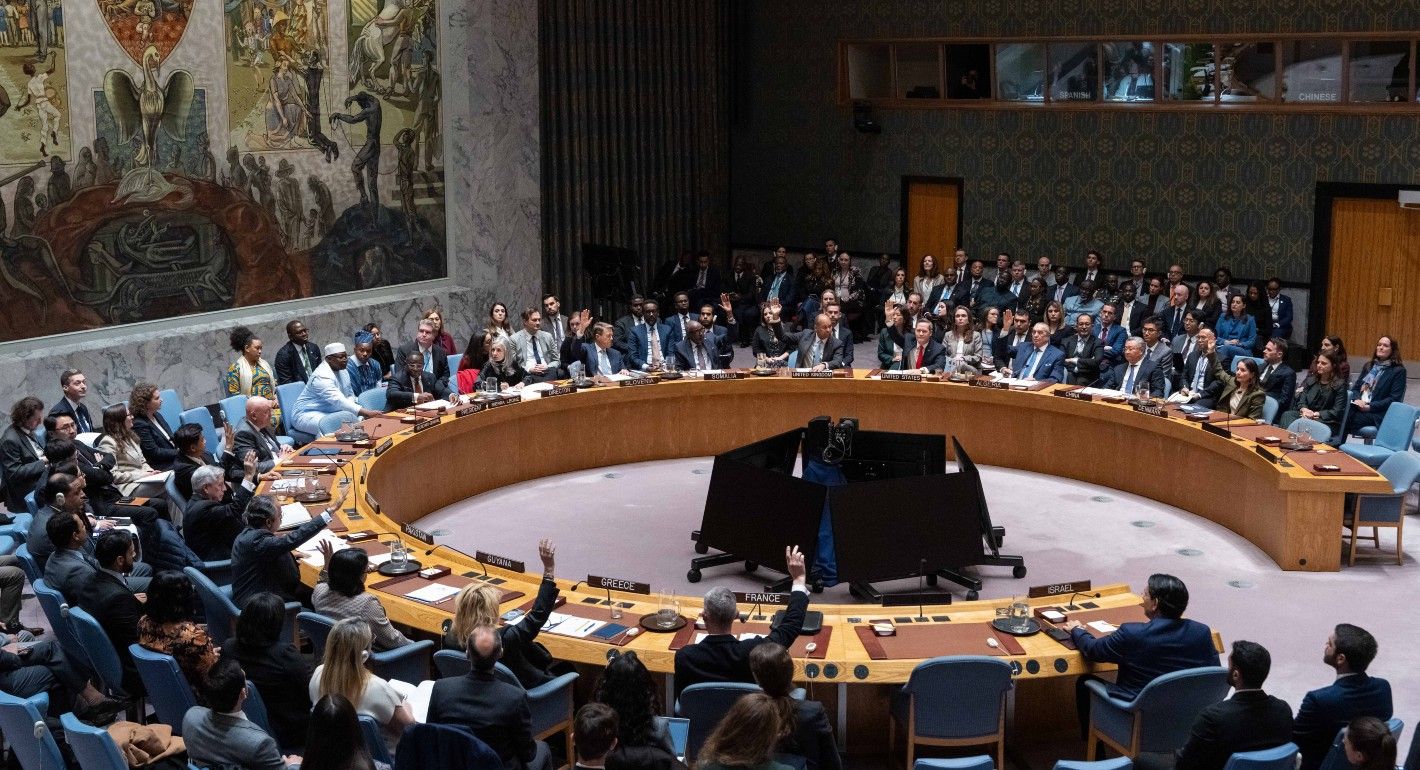
Members of the UN Security Council raise their hands to vote in favor of a draft resolution to authorize an International Stabilization Force in Gaza, on November 17, 2025. (Photo by Adam Gray/Getty Images)
Resolution 2803 legitimizes indefinite Israeli control over Gaza in partnership with the United States and facilitates Israel’s plans to block a Palestinian state.
Last month, the UN Security Council voted to endorse U.S. President Donald Trump’s plan for a permanent ceasefire between Israel and Hamas and, purportedly, to advance a longer-term political settlement between Israel and the Palestinians. The vote was preceded by an endorsement from eight Arab and Muslim-majority states, as well as the State of Palestine (which used the term “welcome” rather than “endorse” and did not attend the vote in the council). While the Trump administration has hailed the resolution and its plan for Gaza as a victory for world peace, human rights organizations and legal experts see it as an affront to international law, legitimizing Israeli control over the entirety of the occupied Palestinian territory in partnership with the United States, thus further enabling Israeli colonization plans.
The first phase of Trump’s plan preceded the council’s endorsement and largely involved allowing humanitarian relief efforts and the exchange of captives. But if the first phase’s implementation is any indicator, Palestinians throughout the occupied territories—in Gaza and the West Bank, including East Jerusalem—are at higher risk of forcible displacement. Already, diplomats based in the region acknowledge that the long-term division of Gaza is likely, and human rights organizations are documenting a military and civilian campaign to drive Palestinians off their land. Against this backdrop, more states are backing out of or qualifying commitments made to contribute troops to stabilize Gaza. Like the Middle East region itself, the international legal order is facing seismic disruptions. A transition from “rule of law” to “rule by law” is taking place, and though weaker parties in the international system will pay a higher price for it, all parties will be impacted for the worse. As the United States leans into illiberalism on the international level, bartering universal principles and human rights for access to humanitarian aid and a reprieve from mass atrocities is likely to become normalized—a reality that makes everyone less safe.
The support in the UN Security Council for Trump’s Comprehensive Plan to End the Gaza Conflict (CPEGC) was resounding. The vote adopting Resolution 2803, thirteen to zero with China and Russia abstaining, was all the more surprising—if not shocking—because the text implicitly embraced the notions that Palestinian access to humanitarian aid and funding for restoration of essential infrastructure in Gaza could be conditioned and that Palestinian governance and self-determination could be subject to agreements among foreign powers in consultation with the occupying power, Israel. The first operative paragraph is the only one with immediate, practical effect, providing council imprimatur for the CPEGC; it “endorses” the plan without qualification, “acknowledges” (incorrectly) that “the parties” had agreed to the terms (without naming who the parties were) and “calls” for implementation of the plan “in its entirety.” Hamas, like Israel, only explicitly accepted the first phase of the CPEGC, which involved the cessation of hostilities, exchange of captives from both sides, and surge of humanitarian relief to Gaza. Hamas as well as virtually all Palestinian political factions and Palestinian civil society organizations writ large have issued statements strongly opposing the second phase of the plan and/or the UN resolution endorsing it.
The remainder of the resolution largely repeats the terms in the plan while using aspirational language regarding the role to be played by third parties who are “authorize[d]” and “encourage[d]” to participate in implementation. A so-called Board of Peace will oversee governance, security, humanitarian relief, reconstruction, Palestinian Authority (PA) reform, and “all operational activities” conducted in Gaza until December 31, 2027, at which time the Security Council may renew its mandate. All Palestinian political factions are specifically excluded from participating in any of the operational activities inside Gaza, including the envisaged Palestinian administrative committee that will be responsible only for the delivery of municipal services. The Trump-headed transitional governance body, in consultation and cooperation with Israel, is tasked with deciding if and when the PA may take over Gaza. The West Bank and the PA’s future there are not mentioned in the UN resolution or the CPEGC, except to say that the PA must make an unspecific number of reforms and comply with Trump’s 2020 peace plan, which provided that the Palestinian leadership must cease actions for legal accountability in judicial forums against Israel—a power neither the Palestine Liberation Organization nor the PA possesses. A “credible pathway for Palestinian self-determination and statehood” may be possible at some point in the future only if the PA proves to Israel’s satisfaction that it can govern “securely and effectively.” At that time, the United States will initiate a dialogue for “Israel and the Palestinians to agree on a political horizon.”
The contour of the International Stabilization Force (ISF) envisaged in the resolution and the CPEGC is not a peacekeeping endeavor. The apparent aim is to subdue all Palestinian armed resistance and the potential for it. The ISF will work in close cooperation with Israel and Egypt, alongside a vetted Palestinian police force, to secure the borders, demilitarize the enclave, and disarm militias. Israeli forces will only withdraw from Gaza based on benchmarks and conditions that Israel will have final say over as it maintains overarching security control over the enclave.
While the resolution is vague on the subject of humanitarian aid delivery beyond “underscor[ing]” its importance, the CPEGC provides that neither Hamas nor Israel should interfere with access to aid, which will be executed pursuant to the same mechanism in place during the January 2025 six-week ceasefire that included the opening of the Rafah crossing with Egypt and the entry of at least 600 trucks of aid per day.
While the United States has blocked many UN Security Council resolutions condemning Israeli actions and asserting the applicability of international law in the past (see figures 1 and 2), UN Security Council Resolution 2803 may represent the first time the United States has instrumentalized the council to facilitate Israeli illegality.
This ought to give those who care about international law and human rights pause. The Security Council’s endorsement of the CPEGC stands in stark contrast to the series of binding legal decisions and advisory opinions—authoritative statements of international law—decided by the International Court of Justice (ICJ) between 2024 and 2025. These include the following rulings and determinations.
In July and September, the UN hosted a high-level conference co-chaired by Saudi Arabia and France with the aim of supporting Palestinian statehood and encouraging states that had yet to do so to recognize the State of Palestine. (Today, 157 out of 193 do so, representing more than 80 percent of UN membership.) One outcome of the convenings was the signing of the New York Declaration (also endorsed by the UN General Assembly), which called on third states to take “collective action” for the “effective implementation of the two-state solution.” All eight Arab and Muslim-majority countries that endorsed the CPEGC are signatories to the declaration. The declaration stressed that these measures should be timebound, pursuant to an action plan, and consistent with international law, UN resolutions, and ICJ rulings “to help realize the right of the Palestinian people to self-determination and to counter the illegal settlement policy in the occupied Palestinian territory, including East Jerusalem, and policies and threats of forcible displacement and annexation.”
It is impossible to reconcile the ICJ rulings and the New York Declaration on the one hand with the CPEGC and the UN Resolution on the other. Unease was apparent in the explanatory remarks of many of those Security Council members voting in favor of the resolution, particularly Algeria, France, Pakistan, Guyana, and Sierra Leone, the latter three of whom are also members of the UN Committee on the Exercise of the Inalienable Rights of the Palestinian People. The diplomats of these states explained that Arab stakeholders and the “Palestinian Authority at the highest level” supported the Trump plan and that U.S. engagement presented the only hope for a lasting ceasefire to take hold. They expressed hope that rights-respecting implementation of the plan had the potential to cure infirmities in the text and pointed to specific provisions in the UN-backed plan, annexed to the Security Council resolution, that prohibit either forced displacement of Palestinians or Israel’s annexation and occupation of Gaza, while also calling for Israeli troop withdrawal from the enclave. Sierra Leone, in particular, reminded council members that the body lacks the power to legitimize actions that are illegal under international law, noting that the right to self-determination is a preemptory norm from which there is no derogation. It added that the council is duty bound to “operationalize that right, not to postpone or dilute it.” In a clear attempt to clarify the Security Council endorsement and calibrate the CPEGC toward international legitimacy, the UN General Assembly overwhelming passed a resolution mandating Saudi Arabia and France to follow up on the objectives of the UN high-level conference and the commitments states made in the New York Declaration.
Stakeholders who had indicated their support for the CPEGC face a dilemma. Where the proponents of international legality—the ICJ and endorsers of the New York Declaration—define the problem that needs addressing as prolonged Israeli occupation and colonization of Palestinian land, the Trump administration and the Security Council contend that Palestinian radicalization is the principal issue. And where the former camp calls for actualizing Palestinian self-determination and sovereignty, the latter’s initiative, if implemented, would legitimize continued Israeli occupation, enable continued settlement construction, and sanction the notion that an occupied people may be forced to concede rights to foreign powers through coercion, something that is prohibited under international humanitarian law.
Why did those actors endorsing international legality as set out in the New York Declaration within days express support for a deeply flawed Security Council resolution? While each country has its own bilateral relations with the very transactional Trump administration, which undoubtedly informed the decisions, the reality is that the United States is the only stakeholder with sufficient influence over Israel to stop the war on Gaza and end what the UN commission of inquiry determined is a genocide. Trump’s plan constituted the only available mechanism for ending the suffering and stabilizing the situation on the ground.
Despite being ensconced within a Security Council resolution and widely endorsed, the CPEGC has little chance of being implemented with meaningful international support—and that is likely by Israeli design, not by accident. To participate in a plan that on paper is so fraught, stakeholders would require certain guarantees to prevent them from becoming complicit in war crimes and crimes against humanity. States have demanded a clearly defined political objective—Palestinian sovereignty and statehood—and the withdrawal of Israeli troops from Gaza backed up by the United States. Israel is absolutely opposed to both, and neither appears forthcoming anytime soon.
The Israeli prime minister explicitly promised to oppose Palestinian statehood only days before the vote on the Security Council resolution, echoing the Israeli Knesset, which in July 2024 overwhelmingly passed a declaration ruling out a Palestinian state anywhere west of the Jordan River. Trump has also been noncommittal and evasive, refusing to comment after the signing of the CPEGC in Sharm El Sheikh on whether he supported a Palestinian state, saying only “we’ll have to see.” Most stakeholders—including Saudi Arabia, which Trump is keen to see normalize with Israel, and the United Arab Emirates, which normalized relations with the Jewish state in 2020—have indicated that they will not be involved in either funding or contributing troops inside Gaza so long as the PA is excluded and the political horizon is undefined and subject to Israel. Even Azerbaijan, a major recipient of weapons from and supplier of energy to Israel with deep bilateral cooperation that only increased after October 7, 2023, is not planning to move forward with contributions of troops for the ISF in the current situation.
Given how poorly the first phase of the CPEGC has been executed, stakeholders are losing confidence in the prospects for a phase two. Since the ceasefire started on October 10, Israel has violated it hundreds of times in myriad ways. More than 300 Palestinians have been killed in Israeli airstrikes. Only around a quarter of the agreed aid under the ceasefire is entering Gaza, and Israel is still refusing to open all the crossings despite the terms of the CPEGC. And while the terms of the CPEGC and the UN resolution were being negotiated, Israel divided Gaza into two separate areas: a “red zone” where extreme deprivation is likely to persist and where almost all Palestinians have been forcibly relocated, and a “green zone,” constituting as much as 58 percent of the territory, where Israel is currently engaged in destroying the remaining housing stock and infrastructure so that plans for a so-called New Gaza can begin. Thus far, plans for rebuilding Gaza are going forward only in the Israeli-controlled green zone, where Israel intends to confiscate private Palestinian property for “safe communities” while most of the property owners will continue to live in a super camp in the red zone without essential infrastructure.
According to the BBC’s recent review of satellite imagery, Israel has destroyed more than 1,500 buildings in the parts of Gaza it currently controls since the ceasefire began. U.S. military planning documents viewed by the Guardian indicate that the mandate for the ISF may be shifting: It was envisaged as replacing the Israeli army inside Gaza, but now it may work alongside it inside the Israeli-controlled green zone only.
In the red zone, humanitarian supplies for Palestinians will continue to be run by the Israeli military administration responsible for the occupied territories. The humanitarian operations of the Board of Peace will be integrated into Israeli military systems; like the ISF, the board will not replace Israeli control. In addition, the same private military contractor, UG Solutions, that supplied mercenary forces for the much-criticized Gaza Humanitarian Foundation, which resulted in hundreds of desperate Palestinian aid seekers being killed in what the UN described as a “death trap,” is currently recruiting candidates to provide security at new distribution sites along the invisible “yellow line” separating the green and red zones.
European and Arab stakeholders currently involved in the U.S.-led Civil-Military Coordination Center, located inside Israel and mandated with facilitating humanitarian relief in Gaza during the ceasefire until the U.S.-led Board of Peace is supposed to take over, have raised legal and moral questions about what is taking place in the Israeli-controlled green zone. And as Israel prosecutes an ethnic cleansing campaign in the West Bank and extrajudicial killings on camera, more and more stakeholders must be concerned about providing material support for implementation of the CPEGC, which plays directly into the hands of a “Greater Israel” agenda in the West Bank. According to a retired Israeli general speaking about settler violence against Palestinians and their property, Israel has given “Jewish terrorism complete freedom of action” with its “explicit policies on one hand and silence on the other.”
Though many states justified their endorsement of the CPEGC on the hope and belief they could influence implementation, given the need for funding and boots on the ground from the United States, they may have failed to fully appreciate how Israel’s involvement in drafting the CPEGC, its commitment to its stated policies, and its actions in Gaza and the West Bank would prevent that. From Israel’s perspective, the real benefit of the Trump plan and the Security Council endorsement was not the return of Israeli captives, something that few believe the government ever prioritized; it was that the plan helped to relieve the intense international pressure to impose sanctions on Israel and secure accountability against its leaders. Debates about the legal obligation of states to arrest Israeli officials indicted by the International Criminal Court have now given way to discussions about how to support implementation of the CPEGC. And states that were considering sanctions or downgrading relations with Israel are now backing away, purportedly to enable Gaza’s reconstruction. Germany was quick to remove its partial arms embargo on Israel despite the continued Israeli airstrikes on Gaza since the purported ceasefire began.
Without third-party engagement and with the United States as its partner, Israel can divide Gaza, continue to create conditions in Gaza to force Palestinians to leave, and escalate tactics in the West Bank to force Palestinians there to move to smaller, more controllable areas where emigration will also become incentivized. An ICJ-adjudicated illegal occupation and colonization project has now been rebranded as a UN-sanctioned, U.S.-led enterprise for the benefit of international peace.
As it becomes more and more apparent that the CPEGC cannot be implemented in a manner consistent with international law, regional stakeholders and others will have a choice to make: Do they stand back and watch the disastrous results play out on the ground and further destabilize the region, with all that means for international peace and security? Or do they reengage as a coalition of the willing with the New York Declaration and its call for effective state and collective measures? In this fluid, highly transactional geopolitical moment, states will have to balance their immediate interests against an illiberal international future in which prohibitions on the use of force and territorial conquest stand on shaky ground and respect for human rights is deprioritized, making everyone less safe.
The author would like to thank Charles Johnson for research assistance and compiling data for the figures.
Senior Fellow, Middle East Program
Zaha Hassan is a human rights lawyer and a senior fellow at the Carnegie Endowment for International Peace.
Recent Work
Zaha Hassan
Zaha Hassan, Charles H. Johnson
Carnegie does not take institutional positions on public policy issues; the views represented herein are those of the author(s) and do not necessarily reflect the views of Carnegie, its staff, or its trustees.

Russia’s AI-driven propaganda campaigns operate in a fragmented, chaotic, and often illogical manner. That’s not necessarily a problem for the Kremlin, though: It’s much easier to mimic genuine public debate that way.

Ilya Klishin

While the EU and European governments are embracing the much-lauded middle-power moment, this entails three difficult conundrums.

Richard Youngs

Europe is facing rising populism internally as well as external pressures from Russia, China, Turkey, and the United States.

Dimitar Bechev

Policy proposals on sovereign debt must both match the scale of the challenge and be implementable within existing political constraints.

David McNair

The acknowledgment has sparked fears of a new arms race with China and Russia.

Chris O’Meara