

Paper
America’s foreign-policy objectives have grown more demanding while Americans have demanded greater focus on their own affairs.
Stephen Wertheim
Source: Getty
Most Americans believe the United States is declining in global power and influence, and nearly two-thirds say China’s power now equals or exceeds that of the United States.
Most Americans believe the United States is declining in global power and influence, and nearly two-thirds say China’s power now equals or exceeds that of the United States, according to a nationally representative poll designed by Carnegie Endowment for International Peace scholars.
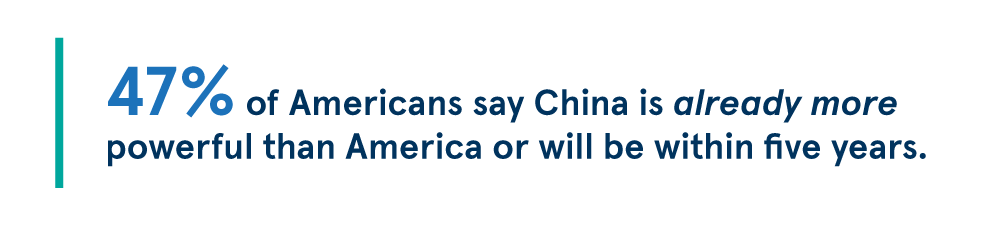
A majority of the Americans surveyed thought the United States is one of several powerful countries rather than the most powerful nation. Nearly three-quarters expected China to overtake the United States in power and influence at some point. Almost half, 47 percent, said China has already surpassed the United States or will do so within the next five years.
Respondents wanted the United States to be a formidable power in almost every world region. If China overtook the United States in power and influence, they would view that development negatively. At the same time, a solid majority—62 percent—said their lives would not get worse if China gained more power than the United States. This striking finding casts doubt on whether the American public would be willing to bear significant costs to maintain a power position superior to China’s.
Very few of the Americans polled said U.S. global power and influence was unimportant to them. Millennial and Gen Z respondents, however, were less fervent and more ambivalent about the value of American power than older generations. Meanwhile, Democrats were more likely than Republicans to see the United States as one of multiple powerful nations and as being in decline. Most Democrats thought their lives would not get worse if China surpassed the United States in power and influence, whereas most Republicans thought their lives would get worse.
This article breaks down the findings in two sections. First, it reports how respondents gauged the amount of power the United States possesses in the world. Second, it shows how they judged the importance of American power.
In appraising the power and influence that the United States possesses, a solid majority of respondents believed their country is no longer in a category of its own. When asked whether the United States is the world’s most powerful and influential nation or one of several such nations, only 41 percent chose the former as better representing their view, and 59 percent chose the latter (see figure 1). By an 18-point gap, then, respondents said that several other countries have a level of power and influence similar to the United States’.
The responses to this question diverged sharply by party affiliation. Most Democrats, 71 percent, saw the United States as one powerful country among others. By contrast, most Republicans, 61 percent, took the opposite view, saying that the United States is the single most powerful nation. (see figure 2).
This finding suggests that U.S. President Donald Trump and former president Joe Biden have not been well aligned with their respective party rank and file. Trump has sometimes spoken of the United States as the dominant global power, but he has more frequently claimed that the United States is “crippled” and even akin to a “Third World country.” After taking office last year, Secretary of State Marco Rubio stated that the United States faced “a multipolar world, [featuring] multi-great powers in different parts of the planet.” But in the survey, a majority of Republicans said the United States stands above all other nations in power and influence.
For his part, Biden asserted that the United States was “the indispensable nation” that “holds the world together.” This claim seems out of step with the more modest appraisal of American power offered by a large majority of Democrats.
In addition to viewing the United States as one powerful country among others, most survey respondents said the United States is declining in relative power (see figure 3). In other words, they believed the unipolar moment is not coming back. A slight majority, 54 percent, agreed that the United States is becoming less powerful in the world. Far fewer respondents, 28 percent, disagreed, implying that they believed the United States is either maintaining or strengthening its power position.
Again, Republican and Democrats gave divergent answers. Far more Republicans than Democrats rejected the view that the United States is becoming less powerful (see figure 4). Approximately half of Republicans disagreed, with 29 percent disagreeing strongly. Nonetheless, despite the partisan variation, the consensus was that U.S. global power is waning.
Strikingly, nearly two-thirds of respondents said China currently matches or exceeds the United States in power and influence globally (see figure 5). In addition, that question surfaced a significant difference by gender: More women (71 percent) than men (58 percent) thought China was as powerful as or more powerful than United States.
Even larger numbers of Americans envision China overtaking the United States in the future. When asked how long it would take for China to surpass the United States, respondents gave varied timelines: 47 percent believed China has already surpassed the United States or will do so within the next five years, 27 percent said the power transition would take longer, and only 26 percent said China will never catch up (see figure 6).1 By a three-to-one margin, then, Americans envision China overtaking the United States in power and influence at some point.
Respondents viewed technology as the single largest area of advantage for China. When asked about the dimensions of power in which China has the advantage, 63 percent said China has a technological advantage over the United States (see figure 7). Notably, 74 percent of Democrats, 62 percent of independents, and 52 percent of Republicans agreed on this subject, implying that there is a consensus across the political spectrum that China is in a strong position technologically (see figure 8). While Americans seem to have internalized China’s status as a technologically sophisticated power, it remains unclear whether they view China as indigenously innovative or simply imitative of the United States.
Some respondents, although not a majority, perceived China as having an edge in other domains as well. For example, 42 percent thought China holds an economic advantage. On the other hand, most respondents believed China has not surpassed the United States militarily.
A majority in all age groups maintained that the United States is only one of several influential nations. Yet generational splits were evident (see figures 9–11). Americans under the age of 65 were more likely than their elders to view the United States as one of multiple powerful nations rather than the single most powerful. Twenty-five percent of Americans ages 18 to 29 believed that China has more power and influence than the United States, compared to just 12 percent of Americans ages 65 and above. Still, most older Americans said China’s power equals or exceeds the United States’.
The survey found no evidence that the American public has stopped wanting the United States to have power and influence abroad (see figure 11). Three-quarters of respondents said it is either very or somewhat important to them that the United States has power and influence around the globe. Furthermore, 48 percent said that U.S. global power is very important. By contrast, the number of respondents who said U.S. global power is somewhat or very unimportant was vanishingly small, at 9 percent.
This result does not necessarily imply that Americans place high importance on the United States remaining or becoming the single most powerful nation in the world. Given that a majority said the United States is currently one of several powerful countries and expected China to surpass the United States at some point, some respondents who value U.S. power and influence may be satisfied with a less-than-preeminent role for the United States.
A large majority of respondents judged U.S. power and influence to be important in every region that has been a focus for U.S. foreign policy since the end of the Cold War—the Americas, Asia, Europe, and the Middle East (see figure 12). Only in the case of Africa did less than 30 percent of respondents say that U.S. power and influence is very important, and even so, a total of 58 percent ascribed importance to U.S. power in Africa.
Despite intense debate in Washington about how the United States should set priorities among key regions, respondents identified only North America, home of the U.S. mainland, as being more important than the others. The Trump administration is currently placing new emphasis on Central and South America, where it has conducted military operations against Venezuela and alleged narcotics trafficking boats, but poll respondents attributed a similar level of importance to Central and South America as to regions outside the Western Hemisphere.
In addition, many foreign policy experts view Asia as the most important overseas region for U.S. power and influence, because China stands alone as the only peer competitor to the United States in most dimensions of national power. Yet among respondents, Asia did not stand out. Respondents deemed U.S. power and influence in Asia to be important by roughly the same margins as Central and South America, Europe, and the Middle East. Thirty-five percent said U.S. power and influence in Asia is very important, compared with 39 percent for the Middle East, 36 percent for Europe, and 35 percent for Central and South America.
Even as the Trump administration attempts to shift defense burdens onto European allies, respondents placed a high importance on U.S. power and influence in Europe. Republicans ascribed slightly more importance on U.S. power in Europe than did Democrats or independents: 79 percent of Republicans said U.S. power in Europe was important, whereas 73 percent of Democrats and 69 percent of independents did the same (see figure 13).
This result may indicate that the Trump administration is placing less importance on Europe than the Republican rank and file does. However, because the poll did not ask how the United States should organize or exercise power and influence in each region, respondents who said that U.S. power in Europe is important may still favor greater European efforts to manage their conventional defense; these positions do not necessarily contradict each other. Likewise, it is unclear whether Republican respondents would support or oppose the 2025 National Security Strategy’s controversial stance of “cultivating resistance to Europe’s current trajectory within European nations.”
Even though a majority of respondents placed importance on U.S. global power and influence, 54 percent said their lives would be unaffected if China were to outmatch the United States in global power (see figure 14). Combined with the small number who thought their lives would improve, a total of 62 percent judged their lives would not get worse if China gained more power than the United States.
Of the respondents who said their lives would get worse, most expected their lives would become only somewhat rather than much worse. In all, just 14 percent answered that China surpassing the United States would make their lives much worse. This result indicated that very few Americans viewed the potential eclipse of the U.S. power position by China as being catastrophic, suggesting that the general public would not want to endure major financial, military, or other costs to prevent such an outcome.
This finding reinforces an April 2025 Pew Research Center survey, which showed that the American public was becoming somewhat less adversarial toward China. That survey revealed that only one-third of Americans viewed China as an enemy, as opposed to a competitor or partner, down from 42 percent in the previous year.
Respondents again displayed a partisan split for this question. Republicans were 18 percentage points more likely than Democrats to say that their lives would become much worse if China overtook U.S. power (see figure 15). Overall, a narrow majority of Republicans thought their lives would be worse, whereas a strong majority of Democrats thought their lives would not be worse.
Partisan differences regarding China’s rise have persisted across presidencies. In 2023, for example, a survey by the Chicago Council on Global Affairs found that 71 percent of Republicans viewed the development of China as a world power as a “critical threat to the vital interest of the United States,” whereas only 52 percent of Democrats and 53 percent of independents did the same.
Still, nearly half of Republicans in Carnegie’s poll said their lives would be the same or better if China surpassed the United States in global power. The split between concern and ambivalence within the Republican base is reflected in the second Trump administration’s vacillating approach to China; Trump may sense that he has political space to cast China in less threatening terms than during his first presidency.
Americans under 45 placed somewhat less importance on U.S. global power and influence than their older counterparts did. Whereas a majority of Americans 45 and older, or 56 percent, deemed U.S. global power to be very important, only 38 percent of both Millennials and Gen Z had the same judgment (see figure 16). Those younger cohorts were correspondingly more likely to view American power as somewhat important or neither important nor unimportant. In sum, the Millennial and Gen Z generations differed from their elders mainly in being less fervent and more ambivalent about the value of American power. Still, very few said U.S. power was positively unimportant.
Notably, younger Americans were less likely than older Americans to emphasize Asia as an important region for U.S. power and influence (see figures 17 and 18). Even though Asia has overtaken Europe as a center of global GDP over the past three decades, respondents in the 18–29 and 30–44 age groups ascribed similar levels of importance to U.S. power and influence in Asia and Europe and lower levels than their older counterparts did. For example, whereas 79 percent of Americans 65 and over considered U.S. influence in Asia to be important, only 56 percent of Gen Z respondents and 63 percent of Millennials took this view.
Younger respondents were considerably less likely than older respondents to expect their lives to get worse if China were to surpass the United States in global power (see figure 19). Whereas 52 percent of Americans 65 or older said their lives would get worse, just 27 percent of Americans ages 18 to 29 thought the same. The trend line was consistent: As each cohort got younger, respondents became less inclined to say their lives would be made worse by China outmatching the United States. Perhaps because younger Americans have lived more of their lives in a world with a strong China, they seem less concerned about China’s rising power.
The data analyzed in this article are from an original online survey of a nationally representative sample of 1,500 adults ages 18 and older. The survey was designed by scholars at the Carnegie Endowment for International Peace and conducted by polling firm YouGov between November 24 and December 1, 2025. The overall margin of error (adjusted for weights) is plus or minus 2.96 percent.
This research was conducted as part of Carnegie’s project on the Future of American Power, which is part of Carnegie’s Beyond Disruption initiative. This initiative aims to meet the moment by looking ahead to develop a realistic and constructive vision for the future of world order and its architecture, institutions, and power dynamics.
What is the future of American power? The United States commands extraordinary resources across every dimension of national power, yet in recent years it has struggled to achieve many important foreign policy aims. This paradox raises a key question for Americans and the world: What can the United States actually do with the power it has? Our project examines not just the quantity but the qualities of American power, assesses the degree to which it is eroding, and asks how the United States might use the power it has to better effect.

Senior Fellow and Director, American Statecraft Program
Christopher S. Chivvis is the director of the American Statecraft Program at the Carnegie Endowment for International Peace.

Senior Fellow, American Statecraft Program
Stephen Wertheim is a senior fellow in the American Statecraft Program at the Carnegie Endowment for International Peace.
Liana Schmitter-Emerson
Former James C. Gaither Junior Fellow, American Statecraft Program
Liana Schmitter-Emerson was a James C. Gaither Junior Fellow in the Carnegie American Statecraft Program.
Carnegie does not take institutional positions on public policy issues; the views represented herein are those of the author(s) and do not necessarily reflect the views of Carnegie, its staff, or its trustees.

America’s foreign-policy objectives have grown more demanding while Americans have demanded greater focus on their own affairs.
Stephen Wertheim
Smaller powers cannot go it alone, but Canadian history shows that integration with the United States will not always be benign.
Paul Samson
Soft power on its own is insufficient to meet U.S. national security needs, but hard power also has its limits. Soft power allows for more effective and efficient use of hard power than hard power alone, as it encourages cooperation and compliance which deters the need for hard power.

Sarah Yerkes
Washington needs to recognize that influence in the Western Hemisphere comes from presence, delivery, and reliability. It also must recognize that while the United States remains the key external actor, it no longer operates in a permissive environment and cannot presume deference from regional players who have other options, namely China.
Juan S. Gonzalez
Chinese strategists are once again debating whether American power is declining and whether U.S. hegemony is experiencing irreversible decay.
Wu Xinbo