

Commentary
Despite public disputes over trade and immigration, the strategic partnership’s foundations remain sturdy.
Sameer Lalwani
Source: Getty
The conventional narrative of the second Trump administration simply repudiating multilateralism is incomplete. The record to date is far more mixed and varies across issue areas and institutions.
The second administration of U.S. President Donald Trump has unleashed an assault on the world that America made, abdicating U.S. leadership of an open, rule-bound international system.1 Whereas his predecessors invested in and supported multilateral institutions and alliances, Trump largely dismisses these as a hindrance to the untrammeled exercise of U.S. power, the pursuit of relative advantage, and the rights of Americans. He has adopted a more transactional posture, leveraging U.S. global dominance to advance short-term national interests and defend against alleged incursions on U.S. national sovereignty. Consistent with this view, his administration has withdrawn from or reduced support for multiple international organizations, treaties, and initiatives perceived to be at odds with its “America First” agenda. He has also rejected any international legal limits on the use of U.S. military force, most obviously in Iran.2
This earthquake has weakened the already shaky pillars of world order, and the tremors are ongoing. Long-standing U.S. allies and partners increasingly mimic the “fence-sitting” of emerging and middle powers by diversifying their diplomatic portfolios and securing themselves against an unpredictable United States.3 The beleaguered United Nations, which, for all of its flaws, remains the bedrock of the multilateral system, has fallen deeper into crisis, raising fears that it could even go the way of the League of Nations.4 Liberal internationalists lament each new U.S. budget cut, institutional withdrawal, or rhetorical slight as another toll in the death knell of the multilateral order.
This sense of disquiet and loss is understandable. The United States—which served as the main architect, contractor, underwriter, and guarantor of the post-1945 system—appears at times to be taking a sledgehammer to the legal and institutional scaffolding of international cooperation it helped to construct. Yet, as Canadian Prime Minister Mark Carney stated at Davos in January, “nostalgia is not a strategy.”5 Responding to the current moment requires moving beyond elegy to grapple with the why, what, how, and so what of this revolution in U.S. foreign, economic, and national security policy.
Such an assessment begins by acknowledging two truths: First, the multilateral system has long been burdened by chronic weaknesses, including bureaucratic inefficiency, collective inaction, mediocre performance, and ample hypocrisy. It is reasonable and indeed imperative for multilateral institutions to account for delivering on their stated goals and advancing the collective purposes of their member states, not least those of their dominant member. Second, the United States has always been ambivalent and selective in its commitment to multilateralism, given its desire to preserve freedom of action, its sensitivity to perceived sovereignty losses, its extensive unilateral and bilateral alternatives, and its unique Constitution, which places high legislative hurdles to assuming international obligations (particularly in the case of treaties).6
What sets the Trump administration apart from its predecessors is the intensity of its antipathy. It is distinctive in its exaggeration of multilateralism’s shortcomings and its appetite for disruption in addressing them.
From the moment Trump returned to office, his administration had multilateralism in its sights.
From the moment Trump returned to office, his administration had multilateralism in its sights. Several themes quickly became apparent: an antagonism toward any perceived infringements on U.S. sovereign prerogatives; an insistence on more equitable burden-sharing within international organizations; a “back-to-basics” push to strip international organizations of perceived mission creep, including on climate and gender issues; a deliberate shift toward bilateralism, not least on trade, to extract concessions in one-on-one bargaining; and a preference for targeted, conditional funding over general budget support, to reduce the discretion of international bureaucracies.
In sum, the administration’s animating impulses have been sovereigntist, transactional, ideological, and leverage focused. A recurrent refrain is that generations of “American foreign policy elites” have led the United States astray by pursuing a “globalist” agenda at odds with U.S. interests and identity. According to the administration’s National Security Strategy, the U.S. foreign policy establishment “lashed American policy to a network of international institutions, some of which are driven by outright anti-Americanism and many by a transnationalism that explicitly seeks to dissolve individual state sovereignty.”7 There is no hiding that the administration harbors a degree of hostility toward the multilateral system, at least as we know it today.
That said, the conventional narrative of the second Trump administration simply repudiating multilateralism is incomplete. The record is more complicated, has evolved since January 2025, and varies across issue areas and institutions. The administration’s behaviors toward multilateralism and international organizations can be sorted into four broad categories, which might be labeled disengagement, disruption, substitution, and conditional continuity. Or, for the more alliteratively minded: retreat, rebellion, replacement, and reform.
In some settings, the United States is indeed defecting from the old order it helped to build. In other contexts, it is exercising leverage to disrupt existing bodies and reconfigure the terms of U.S. participation. In still others, it is experimenting with alternative arrangements, creating new frameworks that operate outside of or alongside inherited multilateral institutions. Finally, in ways that receive less attention, the United States is in some instances doubling down on multilateral institutions, while trying to narrow their mandates or reform their functions to advance America First preferences.
Importantly, these behaviors are not mutually exclusive. The administration sometimes pursues these approaches in parallel within the same institution. The overall result is less a policy of pure hostility or exit but a more selective, transactional, and ideologically conditioned form of multilateral engagement.
Disengagement has been the most headline-grabbing dimension of the administration’s posture. At its core, it reflects a deliberate effort to withdraw from—or sharply curtail participation in—multilateral institutions and agreements deemed costly, constraining, or misaligned with America First priorities. In practice, this has ranged from loud formal treaty exits to quieter reductions in diplomatic engagement and funding. The common thread in such defection or retreat is a willingness to accept reduced influence, even if this means ceding ground to China or other competitors.
On inauguration day, Trump signed executive orders initiating withdrawal from two institutions he had sought to exit in his first term, but which Joe Biden had later rejoined: the Paris Climate Agreement and the World Health Organization (WHO). He also pulled the United States out of the Organization for Economic Cooperation and Development’s global minimum corporate tax agreement. The White House portrayed the tax arrangement as a discriminatory infringement on U.S. sovereignty and the climate accord as a “rip-off” that damages the American economy.8
The administration justified its WHO withdrawal by citing the organization’s alleged mismanagement of the COVID-19 pandemic, insufficient commitment to institutional reform, political bias (by which it means Chinese influence), and disproportionate financial burdens borne by the United States.9 The withdrawal process, completed on January 22, 2026, has deprived the body of its largest donor.10 The United States also owes hundreds of millions of dollars in unpaid mandatory contributions to the organization for 2024–2025. Facing immense operational strain, the WHO has initiated plans to slash roughly one-quarter of its workforce and consolidate its ten divisions into four.11 China, which is now set to replace the United States as the WHO’s top state donor, has pledged an additional $500 million to the organization over the next five years to help fill the funding gap—a roughly forty-fold increase over its previous annual voluntary contribution of $2.5 million in 2024–2025.12 This shift in funding, of course, will entrench the very Chinese influence that the Trump administration fears.
Beyond the WHO, the administration froze U.S. funding for the UN Relief and Works Agency for Palestinian Refugees in the Near East, terminated U.S. participation in the UN Human Rights Council, and initiated a review of U.S. membership in the UN Educational, Scientific, and Cultural Organization (UNESCO)—ultimately leaving UNESCO in July 2025.13 The White House also canceled U.S. funding for the Vaccine Alliance (Gavi), on which the United States lost its board seat amid persistent public questioning by Secretary of Health and Human Services Robert F. Kennedy Jr. about the well-established scientific consensus on vaccines.14 (By spring 2026, Kennedy was holding up $600 million in congressionally appropriated funds for Gavi.)15
These moves presaged a broader ambition. In February 2025, Trump directed Secretary of State Marco Rubio to conduct a sweeping audit of U.S. participation in international organizations and treaties, and to return with recommendations for additional withdrawals .16 Some internationalists worried that this comprehensive review might result in U.S. departure from cornerstone treaties and organizations, including even the United Nations and the Bretton Woods institutions themselves. On January 7, 2026, the White House released a presidential memorandum announcing the findings of its review conducted to date. It directed U.S. withdrawal from thirty-one UN entities and thirty-five non-UN intergovernmental bodies “that no longer serve American interests,” and indeed “undermine America’s independence and waste taxpayer dollars on ineffective or hostile agendas.”17
As it happened, the worst fears of multilateralists proved unfounded. Many of the sixty-six arrangements were modest in size and focused on niche topics, such as the International Lead and Zinc Study Group and the Forum of European National Highway Research Laboratories. The list also included several important bodies, targeted for their focus on allegedly “woke” topics like the environment, gender, and development. Among the most consequential were the UN Framework Convention on Climate Change (UNFCCC), the Intergovernmental Panel on Climate Change (IPCC), the UN Peacebuilding Commission, UN Women, and the UN Conference on Trade and Development.
Still, the culling could have been far more dramatic. The United States did not withdraw from the World Bank and the International Monetary Fund (as called for in Project 2025), or the United Nations itself.18 That said, the administration’s review of U.S. multilateral engagements is ongoing.19 The January 7 withdrawals could turn out to be the zenith of U.S. disengagement. But it is also plausible that the administration is taking more time to chart its next steps vis-à-vis larger, more consequential organizations.
Beyond formal withdrawal, U.S. defection has also taken the form of absence. The administration declined to send any representatives to several major multilateral gatherings in 2025, including the UN Oceans Conference in Nice, France; the thirtieth Conference of the Parties to the UN Framework Convention on Climate Change (COP 30) in Belem, Brazil; and the Group of 20 (G20) summit in Johannesburg, South Africa.20 It also pulled the U.S. delegation in the midst of negotiations at the fourth Financing for Development conference in Sevilla, Spain.21 Going AWOL in these settings has eroded confidence in U.S. global leadership and obviously curtailed U.S. influence in agenda-setting and negotiation on critical issues.
The most striking instance of U.S. disengagement from the multilateral system may be the Trump administration’s blithe dismissal of international legal restraints, particularly UN Charter prohibitions on the use of military force without UN Security Council authorization, or in instances of self-defense.22 The White House and senior administration officials have denigrated international law and ignored it at will, whether in launching an aggressive war against Iran, killing suspected narcotics traffickers without due process, or threatening force to seize Greenland.
To be sure, the U.S. relationship toward international law has long been complicated. Prior administrations have at times pushed boundaries or taken action outside of international legal frameworks. George W. Bush chose to invade Iraq without UN authorization, and his predecessor Bill Clinton engineered NATO intervention in Kosovo without even putting the matter before the Security Council. But both at least attempted to engage with international norms, sought allied coordination (notably through NATO in Clinton’s case), and offered legal justifications: They constructed a coherent case. The Trump administration has been a difference in kind, not merely degree, displaying a blatant disdain for any international legal constraints on U.S. power.
A repeated refrain in the Trump administration’s repudiation of multilateralism, rooted deeply in U.S. history, is the claim that many international organizations and treaties pose a grave threat to the sovereignty of the United States.23 While politically potent, these contentions are grossly exaggerated. The U.S. decision to join an international organization or become party to an international treaty may be wise or unwise. But as long as it is done pursuant to the U.S. Constitution, it is an exercise rather than an abrogation of sovereignty. Moreover, when the United States ratifies a treaty, it typically does so with extensive reservations, understandings, declarations, and other provisos protecting and highlighting U.S. independence. Finally, unlike members of the European Union for some purposes, the United States never accedes to hierarchical arrangements that subordinate it to supranational authorities. In sum, contrary to much America First rhetoric, the notion that multilateralism endangers U.S. sovereignty is a canard.
What multilateralism does imply is some voluntary sacrifice of a country’s notional freedom of action in a particular policy domain, and the acceptance of certain common standards and obligations, in return for reciprocal commitments on the part of other nations. That is in fact the very purpose of multilateral cooperation—and international law, for that matter. Multilateralism thus represents a trade-off between the costs and benefits of autonomy, on the one hand, and those of institutionalized cooperation among many countries, on the other. It is on those grounds that decisions about multilateral withdrawal should be debated.
Alongside defection, the second Trump administration has pursued policies of coercion and disruption within multilateral organizations. Rather than exiting, the United States has often remained inside key forums while leveraging its financial contributions, security guarantees, and other structural advantages, both to torpedo international projects it finds objectionable and to drive multilateral action in directions more congenial to its Make America Great Again preferences.
This approach operates along two complementary tracks. First, the administration uses coercive tools—budgetary pressure, threats of tariffs, and conditional security commitments—to extract concessions from both international organizations and their member states. Second, it relies on procedural obstruction—blocking consensus, vetoing initiatives, and diluting outcomes—to prevent institutional actions that run counter to administration priorities.
The most obvious coercive tool the United States has exercised against multilateral organizations, especially the United Nations, is financial. Since entering office, the Trump administration has refused to pay the vast majority of its assessed, legally binding contributions to the UN’s regular and peacekeeping budget, resulting in a collective $4 billion in U.S. arrears to the world body as of spring 2026.24 Trump’s FY26 budget request called on Congress to slash U.S. contributions to international organizations by 83 percent, from (the pre-recission funding level of) $1.54 billion to only $263.8 million.25 It also zeroed out any spending on the country’s legally binding UN peacekeeping assessments (which had been approved at $1.23 billion in the previous year), citing “disproportionately high” burdens on the United States and “ongoing mission failures.” In late April 2026, the Republican-controlled House Appropriations Committee approved legislation for FY27 that would cut U.S. contributions to international organizations even further—by 77.6 percent from the previous fiscal year. It would also zero out funding for the UN’s regular budget and cut contributions to international peacekeeping by an additional 60 percent.26
There is some method to the Trump administration’s madness. It is trying to pressure Congress to use its power of the purse to force the United Nations to become more focused and streamlined, reversing what senior administration officials perceive as endless expansion of activities and overreliance on U.S. funding. Testifying in late March 2026 at the first-ever congressional hearing held at the U.S. Mission to the UN, U.S. Ambassador Mike Waltz called for deeper UN structural changes, bureaucratic consolidation, and staff cuts to ensure that “every taxpayer dollar is spent responsibly.” The ultimate goal of budgetary discipline, he declared, is a UN that “does less and does it better.”27
These U.S. steps have placed the world body under extraordinary financial pressure, inducing outgoing UN Secretary-General António Guterres to mandate drastic cuts to agency staff and budgets.28 Waltz highlighted a historic 15 percent cut (roughly $570 million) to the UN’s regular budget as well as the elimination of nearly 3,000 headquarters positions, exulting that these would reduce the annual U.S. assessment to the UN’s regular budget by approximately $126 million. While some agency consolidation is clearly warranted, the ultimate outcome of the UN’s across-the-board cost-cutting remains uncertain, since its very abruptness makes it difficult for would-be reformers to differentiate between islands of excellence and forests of dead wood. Even so, Guterres has warned that the United Nations faces the possibility of financial collapse as early as July of this year if the UN’s budget rules are not overhauled, or if member states (chiefly the United States, which accounts for over 95 percent of the overdue payments to the regular budget) do not pay their annual dues.29
For its part, the administration in February 2026 released about $160 million of the $4 billion it owes the UN, promising more funds as the UN implements greater reforms.30 In April, internal memos circulated from Washington to U.S. diplomats in Geneva and New York revealed the Trump administration’s plan to continue withholding its dues to the UN unless the organization agrees to a slate of nine “quick-win” reforms.31 These include overhauling the UN pension system, ending business-class travel for anyone below the undersecretary-general level, reducing the number of UN staff, shifting from human interpreters to AI-powered translation and interpretation tools, and blocking China from channeling tens of millions of dollars to a discretionary fund within the secretary-general’s office every year.
Deploying financial leverage over the United Nations is a well-trodden path for the United States. Both the Kassebaum-Solomon Amendment of 1985 and the Helms-Biden agreement of 1999 conditioned the payment of U.S. dues to the United Nations on budgetary discipline and new burden-sharing arrangements—and both ultimately produced negotiated outcomes largely in line with U.S. preferences. Financial “coercion,” as these examples attest, can produce positive results. Indeed, it is one of Washington’s most powerful levers for effecting change in institutions that may otherwise resist it. But such efforts are most effective when tied to a clear, articulable list of reform demands and carried out in collaboration with other stakeholders and allies with shared concerns. To its credit, the administration is making some progress on the former, albeit months too late. By contrast, it has done little to coordinate its policy with other concerned member states.
Beyond withholding dues, of course, the administration has other coercive instruments at its disposal. One is tariffs, which it has wielded more aggressively and more broadly than any of its predecessors.
Beyond withholding dues, of course, the administration has other coercive instruments at its disposal. One is tariffs, which it has wielded more aggressively and more broadly than any of its predecessors, imposing them on strategic competitors and allies alike to exert its will both in bilateral and multilateral settings. Beyond the sweeping “Liberation Day” measures announced in April 2025, the administration has deployed tariffs for purposes as varied as pressuring Mexico and Canada to stem migration and fentanyl flows, threatening European countries that opposed U.S. designs on Greenland, punishing Brazil over the perceived political persecution of former president Jair Bolsonaro, protecting favored domestic industries such as autos and pharmaceuticals, and, at least by the administration’s logic, attempting to shrink the U.S. trade deficit more broadly (unsuccessfully so far).32
The administration has also carried these coercive tariff tactics into multilateral settings. A prime example is its campaign to torpedo the International Maritime Organization’s net-zero framework. This landmark deal—over a decade in the making and with broad support from both the shipping industry and IMO member states—would have set the first binding greenhouse gas emissions targets for an industry which, were it a country, would rank as the world’s sixth-largest polluter.33 Last October, Trump threatened any country supporting the “Global Green New Scam Tax on Shipping” with an array of penalties.34 These included tariffs, higher port fees for vessels registered to supporting nations, investigations and potential blocking of ships from U.S. ports, visa restrictions on crew members, commercial penalties, and even the sanctioning of officials deemed to be supporting “activist-driven” policies. The pressure worked. Some countries that had voted decisively in support of the measure only a few months earlier either abstained or voted to defer discussion on the agreement. These included several shipping-reliant Caribbean island states vulnerable to U.S. economic coercion such as Antigua and Barbuda, the Bahamas, Haiti, and Jamaica.35
The legal foundation for much of this mercantilist arm-twisting has been the International Emergency Economic Powers Act (IEEPA), a U.S. statute whose deployment for tariff purposes was legally contested from the outset. A February 2026 Supreme Court ruling cast doubt on that foundation and has forced the administration to reconsider its toolkit, potentially requiring a shift toward slower and more procedurally demanding instruments like Section 301 investigations—mechanisms that require formal findings, public comment periods, and more explicit legal justification.36 This would constrain the administration's preferred mode of rapid, unpredictable tariff pressure. Still, it would be unwise to conclude that the coercive trade agenda is spent; the administration has demonstrated consistent creativity in finding legal authorities to support its preferred outcomes, and the underlying political commitment to tariff leverage shows no sign of abating.
On security, the administration’s approach to NATO illustrates a mix of coercion and conditional engagement at its most consequential. Under heavy U.S. pressure, the alliance finally agreed to a defense spending target of 5 percent of GDP by 2035—with Spain the only holdout—a genuine commitment to allied burden-sharing of the sort that U.S. administrations of both parties had sought for decades.37
But this recent U.S. achievement has come at heavy diplomatic cost. Trump has repeatedly implied that Article 5 of the North Atlantic Treaty—the collective defense commitment that is the alliance’s foundational guarantee—is contingent on member states meeting their financial obligations. Most notoriously, he even suggested on the campaign trail in 2024 that he would encourage the Russians to do “whatever the hell they want” to allies that underspend on collective defense.38 More recently, angered by allied reluctance to support U.S. military action against Iran, Trump has floated the possibility of leaving NATO altogether and has considered punitive measures against allies deemed insufficiently supportive of the military campaign against Iran.39 To underscore this threat, Trump in spring 2026 ordered the withdrawal of 5,000 U.S. troops from Germany, shortly after its chancellor characterized the war with Iran as a “humiliation” for the United States.40
Treating Article 5 as a bargaining chip, however, risks jeopardizing something that increased allied spending cannot easily repair—the foundational credibility of the alliance as a mutual defense commitment.41 NATO today is simultaneously better funded and more strategically uncertain than at any point in its history. How that tension will resolve itself is one of the most consequential open questions in international security.
In addition to deploying coercive tools, the United States under Trump has adopted an obstructionist orientation in multiple multilateral venues, including UN forums and agencies. On one level, again, this is nothing new. Other U.S. administrations have at times blocked international initiatives, withheld treaty signatures or ratifications, and sought to dilute outcomes they found uncongenial. What distinguishes the Trump administration is the scale and ideological tinge of its obstructionism, which includes a systematic effort to purge multilateral forums of language and commitments the White House associates with “woke” social agendas, not least with respect to climate and gender.
In March 2025, the U.S. Mission to the UN announced that henceforth it would oppose any UN resolution that mentioned the Sustainable Development Goals (SDGs), a set of ambitious targets unanimously endorsed by UN member states in 2015 to inform global development efforts through 2030. As a U.S. official explained, although the SDGs might be framed in innocuous language, they in fact “advance a program of soft global governance that is inconsistent with U.S. sovereignty and adverse to the rights and interests of Americans.”42 This contention is patently absurd, since the goals are voluntary rather than compulsory and impose no binding legal obligations. They are simply a list of noncontroversial aspirations designed to promote human flourishing.
The apotheosis of U.S. ideological grandstanding to date occurred in March 2026. During the annual conference of the UN Commission on the Status of Women (CSW), the United States forced a vote on the outcome document, typically approved by consensus. Despite intense U.S. resistance, the UN’s Economic and Social Council approved it by a vote of thirty-seven to one (with six abstentions), resulting in a standing ovation and derision at the U.S. stance. In justifying U.S. opposition, the U.S. representative explained, “We could not adopt a draft that included ambiguous language promoting gender ideology, vague, unqualified commitments to sexual and reproductive health that can be interpreted as implying abortion rights and censorship or broad language on regulation of AI, in addition to other concerns.”43 Bethany Kozma, director of global affairs at the Department of Health and Human Services, added, “The United States will not stand idly by and watch as malicious forces misuse multilateral organizations to promote their ideologies and social agendas, obstructing nations’ ability to exercise their national sovereignty.”44
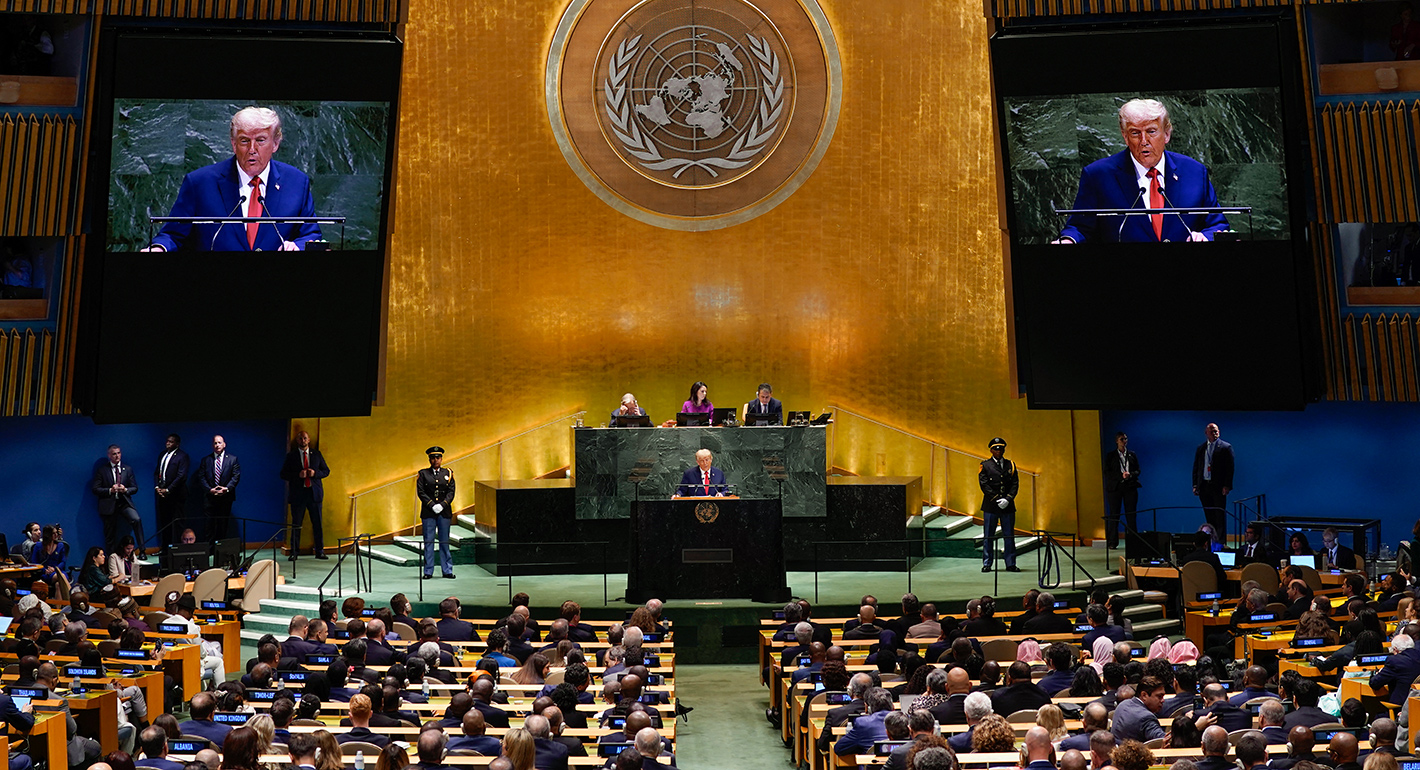
A further illustration came in May, when the United States rejected a declaration by the UN’s International Migration Review Forum—and indeed declined to participate in the forum altogether.45 The declaration’s language was measured: It affirmed that migrants have human rights, while explicitly recognizing nations’ rights to promote the security and prosperity of their communities. The administration’s response was not: A State Department spokesman denounced the UN’s alleged effort to “facilitate replacement immigration,” describing past multilateral migration assistance as having enabled “the invasion of our country” by “millions of foreigners from the worst corners of the world.”46 This was a striking rejoinder to language that would have been regarded as uncontroversial under any previous administration. But it was entirely consistent with the president’s own incendiary accusation, in his September 2025 UN General Assembly address, that “the United Nations is funding an assault on Western countries and their borders,” encouraging and facilitating a global system of mass illegal migration.47
The Trump administration’s disruptive efforts have also extended to the G20. Prior to the U.S. assumption of the group’s rotating chair from South Africa in December 2025, the United States repeatedly sought to undermine consensus in G20 ministerial and working group meetings, refusing to negotiate and objecting to language the administration deemed problematic, including references to the “energy transition,” “equity,” or “universal healthcare.”48 In the run-up to the November 2025 leaders’ level summit in Johannesburg, which the United States boycotted, Trump himself placed heavy pressure on Pretoria and other G20 governments not to adopt a final summit declaration. He failed, as the other members (with the exception of Argentina) endorsed a 122-point statement.49
In a few cases, it should be acknowledged, U.S. procedural disruption has represented (bipartisan) continuity rather than departure. The most obvious case is continued U.S. blockage of new appointments to the Appellate Body of the World Trade Organization (WTO). Barack Obama’s administration was the first to break from tradition in blocking the appointments of an American, and later, a South Korean judge, in an effort to curb alleged judicial overreach and reform the Appellate Body.50 Though the Obama administration ultimately allowed alternative candidates to fill those seats, this weaponization of the consensus-based appointment system laid the groundwork for the first Trump administration’s move to completely block all new judicial appointments beginning in 2017.51 The Appellate Body eventually ground to a halt in December 2019, when it fell below its required three-judge quorum, and that policy of paralysis has continued uninterrupted through the Biden and second Trump terms.52
The administration’s third approach has been to bypass the UN and other legacy organizations entirely and instead establish coalitional arrangements as flexible vehicles for pursuing “America First” priorities and exercising U.S. power. On one level, as with disruption, this parallel approach is nothing novel. Under recent Democratic and Republican presidents alike, the United States has often created bespoke minilateral frameworks that allow subsets of nations to collaborate on global agenda items and escape the lethargy and lowest-common-denominator dynamics of lumbering international bodies.53 Many such coalitions are in practice hub-and-spoke arrangements, with the United States as primus inter pares.
What sets the Trump administration apart from its predecessors is its highly personalized, partisan, and transactional approach to institutional substitution. A prominent example is the Board of Peace, which Trump has periodically depicted not only as a complement to the UN but as a potential replacement. It is also a body in which the United States enjoys the sole veto. The Security Council authorized the board’s creation on November 17, 2025, as part of a resolution (from which China and Russia abstained) endorsing the U.S.-brokered cease-fire in Gaza.54 It is intended to serve as a transitional administration for the territory, establishing the framework and overseeing funding for security, governance, and reconstruction pending the reform of the Palestinian Authority. In January 2026, the White House invited fifty-eight countries to join the board and unveiled its U.S.-drafted charter.55
The charter’s most novel and jarring element pertains to the board’s institutional design, which has little precedent among intergovernmental organizations. Trump—as a private individual—serves as its inaugural chairman and enjoys wide discretion over its decisions and activities. (He can even remain as chairman after he leaves office, if he chooses.) The charter sets a minimum contribution of $1 billion for heads of government to become permanent members of the board’s executive committee, subject again to Trump’s personal approval. In sum, the board is akin to an exclusive country club: Aspiring members must pony up a sizeable initiation fee and curry favor with its president. Call it Mar-a-Lago multilateralism.
Significantly and controversially, the charter frames the board’s mandate well beyond Gaza, describing it as “an international organization that seeks to promote stability, restore dependable and lawful governance, and secure enduring peace in areas affected or threatened by conflict.”56 No mention is made of the UN Charter or indeed the UN Security Council, despite the latter’s centrality to international peace and security. Declaring that “durable peace requires . . . the courage to depart from approaches and institutions that have too often failed,” the board’s charter underscores “the need for a more nimble and effective international peace-building body.”57
Such sweeping language has alarmed those who worry the Board of Peace could undermine UN-based international cooperation and accelerate global fragmentation. Trump has reinforced these anxieties, by suggesting that it “might” replace the UN.58 (For his part, French Foreign Minister Jean-Noël Barrot has said that France would say “no to creating an organization as it has been presented, which would replace the United Nations.”)
As of April, twenty-seven nations had joined the board, with membership skewing heavily toward autocratic and semi-autocratic governments from the Middle East, North Africa, Asia, and Eastern Europe. Few U.S. Western allies have joined, preferring the status of observers. For now, the board is preoccupied with Gaza, but whether Trump will pursue his more expansive long-term ambitions for it remains unclear.
In the Western Hemisphere, meanwhile, Trump is pursuing a U.S.-dominated security structure that would bypass existing multilateral bodies and processes, including the Organization of American States (OAS) and Summit of the Americas. Christened “the Shield of the Americas,” this multinational coalition would combat transnational criminal organizations, particularly drug cartels, and illegal immigration in the hemisphere, including through enhanced intelligence sharing, joint military operations, and expanded security cooperation. Trump unveiled it on March 7, 2026, at a summit in Doral, Florida, attended by thirteen ideologically aligned leaders, including from Argentina, Chile, and El Salvador.59 (Pointedly absent were representatives from left-wing governments of Brazil, Colombia, and Mexico—which collectively account for more than half of Latin America’s GDP—as well as the government of Canada.)
The Shield of the Americas is consistent with the Trump Corollary to the Monroe Doctrine. As the administration’s 2025 National Security Strategy declares, the United States will once again “reassert and enforce the Monroe Doctrine to restore U.S. preeminence in the Western Hemisphere,” with the goals of preventing adversarial great powers from meddling in the Americas and cracking down on uncontrolled migration and drug cartels.60
The shield has been criticized for its narrow ideological foundations, inattention to the root causes of transnational problems, over-emphasis on militarized (as opposed to law enforcement) approaches, lack of provisions for burden-sharing, and absence of clear funding sources.61 But another problematic aspect of this experiment is its lack of connection to existing and more comprehensive regional structures that could provide a sustained institutional foundation for cooperation. In elevating “strategic mini-lateralism,” the Trump administration is signaling its desire to sideline (and potentially abandon) the consensus-based Summit of the Americas and OAS in favor of a U.S.-dominated regional order based on solidarity with right-wing partners and the hard power of U.S. Southern Command.62 Such a coercive sphere of influence approach—anchored as it is in Trump’s personal relationships and conditioned by ideological alignment—is unlikely to be sustainable over the long term, as fleeting partisan affinity gives way to political turnover (these are democracies, after all).63
A coercive sphere of influence approach is unlikely to be sustainable over the long term, as fleeting partisan affinity gives way to political turnover (these are democracies, after all).
The Trump administration has promoted and at times pursued substitution at the global level too. Consider global health. Following the formal U.S. departure from the WHO in early 2026, the Department of Health and Human Services proposed spending some $2 billion to replicate that organization’s disease surveillance and rapid-response capabilities, which the United States had previously been able to access for a fraction of the cost.64 This alternative platform, based on bilateral agreements between the United States and other countries, would in effect create a parallel system of global data-sharing, collaboration among national laboratories, and mechanisms for pandemic response. Beyond costing three times as much as what the United States previously spent annually on the WHO, such an arrangement would still leave gaping holes in global coverage (excluding, for example, information regularly provided to the WHO by Russia and China). Moreover, although U.S. policymakers and manufacturers will likely still be able to access information regarding the WHO’s conclusions, the United States will no longer have any say in how that data is analyzed—potentially leading to a misalignment in WHO recommendations and those of U.S. authorities, and complicating public health work ranging from pandemic response to the yearly development of an influenza vaccine.65
Finally, the Trump administration has introduced substitution in its trade policy, seeking to move the world from a rules-based multilateral system founded on nondiscrimination and most-favored nation (MFN) treatment toward a more managed approach based on customized bilateral agreements on reciprocal trade (ARTs).66 Unlike broad multilateral deals negotiated under WTO auspices, as well as plurilateral free trade agreements (FTAs) involving multiple parties, ARTs allow the United States to bring its full leverage to bear. Such bilateral arrangements can also be negotiated and implemented quickly, though their effectiveness is not yet clear, as the fickleness of U.S. tariff commitments have cast doubt on their long-term durability.
They come with certain drawbacks as well. A policy of strict reciprocity on trade barriers in effect outsources U.S. tariff policy to other countries, to the potential detriment of U.S consumers and others. ARTs can also expose developing countries, including very poor ones, to much higher U.S. tariffs than they would otherwise encounter. Such country-specific tariffs also impose high administrative burdens for both governments and firms. In addition, ARTs can contribute to the diversion of trade away from more efficient nonmember countries, as well as contribute (collectively) to the fragmentation of global trade.
Beyond substituting for international organizations in established areas such as peace, security, global health, and trade, the administration has also begun to construct minilateral projects tailored to emerging technologies and nascent areas of interest. This impulse is not particularly novel: Prior administrations have done the same as new technologies develop and unexpected challenges emerge. The Artemis Accords, launched during Trump’s first term and expanded under Biden, established a framework (implemented via bilateral mission agreements) to govern civil space exploration and set norms around lunar and deep-space activity among like-minded partners.67 Notably, the Artemis Accords existed outside the UN Committee on the Peaceful Uses of Outer Space, effectively sidelining the more cumbersome multilateral process in favor of quicker, flexible cooperation.
The second Trump administration has similarly originated new frameworks in areas it considers strategically urgent. Pax Silica, launched in 2025, may be the most ambitious. This U.S.-led coalition of partner nations aims to establish shared standards, investment partnerships, and supply chain arrangements for semiconductors and advanced technologies.68 The initiative reflects the administration’s determination to compete with China across technology stacks by working selectively with allies that possess control over key chokepoints, technological expertise, and capacity.
The administration has launched a similarly ambitious effort with respect to critical minerals. At the February 2026 Critical Minerals Ministerial hosted by the State Department, the U.S. launched the Forum on Resource Geostrategic Engagement (FORGE).69 A successor arrangement to the Biden-era Minerals Security Partnership, FORGE is designed as a preferential trade-and-investment zone for critical minerals, using coordinated price floors to counter adversarial market manipulation, primarily from China. The administration’s hope is that FORGE will ultimately link the impressive U.S. streak of (hitherto disparate) bilateral memorandums of understanding on critical minerals into a broader plurilateral system covering two-thirds of the global economy.70
While the ultimate success of Pax Silica and FORGE remain uncertain, they underscore the Trump administration’s attraction to innovative minilateral diplomatic partnerships that promise speed and effectiveness, particularly in areas of strategic competition with China.
Finally, although it has garnered less attention, the Trump administration’s multilateral posture has included considerable continuity, albeit conditional. In addition to defecting from, disrupting, or creating parallel institutions, the United States has in many circumstances offered contingent cooperation, conditioning its continued involvement on cost-cutting, improved performance, and a “back to basics” agenda. In some cases, the administration’s attitudes toward these organizations have evolved over the course of Trump’s second term.
This stance is most apparent with respect to the Bretton Woods institutions. During the first World Bank/International Monetary Fund meetings after Trump’s return to office, in April 2025, Treasury Secretary Scott Bessent publicly slammed the fund for straying from its core mission into “climate change, gender, and social issues,” while accusing the bank of “vapid, buzzword-centric marketing.” His vision for both institutions was a “return to the fundamentals”: a fund refocused on macroeconomic surveillance and acting as a “brutal truth teller” on globally distortive practices—particularly China’s—and a bank prioritizing infrastructure and job creation, lending to the poorest countries, and abandoning climate objectives in support of an “all-of-the-above” energy policy which accommodates fossil fuels and nuclear power.71
Little more than one year later, both institutions have largely worked their way back into the administration’s good graces, in no small part due to their accommodation of U.S. preferences. The International Monetary Fund’s most recent Article IV assessment for China took a slightly harder-than-usual line on Beijing’s export-driven growth model and exchange rate policies.72 Managing Director Kristalina Georgieva has conspicuously pulled back on her climate rhetoric, with the word appearing just once in her 2026 Spring Meetings address, down from six times in 2024.73 (Notably, climate was—and remains—an issue on which the fund itself was internally divided long before Trump returned to the White House.)74
At the World Bank, President Ajay Banga has also proved a willing interlocutor. Even before Trump’s return, Banga had reoriented the bank’s portfolio toward job creation and private sector development, committing major resources to projects such as Mission 300, a $30 billion infrastructure initiative targeting electricity access for 300 million Africans. He also dropped the bank’s long-standing prohibition on nuclear energy financing, in line with the administration’s all-of-the-above approach to energy, and controversially, he assented to the World Bank joining Trump’s Board of Peace.75 These concessions notwithstanding, the bank’s climate finance policies have not changed. Although Banga and other senior World Bank officials have self-censored and downplayed the organization’s climate work under pressure from the administration, the bank has stuck to its Climate Change Action Plan, including its commitment to direct at least 35 percent of its lending to climate-related projects.76 (In the World Bank’s last fiscal year, from July 2024 to June 2025, 48 percent of its financing was classified as having climate co-benefits under its methodology.77)
A similar pattern of initial hostility followed by selective, interest-driven engagement is visible with respect to the G20. After intense criticism of South Africa’s year as chair in 2025, the Trump administration has adopted a back-to-basics theme, using the United States’ year as chair to strip the agenda of discussions on climate, social issues, and development, in favor of core macroeconomic coordination.78 It has identified three priorities consistent with its broader domestic and foreign policy agenda: unleashing economic prosperity by limiting regulatory burdens; unlocking affordable energy and secure energy supply chains as foundations of growth and security; and pioneering innovations in AI and emerging technologies.79
Given the G20’s mission creep, which had diluted its focus and contributed to poor alignment, follow-through, and results, some pruning and strategic recalibration was warranted. But the administration’s abrupt, unilateral slashing of ongoing workstreams has also meant that entire issue areas, from the climate crisis to corporate taxation, have suddenly vanished from formal discussions. Little remains of the expansive G20 agendas that characterized the preceding four consecutive chairs from the Global South.80 During their tenures, Indonesia, India, Brazil, and South Africa elevated and normalized long-sidelined concerns of emerging markets and developing countries, including matters of debt distress and sovereign debt restructuring, reform of the international financial architecture, and issues of inequality and social protection. The elimination of these workstreams implies a loss of institutional continuity and memory, as well as a sense of collective ownership among member states.
Despite these ruptures, the Trump administration has found continued merit in the G20, including as a vehicle to pursue at least a handful of concerns shared by developed and developing countries alike. In April 2026, for example, it called for coordinated G20 action to expand global fertilizer access, in response to the disruption of supply chains caused by the U.S. and Israeli war with Iran.81
The United Nations, too, remains a setting for conditional U.S. engagement. To be sure, the administration’s rhetoric toward the world body has often been hostile. In his blunt September 2025 address to the General Assembly, Trump expressed contempt for the institution and its processes. “What is the purpose of the United Nations?” he asked, declaring “It’s not even coming close to living up to [its] potential.”82 And yet the overall picture has grown more complicated. Mike Waltz, the nation’s ambassador to the UN, has declared America’s intention not to leave it, but to “make the UN great again.”83
Notwithstanding its high-profile departure from some agencies and its slashing of UN funding, the United States remains engaged with most UN organs.
Notwithstanding its high-profile departure from some agencies and its slashing of UN funding, the United States remains engaged with most UN organs. Beyond the Security Council and General Assembly, these include dozens of UN departments, offices, funds, and programs, as well as important technical agencies and bodies like the International Telecommunications Union (ITU), the International Civil Aviation Organization (ICAO), International Atomic Energy Agency (IAEA), and the World Intellectual Property Organization (WIPO).
As U.S. envoy, Waltz has stressed both the UN’s value and its need to do better. In April 2026, during the first congressional hearings ever held at the U.S. mission to the UN, Senator Mike Lee asked the ambassador whether the United States benefits materially from its UN engagement. Waltz was unequivocal: “If we didn’t invent it, someone else would.”84 He stressed the UN’s central role in setting global standards that underpin everyday systems. “When pilots are flying around the world, I want them speaking English. . . . Things like spectrum, space, telecoms—all are regulated internationally.” The United States has an enduring interest in shaping these standards and cannot afford to remain on the sidelines. “We have to get in there and fight, block, tackle, and win.” Finally, Waltz framed UN burden-sharing, including in crisis zones like Haiti, as a cost-saving alternative to unilateral U.S. action. In sum, the world body remains an essential partner and force multiplier for U.S. foreign policy objectives. Whether in delivering humanitarian aid at scale, coordinating global systems or providing a forum where adversaries can still engage, the United Nations serves functions no country alone can replicate.
At the same time, the Trump administration is determined to wield its financial power to impose UN reform and secure diplomatic support from other member states. Its current pressure campaign may result in some breakthroughs by the summertime, as U.S. diplomats push Guterres to accept the nine quick-win reforms (in addition to the funding and staffing cuts already carried out) as a precondition for the U.S. releasing its billions of dollars in withheld dues. The administration also pledged to make an “additional, significant” payment to the UN peacekeeping budget on the condition that the UN implement a further 10 percent reduction in spending across all remaining peacekeeping missions.85 (The blue helmets already endured a 15 percent spending cut last year alongside a 25 percent reduction in troop levels and repatriation of underperforming units.86)
Alongside peacekeeping, another element of the UN system that has received disproportionate attention from the administration has been humanitarian aid. Following the chaotic dismantling of the U.S. Agency for International Development (USAID) and a broad cutback in U.S. bilateral official development assistance (ODA)—which in 2025 declined by a record 57 percent—the Trump administration is beginning to signal a willingness to reconstruct a significantly leaner and more conditional ODA architecture.87 A central component of this new aid approach is increased linkage not only of development but also humanitarian assistance to U.S. strategic objectives, including alignment with U.S. diplomatic and regional priorities. Waltz has explicitly endorsed tying U.S. assistance to countries’ voting records in the UN.88
In what has been named the “humanitarian reset,” the United States has chosen the UN’s Office for the Coordination of Humanitarian Affairs (OCHA) as the central node of its reimagined emergency aid system.89 The administration’s central claim is that much of what was classified as humanitarian over time “bled into other sectors—social programs, long term development, other things,” and that there needed to be a recalibration to focus on exclusively life-saving aid that was “hyper prioritized . . . and focused on the places where we have a foreign policy interest,” in addition to predictable calls for combatting waste, fraud, and abuse. The price for continued U.S. assistance, the State Department declared in late 2025, was consolidation of the UN’s sprawling humanitarian system: “Individual UN agencies will need to adapt, shrink, or die.”90
After months of negotiations between OCHA and the U.S. delegation, the administration made an initial anchor commitment of $2 billion in December 2025, followed by another $1.8 billion pledge in May of 2026. OCHA has had to make numerous compromises as a result, including launching new accountability and impact teams to monitor for fraud, creating a public dashboard to track fund allocation and spending, and breaking from its decades-old pooled funding model to one in which U.S. dollars can flow toward new countries including Venezuela and Lebanon, but not toward nations like Afghanistan, Yemen, or Somalia (where OCHA has historically maintained a presence, but which are not, apparently, priorities for Trump).91 Still, the fate of the most recent $1.8 billion pledge is unclear. In early May, Tom Fletcher, the head of OCHA, stated that he would sooner forgo American funding than accept conditions tied to abortion, gender identity, and diversity, equity, and inclusion under the administration’s recently expanded version of the Mexico City Policy.92
The second Trump administration’s approach to multilateralism is more complex than either its supporters or its critics often suggest. Across multiple international organizations and domains, the administration has pursued policies of disengagement, coercion and disruption, substitution, and conditional continuity.
The dominant tendency has unquestionably been one of hostility toward large parts of the postwar multilateral order, particularly institutions perceived as constraining American sovereignty, imposing disproportionate burdens on the United States, or advancing values the administration views as ideologically hostile. Yet the argument that the Trump administration is categorically anti-multilateral is incomplete and misleading. Even amid dramatic withdrawals and confrontational rhetoric, the administration has engaged selectively in institutions it sees as strategically useful, while attempting to reshape rather than abandon other parts of the system. It has also shifted its attitudes toward certain bodies, as U.S officials have developed a more grounded understanding of the organizations they once treated primarily as symbols of globalist excess. That evolution has not eliminated the administration’s general antagonism toward the multilateral system, but it has produced a more reform-oriented approach in some cases.
To be sure, the turbulence is far from over. Given Secretary of State Marco Rubio’s ongoing review of U.S. multilateral commitments, it is premature to conclude that the administration’s January 2026 withdrawals represent the high-water mark of disruption. What is clear, however, is that this administration is more willing than its predecessors to challenge, upend, and in some cases deliberately weaken core elements of the postwar international order. Whether that disruption ultimately produces necessary reform to outweigh lasting damage remains to be seen.
Even amid dramatic withdrawals and confrontational rhetoric, the Trump administration has engaged selectively in institutions it sees as strategically useful.
To recognize the risks of the administration’s approach does not require romanticizing the multilateral system as it existed before Trump’s return. Even in the best of times, international institutions create what political scientists term principal-agent dilemmas. Because member states must delegate some authority to organizational secretariats, there is always a risk that international organizations (the agents) will depart from the wishes of national governments (the principals). Compounding this predicament, member states typically pool their decisionmaking and oversight responsibilities in governing boards, diluting the influence of any individual state—even the most powerful.
Over time, the vast architecture of international cooperation has developed multiple pathologies, including bureaucratic sprawl, mission creep, institutional duplication, and political paralysis. The UN system in particular has accumulated an ever-expanding ecosystem of agencies, panels, commissions, and reporting mechanisms. Many have persisted long after their usefulness has faded, thanks to entrenched constituencies and institutional incentives. New mandates are routinely layered atop old ones, while diverse member state politics complicate the consolidation or retirement of mandates. Even staunch defenders of multilateralism acknowledge much of the system has become unwieldy, inefficient, and detached from strategic priorities and global realities.
Accordingly, the administration’s critique should not simply be dismissed as nihilistic hostility toward international cooperation. Rubio and others in the administration have articulated a worldview centered on recalibrating U.S. participation in international institutions according to narrower conceptions of national interest. They perceive a bloated and drifting multilateral system becalmed by institutional inertia, heading in unaccountable directions, and untethered to strategic and fiscal considerations at home.
This critique has some merit. Multilateral institutions, from the UN system to the G20 and World Bank, have often stretched beyond their original mandates or purposes, and such expansion should be scrutinized and disciplined. The tendency of multilateral organizations to accumulate initiatives without meaningful review procedures or sunset mechanisms has created systems that frequently fail to allocate resources effectively, follow through on commitments, or adapt to new circumstances. And the long-standing U.S. practice of providing funding to organizations that periodically oppose U.S. positions, without demanding much in return, was always going to be politically vulnerable at home.
For liberal internationalists, this raises a possibility that is uncomfortable but important to consider: that only an administration willing to generate confrontation and provoke institutional upheaval could force serious reform conversations to occur at all. If there is a silver lining to the Trump administration’s assault, it is that those tough conversations are now taking place across the multilateral system, as well as within the NATO alliance. Reforming multilateral institutions was never going to be a consensual or frictionless process. Any meaningful restructuring inevitably requires reducing funding streams, eliminating redundant functions, disappointing constituencies, and redistributing influence. And at least some administration officials, like UN Ambassador Mike Waltz, seem to possess a coherent vision of reform.
Even a correct diagnosis, however, does not guarantee a wise course of treatment. The core problem with the administration’s approach is less its skepticism of multilateralism than its willingness to treat U.S. participation in international institutions as almost entirely transactional, fungible, and disposable. The gap between American advocacy for a rules-based international order and its willingness to subordinate itself to that order is hardly new; the United States has always balanced idealistic rhetoric with selective adherence. But previous administrations, even if dubious about elements of the postwar multilateral order, maintained an appreciation for what that system offered the United States in return: a venue for projecting normative leadership, a mechanism for building international consent around American priorities, and a means of making U.S. power more legitimate and therefore more durable and less costly to sustain.93
The second Trump administration seems far less interested in preserving those longer-term advantages. Instead, it has approached institutions through a narrower calculus of immediate leverage and visible returns, with less regard for the cumulative strategic consequences of withdrawal. This carries significant risks. International organizations, once weakened or hollowed out, are not easily rebuilt. Their effectiveness depends on accumulated legitimacy, professional expertise, and sustained political investment. Once those foundations erode, reconstruction becomes extraordinarily difficult.
The Trump administration has incurred tangible geopolitical and other costs in withdrawing from some international organizations, for remarkably little gain in financial or strategic terms, suggesting that these decisions were not informed by rigorous cost-benefit analysis. The U.S. departure from the WHO is a case in point. Prior to the U.S. withdrawal, the United States had funded the agency at approximately $1.284 billion a year, less than what Americans spend annually on artichokes.94 The United States’ departure has diminished the capacity of the United States and the international community to detect and respond to pandemics, while also forcing Washington to pay three times more than it previously did, for a national alternative far less effective than the WHO.
Perhaps the most enduring damage of U.S. defection and disruption is reputational. The power of the United States within the multilateral system has always depended not only on material resources, but on the perceived reliability of American commitments. International organizations build budgets and programs around anticipated U.S. support. Allies structure defense planning around U.S. guarantees. Developing countries calibrate diplomatic alignments partly through judgments about which partnerships will prove durable over time. The cumulative U.S. reversals of recent years—across trade, security, climate, development, and global health—have reinforced a growing perception that U.S. commitments are less credible, heavily subject to domestic political swings, and thus reversible over the short and medium term. This erosion of U.S. credibility is already being felt, in the hedging behavior of allies, the growing willingness of middle powers to pursue initiatives without Washington, and the increasing openness of Global South states to Chinese or alternative institutional partnerships. Countries participating in negotiations on global health governance, deep-sea mining, digital regulation, and development finance are increasingly preparing for scenarios in which the United States is absent, obstructive, or unreliable.
Just as importantly, vacuums in international governance rarely remain empty. Every institution the United States retreats from creates opportunities for other actors, above all China, to expand their influence. Over the past decade and a half, China has steadily cultivated influence within UN agencies, competed for leadership positions across the multilateral system, and promoted alternative multilateral and minilateral frameworks that emphasize sovereignty, noninterference, and a rejection of universal human rights in favor of contextual approaches. Beijing’s efforts to shape international organizations predate Trump’s second term in office, but the administration’s full-throated critique of multilateralism and its retreat from multiple commitments provides openings for China to cultivate an image as a good international citizen known for its steadiness, predictability, and long-term commitments—in short, a responsible stakeholder—in contrast to the volatile United States. China’s Global Governance Initiative, launched in September 2025, is but one piece of this effort.95 In some areas—such as its $500 million pledge to the WHO—Beijing is moving to cover gaps left by Washington. In others, particularly human rights, China is exploiting the U.S. absence from critical venues like the Human Rights Council to roll back hard-won progress on the advancement of universal values. Such trends are likely to accelerate the emergence of “a UN with Chinese characteristics.”96
An administration deeply preoccupied with restoring American strength may ultimately contribute to one of the most significant long-term erosions of American influence in the postwar era.
The irony is profound. An administration deeply preoccupied with restoring American strength may ultimately contribute to one of the most significant long-term erosions of American influence in the postwar era—not through a single catastrophic failure, but through the gradual accumulation of unpredictability and institutional abandonment.
At the same time, it would be equally misguided to conclude that the answer is simply a return to the status quo ante. Multilateralism cannot be merely an end in itself. International institutions must advance concrete national (as well as international) purposes, and the United States is justified in expecting reforms, accountability, and burden-sharing, particularly from organizations it disproportionately funds. The United States remains uniquely positioned to drive such reforms, given the centrality of its financial, diplomatic, and security contributions. Indeed, credible pressure from Washington may be one of the few forces capable of compelling institutional adaptation.
But successful reform requires coalition-building, legitimacy, and strategic discipline. Durable institutional change is rarely achieved through unilateral coercion alone. Reforms imposed without broader buy-in are less likely to survive political transitions and more likely to be interpreted as ideological attacks than constructive restructuring efforts. An enduring challenge for the United States is to press for multilateral institutional reform without simultaneously destroying the very U.S. influence that makes reform possible.
What emerges from this period of disruption remains uncertain. There are plausible scenarios in which the Trump administration catalyzes meaningful institutional renewal: a leaner and more focused UN system, more equitable burden-sharing among allies and partners, and multilateral organizations more closely aligned with practical problem-solving than bureaucratic self-preservation. It is possible that some institutions will emerge more disciplined, precisely because they were forced to confront existential pressure.
There are also darker possibilities. One is a world of increasingly hollowed-out “zombie” institutions: formally intact, but substantively weakened, underfunded, and instrumentalized by great powers. Another is a multilateral order progressively shaped by Chinese preferences regarding sovereignty, information control, development, and human rights. Another still is a fragmented landscape in which middle powers and regional actors attempt to fill selective governance gaps but lack the scale and legitimacy necessary to sustain truly global coordination. Some institutions will survive this period. Others may not.
The Trump administration still has a chance to pursue genuine reform while preserving the credibility and influence the United States needs to lead, but first it needs to pry open this window of opportunity, rather than allowing it to slam shut. In its haste to dismantle or redirect multilateral institutions, the Trump administration risks undermining tools that the United States will continue to need in order to advance its interests in an era defined by transnational challenges, from the governance of artificial intelligence to pandemic disease, biotechnology, climate change, and financial instability. A strategy that prioritizes short-term leverage over long-term stewardship may ultimately leave both the United States and the international system weaker, less coordinated, and less capable of confronting those challenges. The United States and the world will be worse off for it.
Gustavo Romero
Former James C. Gaither Junior Fellow, Global Order and Institutions Program
Gustavo Romero was a James C. Gaither Junior Fellow in the Carnegie Global Order and Institutions Program.

Senior Fellow and Director, Global Order and Institutions Program
Stewart Patrick is a senior fellow and director of the Global Order and Institutions Program at the Carnegie Endowment for International Peace. His primary areas of research focus are the shifting foundations of world order, the future of American internationalism, and the requirements for effective multilateral cooperation on transnational challenges.
Carnegie does not take institutional positions on public policy issues; the views represented herein are those of the author(s) and do not necessarily reflect the views of Carnegie, its staff, or its trustees.

Despite public disputes over trade and immigration, the strategic partnership’s foundations remain sturdy.

Sameer Lalwani

It signals a new era of tech diffusion and warfare.

Steve Feldstein
International law has a PR problem.


Federica Du Pasquier, Oona A. Hathaway, Stewart Patrick

Russia’s AI-driven propaganda campaigns operate in a fragmented, chaotic, and often illogical manner. That’s not necessarily a problem for the Kremlin, though: It’s much easier to mimic genuine public debate that way.

Ilya Klishin

Ahead of a tough winter for Ukraine, Donald Trump’s swing back toward Russia bodes ill. But instead of panicking, Kyiv’s European allies are focusing on action.

Rym Momtaz