

Commentary
As the U.S.-led Coalition withdraws, the Kurds’ reliance on Baghdad, and on themselves, will only increase.
Wladimir van Wilgenburg
Source: Getty
The civil war in Syria may have ended, but the country continues to serve as a source for the trafficking of illegal substances into and via Jordanian territory.
The Syrian civil war (2012–2024) upended three features that had long defined Jordan’s cross-border economy with Syria. Most strikingly, illicit trade, especially in drugs, became a defining feature of the border economy. During the war, Jordan evolved from primarily a transit route for drugs into both a transit and destination market. Second, before the war, informal trade across the border was a regular occurrence and brought goods to many marginalized border communities. That form of trade, which was conducted without paying customs duties or by paying them only partially, declined sharply with the Syrian war. The fall of Bashar al-Assad’s regime in December 2024 reinforced a third trend, one that had already been underway. As Syria’s economy steadily eroded with the continuation of the war, and Jordan came to export more to Syria than it imported from the country. Together, these three shifts transformed a border economy that had taken shape in the 1970s, endured until the early years of the Syrian civil war, and are now deepening the socioeconomic marginalization of Jordan’s northern border communities.
Moreover, the growing prevalence of illicit trade has erased the line between informal commerce and criminal activity. Informal trade is now increasingly viewed with suspicion and treated by the authorities as potential cover for illicit activity. Bilateral and transit trade may prove a boon to the country as a whole, though benefits accruing to communities along the border are limited in nature. These structural shifts place border communities at a disadvantage, increasing pressure on the state to reconcile its security-driven campaign against illicit trade and its efforts to keep cross-border commerce legal with the need to create viable economic alternatives.
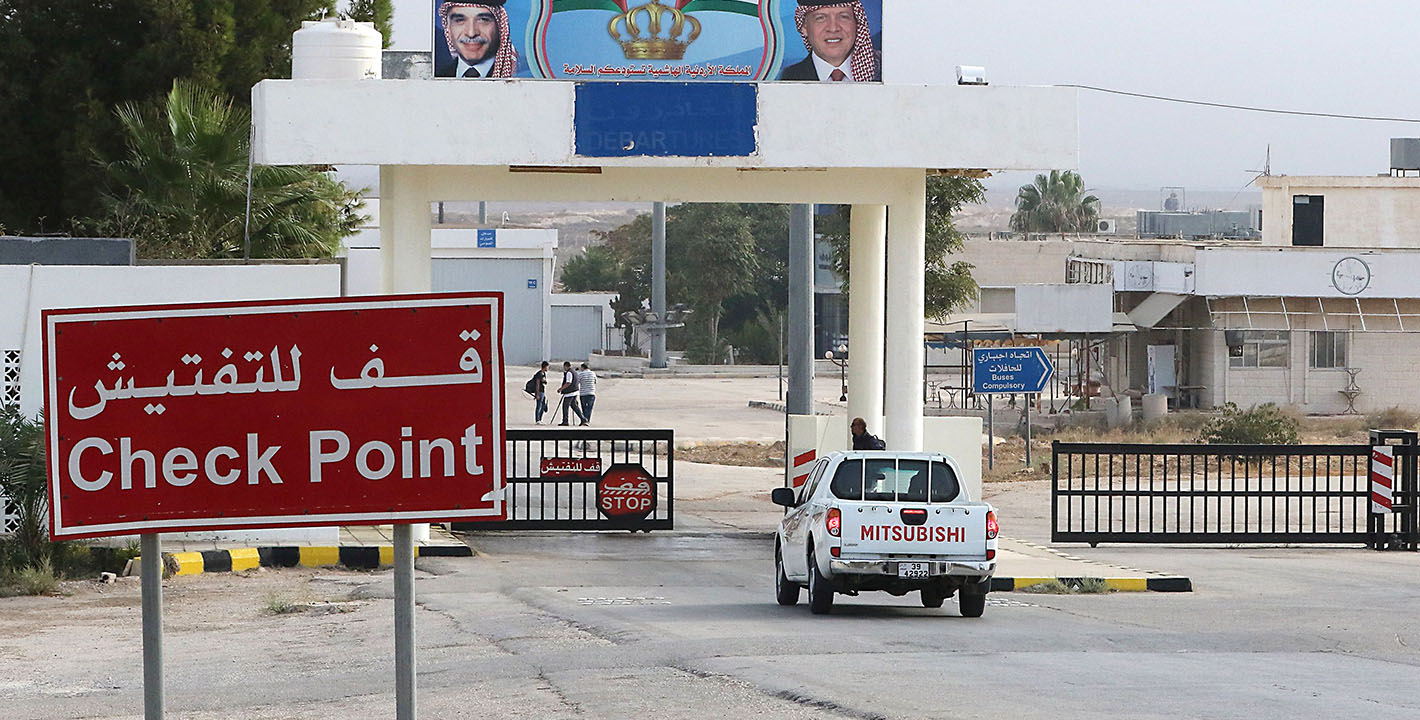
Although the Syria-Jordan border was demarcated in 1932, it was not until 1970 that it was gradually enforced through physical barriers and tighter controls.1 Border enforcement began to tighten that year, following Syria’s military intervention on behalf of Palestinian fighters who were facing off against Jordanian government forces during Black September, though in the sparsely populated region east of Deir al-Kahf, it came several years later.2 Around Ruwaished, in the country’s northeast, locals trace the first serious controls to the Iran-Iraq War in the 1980s and the 1991 Gulf War.3 Even then, enforcement remained incomplete due to the vast desert terrain.
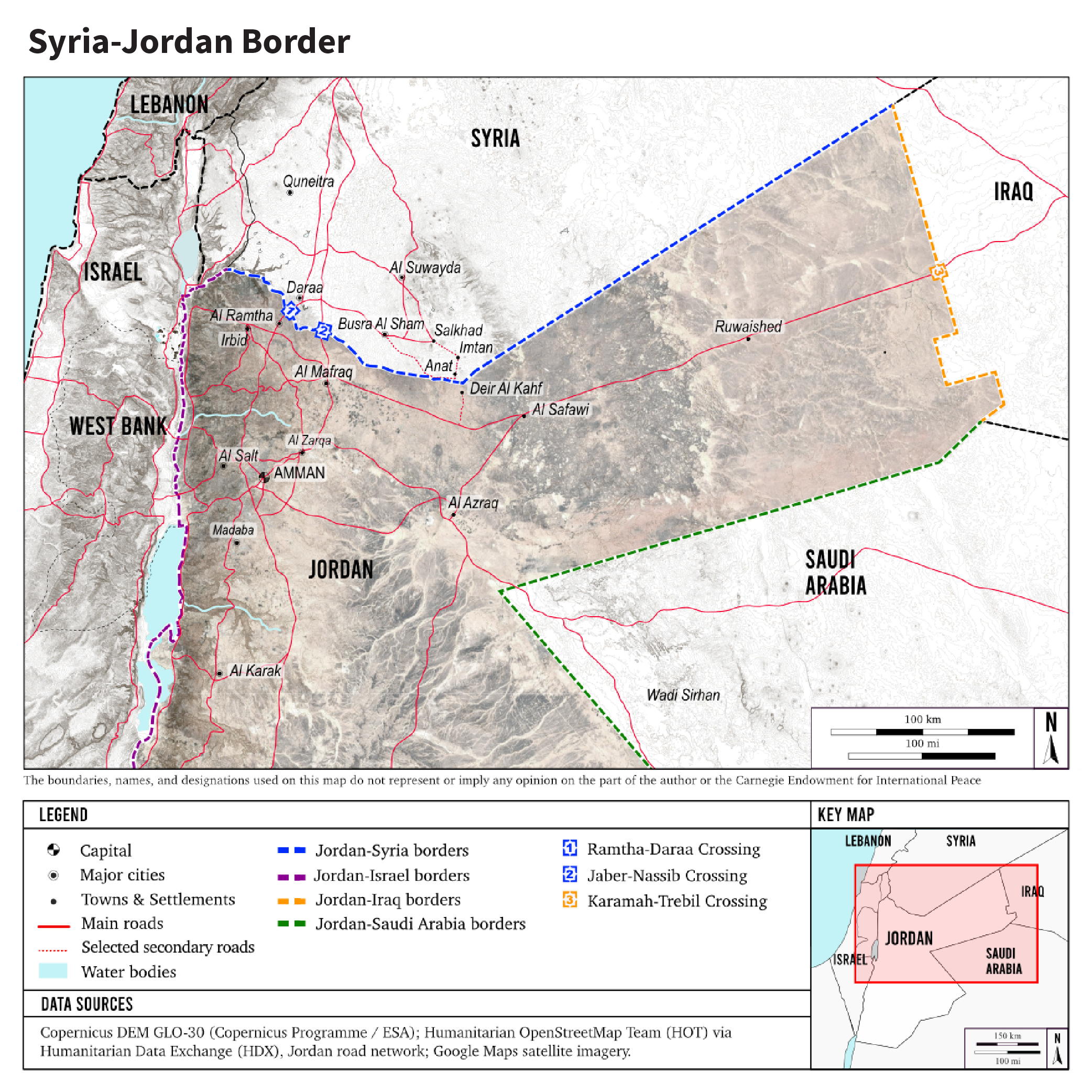
Thus, in essence, petty trade with Syria that had once moved freely across open land was gradually restricted or redirected through what was until the 1990s the only official crossing between Jordan and Syria: Ramtha-Daraa. This laid the foundations of the multimillion-dollar informal economy between the two countries. Centered on Ramtha city, it appears to have remained largely separate from the trade in drugs and weapons, with the two operating through different social networks, across different geographies, and by different methods.
Beginning in the 1990s, Syria’s larger, subsidized economy supplied northern Jordan with cheap, often high-quality goods, from cigarettes and clothing to fruit, vegetables, and sweets. Jordan, with its more open economy, supplied its neighbor or reexported to it a narrower range of goods that were scarce or unavailable in Syria. This was well-reflected in the realm of official trade (see figure 1). Data on informal trade is unavailable, but an earlier study of the Ramtha crossing found large-scale trade with a similar import-heavy pattern. The study conservatively estimated that 350,000 packs of cigarettes entered Jordan each day in 2010. At a market price of $0.70 to $2.10 per pack, depending on their quality, cigarettes alone were worth roughly $7.5 million to $22 million a month.
The Jordanian bahhara, literally “sailors,” embodied informal cross-border trade. Their methods, smuggling techniques, and geographic reach within Jordan exemplified how the informal economy operated in practice. They were an easily identifiable group, mostly hailing from the Ramtha area, that operated under specially licensed cars—some 800 in number by 2011—that were allowed to enter Syria twice a day.4 Although they occasionally ferried passengers, their main income came from transporting merchandise—some legally, but some informally like smuggled cigarettes—for larger traders.
The same applied to Iraq. By 2005, reportedly 500 Jordanian drivers were smuggling fuel and cigarettes via the Karamah-Trebil crossing. Customs duties were either evaded altogether or paid on only part of the cargo. This indicated a degree of tolerance by Jordanian customs and border security officials and, at times, perhaps their cooperation.
In their telling, the bahhara performed a service to the Jordanian state by not seeking employment in the overburdened public sector, and to society by bringing inexpensive goods into the country.5 They also maintained a code of conduct: refraining from carrying weapons or confronting border officers, leveraging the border crossing rather than going around it, and avoiding trading in goods such as drugs and arms, for which the punishment was lengthy imprisonment or execution.6
There were exceptions but local society often viewed the bahhara as shrewd traders serving an economic need in a neglected part of the country.7 More telling, the state generally did not treat them as serious criminals. Rather, their activities appear to have been governed by an informal bargain that benefited all sides: The bahhara earned a living, customs and border officials often looked the other way if bribed, consumers gained access to cheaper goods, and the trade posed little threat to national security.
The opening of the Jaber-Nassib crossing—some 25 kilometers east of the Ramtha-Daraa crossing—in northwestern Jordan in the 1990s facilitated a rise in the immediate vicinity of an informal economy in goods powered by passenger vehicles and trucks. Yet this trade remained comparatively limited; Ramtha continued to be the main hub for redistributing Syrian goods in northwestern Jordan.8 What distinguished Jaber was its role in the formal economy, with much of the bilateral trade (shown in figure 1) passing through the crossing, as well as drug trafficking. Indeed, in 2005, at a time when Jordan was a transit state par excellence,9 a Public Security Directorate report suggested that the majority of drug seizures in Jordan occurred at the Jaber crossing.
If Ramtha was the capital of informal trade in northwestern Jordan, the very remote town of Ruwaished served as a smaller but important market in the northeast. Bordering Syria, Iraq, and Saudi Arabia, the town developed in the 1930s around the H4 pumping station of the Kirkuk-Haifa oil pipeline, which intersected with the Baghdad road and the old Iraq-Jordan border. Initially called H4, the town was renamed Ruwaished in 1985. Various accounts suggest that from the 1960s to the 1990s, Ruwaished was host to a vibrant informal economy. Drugs and weapons were also part of the mix, sustained by porous borders and cross-border tribal ties, mostly coming from Syria and transiting through Jordan before reaching Saudi Arabia.
But, across Jordan, informal and illicit trade did not fully overlap. Roads and customs posts served as the main infrastructure of the informal economy. This was the case with the Karamah border crossing with Iraq as much as it was with Ramtha. In Karamah, the bahhara had a special focus on bringing in cigarettes, meat, and fuel while selling various goods to buyers in Iraq—which was under sanctions from 1990 until 2003.
The illicit economy, by contrast, had very different characteristics, beginning with the fact that it was powered largely by desert-borne smuggling that skirted border crossings. Local Bedouins made up the backbone of the drug smugglers, as the job required intimate knowledge of the terrain, which only they possessed. If the bahhara operated through border crossings, the Bedouin drug smugglers carved out tracks and established logistical infrastructure across the vast desert spanning Syria, Jordan, Iraq, and Saudi Arabia, which they would traverse in four-wheel-drive pickup trucks.10 For example, one Captagon route ran from Türkiye to northwestern Saudi Arabia (Tabuk and al-Jawf) through Syria and Jordan, with smugglers transporting large quantities of the drug across the desert.11 Also, this illicit trade was militarized. Indeed, smugglers often carried automatic weapons and, at times, exchanged fire with border patrols.12
The Syrian war dealt the border’s informal economy several blows. It devastated Syria’s previously productive economy, eroded subsidies across wide sectors, and, after the fall of Bashar al-Assad, opened the country more fully to global markets. Together, these changes undermined the very logic of informal trade—which is to take advantage of the scarcity of certain goods as well as price disparities. Additionally, the war fueled an unprecedented expansion of Syria’s illicit drug economy. It grew into a major cross-border industry, reportedly benefited from the sponsorship and involvement of elements of the Assad regime, and began to make greater use of the Jaber crossing. The illicit trade overwhelmed Jordan and essentially blurred the already thin boundary between informal and criminal activity, both in practice and in the eyes of the authorities.
The war and the security-related closure of the Ramtha crossing in 2012 effectively dismantled that city’s economy, destroying livelihoods and businesses while raising the cost of goods that had previously flowed cheaply from Syria. The reopening of the Jaber crossing in 2018 (following its closure in 2015 due to the war) briefly revived the border economy and lowered prices—but the recovery proved short-lived, as Syria’s economy deteriorated and sanctions on the country tightened in 2020. By 2022, the old pattern had reversed itself: Instead of bringing in goods, the bahhara sold them to buyers in a heavily sanctioned Syria facing scarcity.13 This was also reflected in official trade, the balance of which had tilted in Jordan’s favor (see figure 2 below) and continued to do so in post-Assad Syria. And if state subsidies had declined under Assad, they shrank even further under the country’s new president, Ahmad al-Sharaa. Markets became better supplied, but prices rose. Some goods still offered opportunities for informal trade, but the economic foundation on which the latter had rested for decades was fundamentally shaken.
More consequential, perhaps, was the collapse of the unwritten bargain between the bahhara and the authorities. This was motivated in part by the fear that informal trade could provide cover for illicit commerce. In 2019, a crackdown on the informal cigarette trade together with bottlenecks caused by inspections at Jaber hit the bahhara hard. The fact that the crossing operated only part time, and occasionally closed altogether, as during the COVID-19 pandemic in 2020, exacerbated matters. The bahhara protested repeatedly, but the state stood its ground.
Even after Assad’s downfall, Jordan continued its newfound strict policy against informal trade, with the bahhara allowed to cross only once every four days—to carry passengers, and not goods. Some concealed small quantities of goods, but not enough for what used to be a multimillion-dollar economy. Simple products such as Syrian green beans disappeared from the markets.14 Yet illicit trade continues unabated—indicating that the bahhara are not the only, or even the primary, culprits. In 2024, Jordanian customs reported seizing around 7.5 million Captagon pills nationwide, while in the first half of 2026 alone nearly 6 million pills were seized at the Jaber crossing.
The fact that Jordan’s policy toward informal trade remains unchanged even after Assad’s removal also reflects an effort by the authorities to channel new cross-border trade through the formal rather than the informal economy. The idea is to capture the value it generates. With Syria now a more open and import-hungry market, trade has largely shifted to bilateral commerce and reexports by truck through the Jaber crossing. According to Jordan’s Department of Statistics, exports and reexports to Syria reached about $900 million in 2025 (see figure 2), equal to 5.2 percent of the combined total, 6.6 percent of exports, and 25.1 percent of reexports. These gains may benefit the national economy and create more jobs at border crossings, improve infrastructure, and support a roadside economy, but they are unlikely to reach marginalized border communities more broadly.
Meanwhile, illicit activity became more consequential in the desert, as though tracking the changing geography of the border itself, which becomes harsher and less hospitable the farther one moves east. In Northern Badia district, drugs “entered every home,” as one former elected official put it in an interview, “even our [own].”15 They crossed the border in every conceivable way: by guided balloon and drone, as well as through the old routes across the difficult terrain separating southern Suwayda’s barren lands from Jordan.16 High unemployment and the failure of various development projects made the area more vulnerable to being sucked into the illicit economy. Just as important, traffickers were no longer socially shunned. Because they had money, observed the head of the Deir al-Kahf Community Center in an interview, they came to “sit at the head of the table” during social events. 17
In Jordan’s far east, the decline of petty cross-border trade and the rise in criminal activity began before the Syrian war. After 2003, drugs increasingly entered Jordan from Iraq (a flow that continues today, including through the Karamah-Trebil crossing).18 By the late 2000s, however, informal trade with Iraq was shrinking as insecurity and tighter visa restrictions reduced passenger movement. The Syrian war accelerated this shift. Petty trade declined and likely diminished further after Assad fled, when narrowing price differences eroded its profitability. Drug and weapons smuggling became increasingly prominent and likely the dominant form of commerce.
The Jordanian-Syrian border economy will continue to adjust to a region in political and economic flux. Yet its broader trajectory is unlikely to reverse course. To be sure, some scope for informal trade will remain; cigarettes or a recovering Syrian agricultural sector, for example, could still supply goods that are not always cheaper but may be better in quality, given Syria’s fertile soil and water availability. What is unlikely to return is the subsidy-driven Syrian economy that once sustained large price gaps across the border. Syria’s current policy direction points away from such subsidies, while its fiscal challenges leave little capacity to restore them.
Meanwhile, though the downfall of the Assad regime led to more drug seizures and arrests, trafficking has by no means disappeared. With drug use having risen sharply in Jordan (see figure 3), continued drug demand in the Gulf, a regime in Damascus that is unlikely to secure full control of its country in the near future, and the persistent socioeconomic deprivation of Syria’s southern and Jordan’s northern and eastern regions, the structural conditions that sustain the trade remain largely intact. Drug trafficking is therefore likely to become one of the enduring legacies of the Syrian conflict, rather than a temporary wartime phenomenon, and will continue to shape the evolving Jordan-Syria border economy.
For the bahhara and the border communities that have long depended on Syria, cross-border trade is not just a livelihood but a way of life. They will adapt to changing circumstances but are unlikely to abandon informal trade without incentives—especially if the Ramtha crossing reopens. A more sustainable approach by the Jordanian government may therefore lie in forging a new bargain: allowing small-scale, fully declared, and taxable cross-border trade while imposing strict penalties for trafficking in drugs and weapons. This way, for members of marginalized border communities, the economic and social benefits of entering the formal economy may well outweigh the risks of engaging in informal trade.
Reopening the Ramtha crossing would also ease pressure on the Jaber crossing. Combined with advanced scanning equipment and stronger action against corruption and official complicity, it could facilitate legitimate trade while reinforcing Jordan’s role as a key transit link between the Gulf and the Mediterranean, especially amid ongoing disruptions in the Strait of Hormuz and Bab al-Mandeb. Alternatively, reliance on a single, congested Jaber-Nassib crossing risks creating a bottleneck, weakening Jordan’s competitiveness and diverting transit traffic toward other corridors, particularly through Iraq.
None of these solutions are readily applicable to Ruwaished. Indeed, this may be a case for which no realistic solution exists, given the Jordanian state’s limited capacity and its unwillingness to invest in very remote areas. Even successful development projects or job creation schemes are unlikely to rival the appeal of quick profits from smuggling, particularly when the odds often appear stacked in favor of traffickers rather than the authorities. The region’s vast, sparsely populated desert has shielded illicit activity for decades. What has changed is not the geography, but the economy: The decline of the informal border trade that once provided an alternative source of income, together with the erosion of real wages, has left the illicit economy more dominant and more attractive than ever.
Borders can never be sealed completely—even less so the geographically challenging Jordan-Syria frontier. Nor can border crossings be reduced to security checkpoints alone: They almost inevitably generate markets, livelihoods, and opportunities alongside illicit activity. A securitized approach—strengthening border controls, combating trafficking, and restricting informal trade—is therefore indispensable for countering criminal activity. However, it is also inherently limited. In Jordan’s case, excessive restrictions have at times generated political tensions, as with the bahhara, while also creating congestion at the Jaber crossing, hindering official trade and mobility. The challenge is to strike a balance between risks and opportunities.
That balance requires Jordan to harness its growing role as a conduit for trade between the Mediterranean and the Gulf, while allowing border communities to benefit from the geography that has long influenced their livelihoods, especially when the state offers few realistic alternatives. This calls for a less securitized and more risk-tolerant approach. After all, illicit commerce is likely to remain a lasting legacy of the Syrian war. Painful as that legacy is, it should not become a permanent barrier to commerce, mobility, and opportunity—or further marginalize border communities.


Nonresident Scholar Malcolm H. Kerr Carnegie Middle East Center
Armenak Tokmajyan is a nonresident scholar at the Malcolm H. Kerr Carnegie Middle East Center in Beirut. His research focuses on borders and conflict, Syrian refugees, and state-society relations in Syria.

Laith Qerbaa
Laith Qerbaa is a lawyer, humanitarian practitioner, and researcher based in Jordan.
As the U.S.-led Coalition withdraws, the Kurds’ reliance on Baghdad, and on themselves, will only increase.
Wladimir van Wilgenburg
The Zaidi government’s objective to collect weapons is constrained by regional conflict, but it can take certain measures at home.
Ali Al-Mawlawi

In an interview, Sohaib Jawhar analyzes the profound changes in the ties between the neighboring countries.

Michael Young
Syria's transition promised a fresh start. But are old habits of power making a comeback? This analysis looks at the warning signs and what it will take to build a more accountable state.

Sima Beitinjaneh
Any move by the United States to make good on Trump’s suggestion that Washington persuade Damascus to confront Hezbollah militarily would have catastrophic consequences.

Kheder Khaddour