

Commentary
Yasmine Zarhloule
Source: Getty
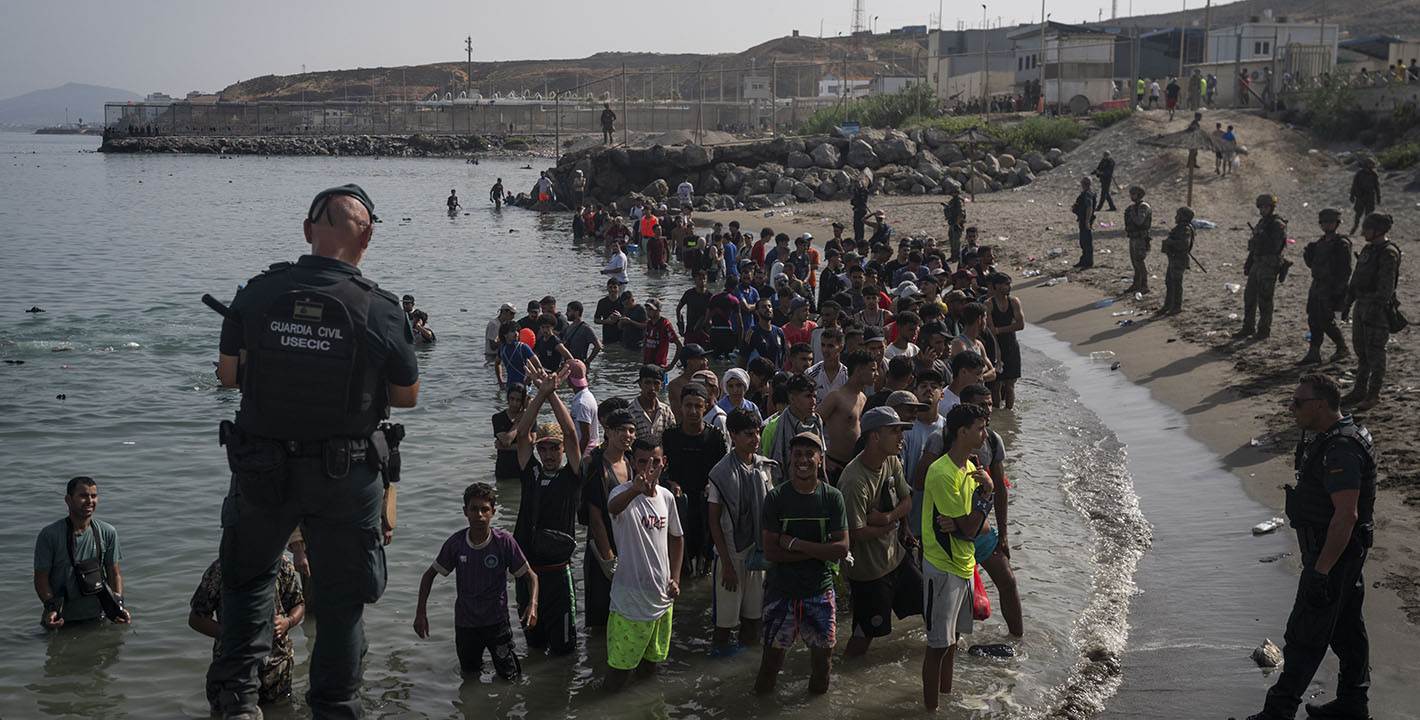
A recent incident in which tens of thousands of people suddenly crossed into an overseas Spanish territory from neighboring Morocco has spurred Spain and other European countries to further lean into the often myopic logic of frontier security, all the while ignoring the economic, political, and social processes that give rise to irregular migration.
The Ceuta (“Sabta” in Arabic) crossings of July 2026, in which large numbers of undocumented migrants managed to enter the Spanish North African exclave from neighboring Morocco, elicited a negative reaction from most European countries. Several European national leaders, as well as the Ceuta authorities, vehemently criticized the migration policy of Spanish Prime Minister Pedro Sánchez’s government, accusing it of encouraging irregular migration and failing to adequately secure the border. Nevertheless, the reasons behind the sudden surge in crossings remain disputed. Explanations have ranged from social media disinformation campaigns and increased activity by emboldened smugglers to politically motivated facilitation by Moroccan authorities, anti-Spanish narratives fueled by pro-Russian and pro-Israeli networks, and neglect of Ceuta by the central government in mainland Spain.
Whatever the immediate causes may have been, the July events bring to mind what cultural anthropologist Nicholas De Genova has termed a “border spectacle”—the stringent and hyper-publicized enforcement of border security. In this conception, migrant illegality appears as an inherent characteristic of those people undertaking the crossing, rather than something produced through wider political, legal, and economic processes. Historically, successive changes to migration and border-security measures between the Maghreb and Europe have not only reshaped the conditions of mobility but also the legal status of the migrant. The exclusive focus on security, political calculations, and the act of crossing obscures these processes as well as the changing function and scope of the border from a space of commerce to one that is increasingly organized around restriction and closure. Unfortunately, however, this focus continues to characterize the policies pursued by the authorities in Spain as well as Europe at large.
The July 2026 Ceuta incident was reminiscent of episodes that took place earlier in the 2020s—and that also led to political tensions and media firestorms. Following such occurrences in 2021 and 2022, Morocco and Spain began to more closely coordinate their policy responses to irregular migration. This manifested itself in joint maritime, land, and air patrols, increased intelligence-sharing, and operations against migrant-smuggling networks. At a high-level meeting in December 2025, the two sides highlighted their cooperation with regard to migration and trade, as well as the reopening of a commercial customs post in Melilla, another Spanish exclave bordering Morocco, and the establishment of one in Ceuta earlier that year.
On July 30, 2026, social media posts showing young people swimming from Moroccan shores to Ceuta circulated widely. The following day, more crossings were recorded—this time showing not just youths but also families and the elderly. Before long, Spanish authorities estimated that at least 72,000 migrants had crossed into Ceuta, either by swimming around the Tarajal breakwater or climbing over the border fence. Up to 100 of them died, with some still listed as missing. In early August, Juan Jesus Vivas, the highest-ranking official in Ceuta, declared that the majority of migrants had returned to Morocco. Nevertheless, several thousand remained in the exclave, including unaccompanied minors who are subject to separate protection and return procedures.
This was not the first incident of its kind. In May 2021, tense relations between Morocco and Spain came to a head following Madrid’s decision to admit Brahim Ghali—leader of the Polisario Front, a politico-military movement that seeks independence for the Moroccan-controlled Western Sahara region—to hospital for treatment. Almost immediately, approximately 8,000 people, including minors, entered Ceuta by swimming around breakwaters or crossing the border fence. Spain accused Morocco of surreptitiously allowing people to cross; Rabat denied the charge. By the evening of May 18, Spanish authorities reported that approximately 4,000 of the 8,000 people who had entered Ceuta had been returned to Morocco.
In June 2022, amid intensified raids by Moroccan security forces on migrant camps around Nador, roughly 1,300 to 2,000 people attempted to cross the Barrio Chino border post into Melilla. Most of those involved were of Chadian, Sudanese, or South Sudanese origin. The crossings were marked by violence, with Moroccan authorities reporting an official death toll of twenty-three persons, although later estimates, notably from Amnesty International, placed the toll at thirty-seven people, with seventy-seven missing. (Scores of people were injured, including members of the Moroccan and Spanish police forces.) Of those who managed to cross, 133 claimed asylum and were thus allowed to remain, at least temporarily. Around 470 others were returned to Morocco, where some faced prosecution.
The July 2026 crossings made visible the ways in which the spectacle was increasingly being instrumentalized by political actors. Spain’s preeminent far-right party, Vox, used the events to attack the Sánchez government’s approach to migration and its relations with Morocco. Such rhetoric appears to be gaining traction amid growing public dissatisfaction with the government’s handling of migration. A September opinion poll found that nearly nine in ten Spaniards blamed Morocco for the crossings, while a majority rated the government’s handling of the events as “bad” or “very bad.” The same poll recorded an increasing willingness by citizens to vote for the conservative Partido Popular or even Vox. On September 26, thousands rallied in Madrid to protest the government’s policy on irregular migration, condemning what they considered a timid official response to the Ceuta events and calling for early parliamentary elections.
In each of these occurrences, images of migrants, police forces on either side of the border, and political speeches—eventually followed by reinforcement of border security infrastructure—fed into the border spectacle. Media narratives framed what happened as a crisis involving a “mass influx of people,” or even an “invasion” as in the case of the July 2026 Ceuta events. The spectacle became a representation of illegality while obscuring the conditions that had led to the illegality in question.
Indeed, the July events were widely digitalized. This amplified their reach and showed how social media and digital platforms play a significant role in influencing how and when would-be migrants cross borders, and possibly even spurring people to decide to choose migration in the first place. Spanish fact-checking nonprofit Maldita.es, working with the Arab Fact-Checking Network, analyzed more than 1,100 Arabic-language Facebook posts in the period July 8–31 that mentioned both Ceuta and a recent ruling by Spain’s Supreme Court. The ruling, issued on June 29, stipulated that people intercepted at sea while trying to reach Ceuta or Melilla could not be summarily returned to their point of departure (a practice known as “hot returns”). On July 30 alone, 215 posts carried the misleading claim that migrants who swam to Ceuta and Melilla would not be immediately expelled.
In fact, the ruling did not prevent migrants from being returned. Rather, it required authorities to follow legal return procedures. The Maldita.es and Arab Fact-Checking Network study also found that Facebook was used to mobilize people for the crossing, while logistics were discussed on WhatsApp. It noted the rapid circulation of identical messages across hundreds of accounts, with some users posting the same message repeatedly within minutes.
Intriguingly, NGO 411, a counter-disinformation group, noted that this coordination appeared to be organic in nature—the work of disparate individual accounts, as opposed to a centrally organized recruitment channel. For its part, Al Jazeera identified Facebook pages and local groups with tens of thousands of followers on Meta platforms showcasing photographs and videos of those who successfully swam across. Some shared practical information about possible routes as well as messages encouraging people to try their luck.
It is clear, then, that digital platforms intensified the visibility of the crossing and accelerated its popularity. Yet treating online mobilization as the explanation for the mass crossing risks ignoring the economic and social factors behind the phenomenon. Beyond the spectacle lie two long-term transformations: the progressive closure of a border once organized around everyday commerce, and anti-migration measures that increasingly restrict people’s mobility.
Ceuta and Melilla, whose histories are entwined with colonialism and competing claims to sovereignty, are disputed between Spain and Morocco. Ceuta entered the Portuguese Crown in 1415 and Melilla entered the Castilian Crown in 1497, with the former falling under Spanish rule in 1640. Both cities remained under Spanish sovereignty following Moroccan independence in 1956, though Rabat considers them occupied territories. The two exclaves’ status has contributed to a form of frontier governance that is distinct from that found at Spain’s borders in continental Europe.
To begin with, Ceuta and Melilla form part of European Union (EU) territory but fall outside the EU customs zone and value-added tax area. Additionally, the Protocol of Accession of Spain, which was appended to the country’s accession to the Schengen Convention in 1991, stipulates that Moroccan residents of the neighboring province of Tetouan are exempt from visa requirements when entering Ceuta. Since then, modalities of access to Ceuta have been regulated bilaterally between Spain and Morocco.
Historically, Ceuta’s economy has depended heavily on the daily movement of people in and out from its Moroccan hinterland, and this particularity has strongly shaped the local informal border economy. Over decades, what is sometimes termed “atypical trade”—small-scale smuggling that was overlooked by authorities on both sides of the border—sustained livelihoods in Moroccan towns located near Ceuta and Melilla. The trade involved individuals purchasing goods on the Spanish side of the border and carrying them into Morocco as personal luggage, thereby avoiding the payment of customs duties. Estimates of this commerce’s value vary considerably, ranging from approximately $618 million to $1.6 billion.
The porteadoras—primarily Moroccan women who carried large bundles of goods across the border on their backs—came to symbolize this economy. In the late 2010s, as many as 9,000 people were estimated to have depended on the trade directly, along with thousands of drivers and traders on both sides of the border whose jobs were indirectly bound up with it. During 2018 and 2019, access through Tarajal II, a pedestrian crossing dedicated to the transport of goods, became increasingly restricted through the introduction by Spanish and Moroccan authorities of fixed men- and women-only days, a weight limit on bundles, and single-size trolleys for larger baggage. In October 2019, Spain’s Government Delegation in Ceuta, announced the indefinite closure of Tarajal II on safety grounds over dangerous overcrowding. The decision came amid Morocco’s own efforts to clamp down on atypical trade with the aim of protecting the formal economy from unfair competition.
In March 2020, the COVID-19 pandemic led to the wholesale closure of the border, abruptly interrupting the daily movement of many cross-border workers and disrupting their livelihoods. Beginning in May 2022, it reopened in phases—albeit only to EU citizens, Schengen visa holders, and authorized cross-border workers. The longstanding visa exemption for residents of neighboring Moroccan provinces remained suspended, and the border economy did not return to its previous levels. In the post-pandemic era, Spanish and Moroccan authorities no longer permitted porteo, meaning that cross-border movement remained limited to people and personal effects.
To address the consequences of the closure on people living in the vicinity of the border, Morocco introduced a raft of development measures. In 2020, the kingdom announced a $42 million package to spur industrial growth in Fnideq, M’diq, and Tetouan—the areas around Ceuta. By the end of December 2023, approximately fifty-five companies had established operations in the newly created F’nideq Economic Activity zone, generating approximately $21 million in customs duties and taxes. At the same time, unemployment remained high. According to the 2024 census by the Haut-Commissariat au Plan, Morocco’s national statistics agency, unemployment in the prefecture of M’diq-Fnideq reached 29 percent compared with 19.6 percent across the wider Tangier-Tetouan-Hoceima region.
The economic consequences of these changes provide only part of the wider social and political conditions in which aspirations to leave may develop. Sociologist Leila Bouasria has noted that two rhythms shape the phenomenon of border crossings. The first is a slow process that makes departure conceivable, whereas the second is a sudden event that makes crossing appear possible. While the online circulation of videos depicting the July 2026 Ceuta events may have encouraged some people to attempt an unauthorized crossing, the conditions that made departure conceivable in the first place were more deeply rooted. Among Moroccans, these included the loss of livelihoods, precarious employment, and a growing sense of exclusion from the benefits of economic development. Such frustrations were expressed during the GenZ212 protests in 2025, when young Moroccans challenged the prioritization of major infrastructure projects amid persistent shortcomings in public services and employment opportunities. Along with notions of a better life elsewhere, these factors feed into a longing by some Moroccans that they be recognized as “bnadem”—full human beings.
With this in mind, looking beyond the spectacle highlights how changes to border regimes have reshaped mobility and socioeconomic life in the surrounding regions. Over the past decade, Morocco and Spain have progressively reorganized which forms of mobility and economic exchange are permitted, thereby altering the border’s permeability. Yet responses to the July crossings have remained overwhelmingly focused on border fortifications and militarization. The emphasis on preventing crossings at the territorial boundary leaves largely unexamined the larger social and economic conditions that give rise to departure.
The July Ceuta events prompted renewed efforts, particularly by Spain, to reinforce the territorial and maritime border. Ironically, the effectiveness of border fortifications in such situations has long been debated. Numerous cases have shown that, far from eliminating crossings, tighter border controls redirect movement toward alternative and often more dangerous routes. The pattern is visible across the Mediterranean. Yet despite this, as well as the fact that the July crossings themselves show the limits of focusing on borders only when they appear to no longer work, the wider social, economic, and political conditions at play remain largely unaddressed by European authorities.
On August 1, Spain installed a 500-meter-long pneumatic barrier along the Tarajal border breakwater in order to make swimming around it more difficult. Later that month, Spanish Interior Minister Fernando Grande-Marlaska formally requested an extension of Operation Minerva, a seasonal border-security operation supporting border checks at Algeciras and Tarifa (both of which are at the southern tip of mainland Spain) and Ceuta. He also requested ten additional officers from the Frontex Standing Corps, the agency in charge of EU border control and security, to assist with screening in Ceuta. The European Commission subsequently approved an emergency support package of approximately $128 million, of which $92.3 million would come from the Asylum, Migration and Integration Fund, and $35.7 million from the Border Management and Visa Instrument. In September 2026, Foreign Minister José Manuel Albares announced that Spain had also requested a permanent Frontex presence in Ceuta and Melilla. Although this has not yet been established, the request marks a departure from the predominantly local and bilateral management of the enclaves toward greater European involvement in border enforcement at Ceuta.
On October 27, partly in response to July’s Ceuta events, the European Commission proposed a substantial expansion of Frontex’s powers. The suggested measures include doubling Frontex’s standing corps to 30,000 officers and expanding its role in deportations and return operations beyond EU territory. For instance, under the proposal, Frontex would be allowed to support operations between non-EU states to return migrants to their countries of origin before they even attempted to reach European territory (although this would require specific agreements with the countries concerned). Importantly, the proposal also envisions the establishment of an office to monitor publicly accessible social media content in order to detect potential border-security threats and anticipate mass arrivals at EU borders.
The proposed granting of such powers to Frontex points to a broader transformation in border enforcement. European border externalization has expanded the reach of migration controls into third countries, including through the spread of biometric data collection, identification technologies, information-sharing systems, and dispersed border enforcement. Increasingly, migration control operates beyond territorial boundaries and conventional territorial checkpoints. The proposed monitoring of social media and online communication associated with prospective crossings is particularly significant given the role digital platforms played in the July Ceuta events. It raises questions about the distinction between information-sharing and yet-to-materialize activities that could ostensibly pose threats to border security. Without adequate safeguarding measures and democratic oversight, the proposed powers could also undermine privacy, curtail already dwindling civil liberties, and add to increasing constraints on online expression.
Fundamentally, the growing emphasis on anticipating crossings can turn the possibility of unauthorized movement into a ubiquitous and specter-like security threat, one that is no longer confined to any particular moment or location at a given border. This is particularly troubling in an already tense political climate where far-right parties in Europe and anti-Black rhetoric in North African countries have, together, channeled domestic grievances into opposition to migrants and diaspora communities. In this context, ordinary exchanges of information about migration could become grounds for suspicion, projecting the figure of the “illegal” migrant onto people before they have even attempted a crossing. Ultimately, the proposed expansion of enforcement risks further entrenching the logic of the border spectacle beyond the crossing while further obscuring the longer political histories through which borders have been constructed.
The response to the July events shows that Spain, fellow European states, and even Morocco itself remain largely focused on border securitization as the means to stem large-scale irregular migration. This approach is short-sighted. It may prevent future crossings at Ceuta—only to redirect them elsewhere, thereby offering a band-aid solution. The result may be a cycle in which each new border spectacle, wherever it takes place, generates official and popular demands for greater security, as well as surveillance and control even farther beyond the territorial line. Such a scenario would continue to obscure the historical conditions shaping border crossings and further undermine the individual rights and freedom of expression of would-be migrants. Indeed, future border spectacles may well unfold in ways that increasingly blur the distinction between the events themselves, their causes, and their subsequent political instrumentalization.

Nonresident Scholar, Malcolm H. Kerr Carnegie Middle East Center
Yasmine Zarhloule is a nonresident scholar at the Malcolm H. Kerr Carnegie Middle East Center.
Recent Work
Yasmine Zarhloule
Yasmine Zarhloule
Carnegie does not take institutional positions on public policy issues; the views represented herein are those of the author(s) and do not necessarily reflect the views of Carnegie, its staff, or its trustees.

MINURSO’s renewal by the Security Council became highly politicized. Its expiration brings concerns about renewed violence and the future of demining efforts.

Sarah Yerkes

Russia’s coveted Red Sea naval base has fallen victim to its erratic foreign policy.

Sergey Konyashin

The global hydrocarbon order is changing. Economic diversification and developing productive economies have become essential for Middle Eastern and North African states, requiring them to address social and political challenges and rethink domestic, regional, and global settlements.



Nur Arafeh, Ishac Diwan, Hamza Meddeb, …

In an interview, Mayssoun Sukarieh discusses youths in the region, and how they are being defined and reshaped.
Yasmine Zarhloule
A notable degree of participative democracy has firmly arrived in Europe. But to have more far-reaching impact, democratic deliberation needs to move into a radically new phase.

Richard Youngs