British officials publicly worried recently that the United States-led coalition occupying Iraq had only about a year before the Shiites of Iraq turned against it. Shiites, the majority in the country, so far have been more welcoming of the coalition military and civilian presence than have Sunni Arabs. But the Shiite community, which is more religious than most outside observers had anticipated, is deeply ambivalent about the occupation. Like most Iraqis, Shiites dislike the idea of occupation, but most also want the security provided by coalition troops, at least for now. If very many Shiites turn hostile, they might begin listening to radical voices. This would make Iraq ungovernable for the coalition.
Tensions have arisen with the Grand Ayatollah Ali Sistani, the preeminent Shiite religious authority, over the procedure for drafting the new constitution. Sistani's July 1 fatwa or legal ruling rejected the U.S.'s original plan, under which the U.S.-appointed Iraqi Governing Council (IGC) would have chosen a committee to draft the constitution. The fatwa stated that "general elections must be held so that all eligible Iraqis can choose someone to represent them at the constitutional convention that will draft the constitution." The pronouncement by Sistani, who has enormous moral authority among mainstream Shiites, convinced the Shiite members of the IGC to insist on this way of proceeding. The Kurds, who fear the tyranny of the Shiite majority, want an appointed committee to do the drafting. This issue has paralyzed the IGC.
Concerns that a lengthy and contentious constitution drafting process could cause friction with the Shiite community appear to have been among the factors leading the U.S. to revise significantly its plan for handing over civilian power to Iraqis. The new plan, to which the U.S. Administrator L. Paul Bremer III and the IGC agreed on November 15, calls for a newly formed provisional assembly to form a government that will assume civil power by June 2004 and hold elections for drafters of a constitution by March 2005. National elections would be held under the new constitution by the end of 2005. This plan may not fully satisfy Sistani and his followers, however. They may object that elections for the provisional assembly will not be truly democratic, since the electors will be local notables and tribal chieftains chosen in a process supervised by the U.S. Already, in a little-noticed fatwa issued on October 6, Sistani's office stated that the IGC was illegitimate because it has been recognized neither by the Najaf religious authorities nor by a popular election.
Coalition relations with the young firebrand Shiite preacher Muqtada Al Sadr are also prickly. As many as a third of Shiites, especially those living in the teeming ghettos of Baghdad and Basra, may sympathize with Muqtada. He has called repeatedly for an immediate U.S. withdrawal, and his lieutenants in mosques throughout the country criticize the Americans as corrupters of morals and as neo-colonial oppressors.
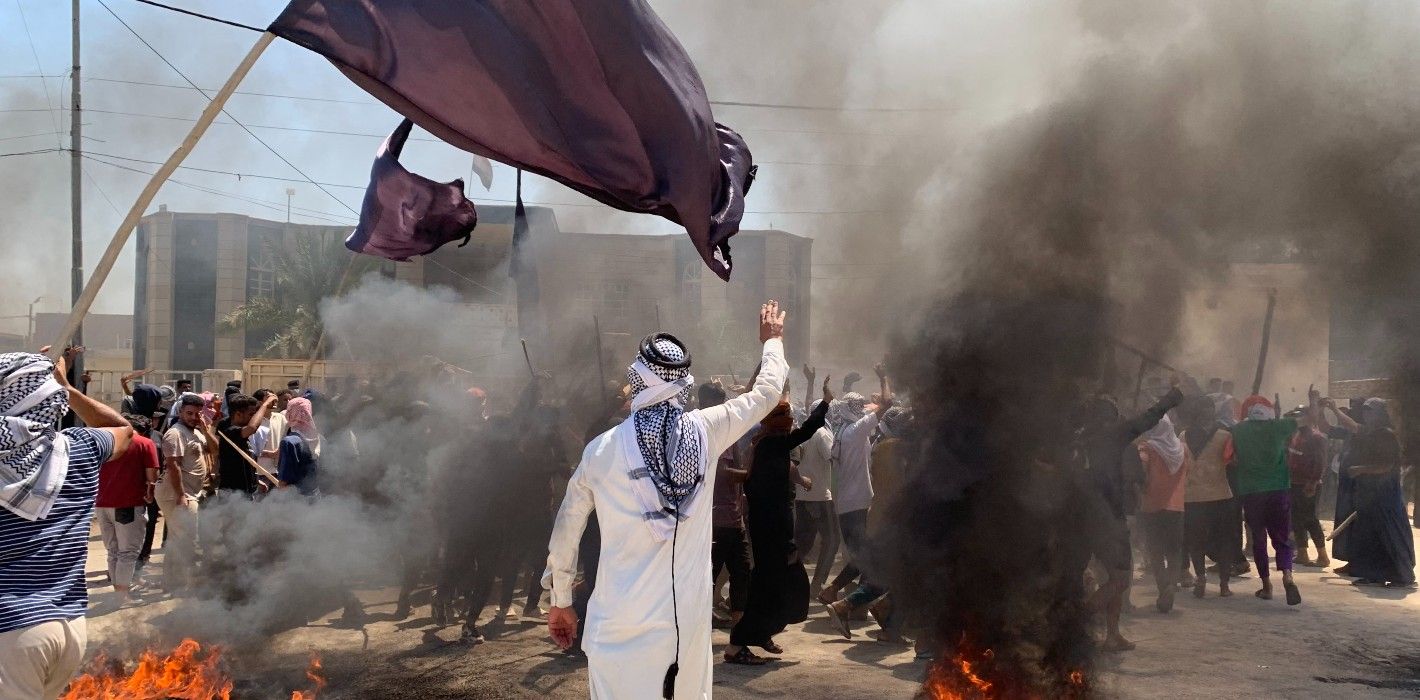
Muqtada and his lieutenants have staged several anti-American demonstrations in Baghdad and Basra ranging in size from a few hundred to five and perhaps ten thousand people. Sadrists, as his followers are known, played a role in whipping up mobs against the British in Basra in August, and coalition troops clashed with Muqtada's militias in East Baghdad and Karbala on October 9 and 16, 2003, respectively. When those clashes resulted in the deaths of U.S. servicemen, the U.S. military considered arresting Muqtada.
Instead, Muqtada appears to have been threatened and perhaps also bribed. He issued a statement in early November praising the U.S. for removing Saddam Hussein (who had killed his father), and calling for cooperation with the coalition. The U.S. cannot count on this conversion to moderation to last, however, since it is clearly rooted in pragmatism alone. Radicalized Shiites might swell the ranks of Muqtada's followers and stage massive urban demonstrations of the sort launched by Ayatollah Khomeini against the Shah in Iran in 1978 and 1979. This would very likely trump the U.S. If the U.S. left hundreds of thousands of demonstrators alone, it would be ceding control over that social space to them. If the U.S. tried to control civilian crowds with force, trouble would escalate.
It remains to be seen whether the U.S.'s planned transition to Iraqi sovereignty in June 2004 can mollify both Sistani and Al Sadr. Both have welcomed the move, but problems remain. The date for a hand-off of civil authority is farther away than most Iraqis would like, and it could slide. The transfer of sovereignty will not necessarily end the large coalition military presence in the country, and many Shiites may lose patience with it. Iran's hard-liners, who have condemned the U.S. presence, have little authority in Iraq at present, but that could change if the Iraqi public becomes deeply unhappy with the Americans. The U.S. is walking a political tightrope, and may have to make further concessions to keep the Shiites happy.
Juan Cole is professor of Modern Middle East and South Asian History at the University of Michigan and author of Sacred Space and Holy War (IB Tauris, 2002).