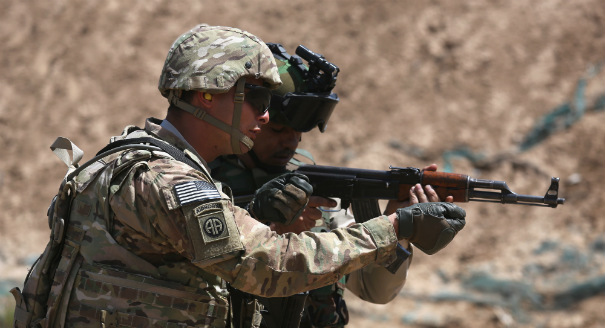
Iraqi factions opposed to the U.S. military presence received a gift on February 3, when President Donald Trump declared that U.S. troops were to remain in Iraq to “monitor Iran.” Yet although they attempted to capitalize on the wide-ranging negative reaction to the statement, parliamentarians calling for the Iraqi government to expel U.S. forces have so far failed to gain a majority since parliament returned to session on March 9. And even if parliament passed an anti-U.S. troops bill, its constitutional validity would be questionable. Still, the result has been an unnecessary headache for U.S. allies in Iraq, especially Prime Minister Adel Adbul-Mahdi, who has been struggling just to complete his cabinet.
While Trump made clear in his comments that he did not wish to use Iraq to launch an attack on Iran, he did link the presence of U.S. troops to U.S. policy toward Iran—directly contradicting Iraqi officials’ line that the troops are there to train the Iraqi military to combat the Islamic State (IS). Similarly, Trump’s unannounced visit to American troops in Anbar in late December stirred a negative response because it appeared to violate protocol—he did not visit Baghdad first nor meet with any Iraqi officials—and was viewed as a violation of Iraqi sovereignty. Adbul-Mahdi was forced to explain that Iraq’s sovereignty had not been violated because U.S. troops were in Iraq at the Iraqi government’s request to fight IS. Badr Organization leader Hadi al-Amiri, the head of Iraq’s Iran-aligned parliamentary bloc, responded by declaring Trump’s visit to be an offense and the presence of U.S. troops to be illegal.
Trump further boasted of how “we have an unbelievable and expensive military base built in Iraq” that was “perfectly situated” to monitor regional events. This contradicted one of Prime Minister Adbul-Mahdi’s common refrains: that there are no U.S. bases in Iraq, only U.S. troops working at Iraqi bases. Given Iraqi sensitivities about their country’s sovereignty and its past exploitation by both the United States and Iran in regional rivalries, the comments caused even U.S. supporters to issue rebukes. Iran-aligned figures took advantage of this broad condemnation they generated, and the resulting anti-American sentiment has been a mainstay for Iran’s allies in Iraq over the past three months.
More significant in legislative terms was that the comments turned the Sadrists’ attention back to their traditional anti-American theme. While Muqtada al-Sadr’s movement has always been ardently opposed to any U.S. troop presence, Sadrist ardor for the issue has tempered in recent years as the movement increasingly focused on domestic issues. Yet now, evidently needing an issue on which to agree with Shia rivals amid the continuing cabinet stalemate, Sadr pledged to work together with pro-Iranian coalition leader Hadi al-Amiri to pass a bill expelling U.S. troops.
However, parliament’s authority to pass such a law is unclear. Parliament passed a resolution in March 2018 “to petition the government to set a clear timetable for the withdrawal of all foreign forces,” but the government ignored the resolution. After Trump’s careless comments, the Sadrists declared they would introduce a formal bill that would be “binding” on the government. According to a draft of the bill, the Iraqi government would have one year to expel U.S. troops from Iraq and would need to seek parliamentary approval for future troop deployments from any foreign country.
Yet based on a 2010 Supreme Court decision (refined by subsequent decisions in 2013 and 2015), parliament does not have the authority to initiate legislation which encroaches upon executive constitutional duties. According to the court’s interpretation of the constitution, the government is responsible for shaping policy, and the legislature can refuse to pass bills but not initiate them. Nonetheless, while security affairs and foreign relations are clearly established as executive functions in the Iraqi constitution, Article 61 of the constitution gives parliament the authority to pass legislation establishing rules for international agreements. In 2015, parliament passed such a law, Article 17 of which stipulated parliamentary approval is required before Iraq can be “obligated” in a foreign agreement that involves security, military, and other matters. Trump’s statements give factions opposed to the U.S. troop presence the support to make this a reality.
The wording of the 2015 law is likely the reason Prime Minister Abdul-Mahdi has emphasized there was no treaty related to basing U.S. troops in Iraq—no Status of Forces Agreement (SOFA)—and thus no “obligation” on Iraq’s part, merely an arrangement for U.S. troops to provide training to Iraqi troops on Iraqi bases. The problem is that Abdul-Mahdi, who is in an incredibly weak position vis-à-vis parliament, has spoken as if he would respect whatever parliament decided. With no coalition behind him, he remains vulnerable.
Yet since parliament returned to session on March 9, backers of the bill have faced their own problems. One sign of difficulty has been that the MPs on the ad hoc committee dealing with the issue are divided between the Sadrist bill and a more flexible one with a 36-month deadline—at which point, Abdul-Mahdi’s term would nearly be over.
Nor has it at any point been clear that the Sadrist bill might even secure a majority. The only bloc clearly committed to the anti-American line, aside from that of Amiri and Sadr, is former prime minister Nouri al-Maliki’s State of Law Coalition. With 48, 54, and 25 seats, respectively, their 127 seats are theoretically enough to pass a bill by a simple majority as long as quorum can be obtained (meaning at least 165 out of 329 MPs must be present). However, in Iraq bills are most often defeated not by voting them down but by preventing quorum and thus blocking a vote altogether. And while these three groups have a majority of Shia MPs, none of the Sunni Arab or Kurdish factions have supported the bill. Abdul-Mahdi’s expression of respect for parliament’s authority may have been based on a calculation that the bill would never pass.
In a further blow to backers of the bill, the parliament’s leadership has implied it favors the Abdul-Mahdi government’s view. When asked about the bill immediately after Trump’s “monitor Iran” comments, Speaker of Parliament Mohammed al-Halbousi suggested he would defer to the prime minister. Halbousi was even clearer in comments on March 28, during his trip to the United States, that the U.S. military role in Iraq is important. Perhaps seeking to end the controversy, President Barham Salih also asserted on March 29, after three weeks in which the bill remains stalled, that there was a “consensus” against it. While that was an exaggeration, backers clearly do not have the majority they claim. Since their goal may have been simply to create an ill-thought-out response from the White House, they may not even get to that point. Yet even so, the issue has been a headache for a U.S.-friendly prime minister that he could certainly have done without.
Kirk H. Sowell is a political risk analyst and the publisher of the biweekly newsletter Inside Iraqi Politics. Follow him @uticarisk.