Three months into his four-year term as Iraq’s prime minister, Adel Abdul-Mahdi appears to have given up on his fight with parliament to secure approval for the rest of his cabinet, particularly the four key ministries of defense, interior, justice, and education. The prime minister’s difficulty arises in part from the nature of his election. As a way out of the post-election deadlock, rivals Hadi al-Amiri and Muqtada al-Sadr—the populist, Islamist, nationalist sponsor of the Sairun bloc—chose Abdul-Mahdi, an independent technocrat, as a compromise. Sadr and Amiri’s ongoing rivalry has so far left Abdul-Mahdi powerless to push either legislation or nominees through parliament. For now, he has at least been able to appoint ministers of oil, which provides essential revenue, and of electricity, through which the government could implement projects to avert summer protests before the temperature rises and demand for electricity grows. Yet without a coalition to fall back on, he will likely have to resort to unilateral executive action to push through other policies and programs.
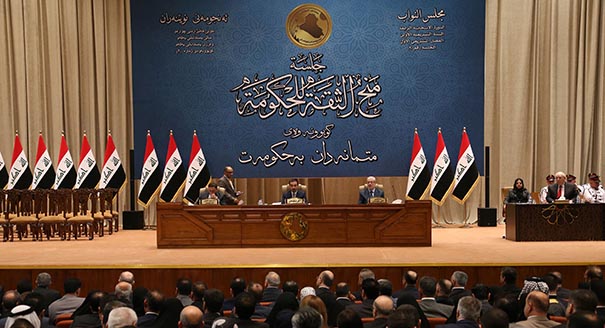
When Abdul-Mahdi first tried to form a government on October 24, the fight between Sadr and Amiri almost derailed the confidence vote. In a compromise, they approved Abdul-Mahdi and 14 of his 22 nominees to head the cabinet’s ministries. Although the Iraqi constitution dictates that the prime minister nominate all cabinet posts, Abdul-Mahdi has deferred to political factions and allocated posts on an ethno-sectarian basis. The parliamentary blocs agreed to allot the defense and education ministries to Sunnis, but intra-Sunni infighting is preventing his nominations for these posts from being approved. Similarly, intra-Kurdish disputes are holding up the confirmation for minister of justice. Even the Ministry of Migrants and Displacement was until December 24 held up by intra-Christian divisions, even though the 329-member parliament has only five Christian representatives. The most consequential division has been over the decision by Amiri’s Construction Bloc (Bina), a coalition dominated by Iran-aligned Shia Islamists, to nominate Falih al-Fayyad for minister of interior.
Amiri spent over a month of futile efforts to convince Sadr to drop his opposition to Fayyad, which was based on Sadr’s accurate perception that Fayyad is as close as he can be to Iran and still be confirmed by parliament. On December 4, apparently siding with Amiri, Abdul-Mahdi decided to present Fayyad again, along with nominees to other ministries—despite a warning from Sadr that if Abdul-Mahdi did so, his supporters would “oppose you in our own way,” a direct threat of mass protests similar to those that shook the government in 2016. The result was a severe setback for Abdul-Mahdi. Sadrists brought chaos to parliament, yelling, “Our decision is Iraqi,” thus implying that Iranians were behind their opponents. Abdul-Mahdi and his nominees walked away in defeat with eight ministries still vacant at that point.
Responding to Sadr’s opposition of Fayyad, Amiri told journalists on December 8 that although Fayyad was his political ally, the prime minister was the one who insisted on nominating him. This was an effort to make Fayyad’s nomination appear less of a power grab than it was, since Amiri’s Badr had controlled the Ministry of Interior before. This led the prime minister to admit that the two rival parties had pressed the nominees for the four key posts on him. Yet Amiri’s coalition continued to claim that Abdul-Mahdi was the one insisting on Fayyad while also declaring he was their only acceptable choice.
In the subsequent parliamentary session on December 18, three of five ministers Abdul-Mahdi put forward passed: Qusay al-Suhail for the Ministry of Higher Education and Technology, Nuri al-Dulaimi for the Ministry of Planning, and Abdulameer al-Hamdani for the Ministry of Culture and Antiquities. The other two nominees, for the Ministry of Education and the Ministry of Migrants and Displacement, were voted down. On December 24, parliament approved new nominees for these positions, Shaima al-Hiyali for the Ministry of Education and Nawfal Moussa for the Ministry of Migrants and Displacement—though Hiyali resigned before taking office over allegations that her family had ties to the Islamic State. Meanwhile, parliament soundly rejected Faisal al-Jarba’s nomination to the Ministry of Defense.
Abdul-Mahdi’s attempt on January 22 to fill the remaining four vacancies in his cabinet fell short, as parliament did not even hold votes for them. Neither of the two new nominees—Arkan Bibani for minister of justice and Safana al-Hamdani for minister of education—is a public figure. Rather, both seem to have been chosen for their lack of notoriety. Yet the very fact that Hamdani was nominated by controversial Sunni leader Khamis Khanjar makes her controversial. Furthermore, the fact that the Ministry of Justice is reserved for a Kurd means that it has become hostage to an entirely separate track of negotiations between the Kurdistan Democratic Party (KDP) and the Patriotic Union of Kurdistan (PUK) to form a new government in the Kurdistan Region.
Even some of Abdul-Mahdi’s confirmed nominees have faced threats of impeachment, including Minister of Sports and Youth Ahmad al-Obeidi (accused of having past ties to al-Qaeda) and Minister of Communications Naim al-Rubayi (accused of having past ties with the Baath party). Abdul-Mahdi has allowed the controversies over these ministers to rage without comment, just as he has done nothing to correct Amiri’s allies regarding who was responsible for Fayyad’s nomination. This has only made him look weak.
The ministerial vacancies do not necessarily mean that the government is paralyzed. The upshot is that because Abdul-Mahdi’s government is exceptionally weak, any positive developments will be the result of powers he can exercise through executive decree. In terms of Abdul-Mahdi’s survival, the two key ministries are those of oil and electricity. The oil sector is what keeps the state going, with production hitting a new all-time high of 4.94 million barrels per day (bpd) in December 2018. Electricity is also vital, given the pattern of mass summer protests as the temperature rises. According to the Iraq Oil Report, Minister of Electricity Luay al-Khatteeb is pushing to complete small but realizable projects quickly in order to boost production by 15-20 percent before the summer.
Abdul-Mahdi’s weak government can stumble along for now because there are few protests such as those that destroyed Haider al-Abadi’s chances of reelection. If he can survive the usual summer protests, he will have a four-year term to address other portfolios vital to Iraq’s future, such as industry, agriculture, and education. It remains to be seen what, if anything, the government can accomplish.
Kirk H. Sowell is a political risk analyst and the publisher of the biweekly newsletter Inside Iraqi Politics. Follow him @uticarisk.