Bahrain’s ongoing political crisis has profoundly transformed the country’s media landscape. Perhaps more so than in any of the other Arab uprisings, the struggle over events’ coverage is at the conflict’s core. From the regime’s rehashing of familiar tools of repression to its more innovative appropriation of “new media”—as well as ways in which local journalists learn to circumvent the new challenges—Bahrain shows us what the new Arab media scene looks like.
Since the beginning of protests in February 2011, restrictions imposed on journalists have proven beyond any doubt that freedom of speech and a free press in Bahrain have always been a fiction. In little over a year, the crackdown on the press has managed to turn the clock back ten years—to the 1975 State Security Law, and a government that enjoyed powers to summarily arrest and detain its citizens without trial.
This backsliding has been well-documented: Bahrain fell 29 points in the most recent Press Freedom Index (Reporters Without Borders) and is now ranked 173rd, putting it among the bottom ten countries in the world. Bahrain also falls into the 12 countries listed as “Enemies of the Internet.” The Bahrain Independent Commission of Inquiry (known locally as the “Bassiouni Commission”), the investigatory body established by King Hamad to investigate if the incidents of February and March 2011 involved international human rights violations, also documented the crackdown. It concluded that much of national television, radio and print media “contained derogatory language and inflammatory coverage of events, and some may have been defamatory.” The report also asserted that “it is clear that the media in Bahrain is biased towards the Government of Bahrain” and recommended that the government consider “relaxing censorship and allowing the opposition greater access to television broadcasts, radio broadcasts and print media.” This recommendation has been ignored.
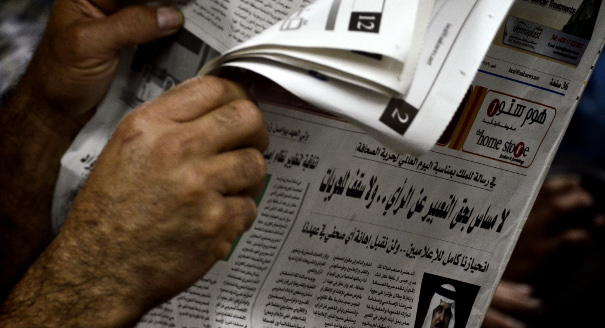
One of the clearest (and most dire) changes over the past year has been the disappearance of independent voices in traditional media outlets (newspapers, television, and radio). Local television and radio channels rarely report on ongoing demonstrations—unsurprising, as the government has repeatedly denied licenses to any private channels. Six of the seven daily newspapers are pro-government and regularly describe the protests as acts of terrorism and sabotage (these include the widely-read al-Ayyam; Gulf News, which is owned by the prime minister and publishes in both Arabic and English; al-Balad, Bahrain’s newest daily, is also close to the prime minister; and al-Watan, infamous for its hostile depictions of all opposition to the government). These dailies have had an influential hand in spinning the political conflict of the opposition against the government into a sectarian clash between Sunnis and Shi‘a. Most have actually halted coverage of certain stories because, in the current environment, even those not directly political could be construed as connected to the current crisis. As a result, many local newspapers have become merely extended bulletins of the official line.
Bahrain’s only independent paper, Al-Wasat, is the sole exception. Since its establishment in 2002, the paper has consistently pushed the envelope of press freedom. But fierce government pressure has significantly lowered the ceiling of its coverage. Editor-in-Chief Mansour al-Jamri was forced to resign in April 2011, and since his reinstatement a couple of months later, he has had to tread softly through the political minefield. In contrast to the inflammatory rhetoric that dominates other papers, al-Jamri’s column calls for a focus on the political elements of the crisis, advocating mutual respect and communal coexistence. Additionally, al-Wasat is the only paper that continues to cover opposition rallies and the crackdown on activists—albeit with great caution. Even so, the newspaper is no longer able to tackle the sensitive issues it did in the past, like political corruption, the royal family’s land grabs, and the ongoing, contentious debate over “political naturalization”—the accusation that the government fast-tracks citizenship applications of Sunni foreigners to change the country’s demographic makeup.
Constraints on al-Wasat’s coverage have cost it a large part of its readership, which has otherwise flocked to the widespread, high-speed, free-of-charge, and easy-to-use “new media.” A study by the Dubai School of Government has found that Bahrain is the third country in the region (following the UAE and Israel) in Facebook users per capita. Twitter account holders have also swelled, and prominent figures have an enormous following, like human rights activist Nabil Rajab (who has 140,000, most of who are Bahraini). The regime’s response to this new medium has differed from other Arab states that faced uprisings; unlike Egypt’s government (which temporarily blocked internet access) or Libya’s (which blocked Facebook), Bahrain has chosen to exploit it. For every opposition Twitter account or Facebook page, there are dozens of others recounting a completely different story. Many in Bahrain believe that most of the accounts that have popped up to defend the regime are fake ones sponsored by the government.
The government has also employed twelve public relations firms (including the well-known DC-based firm Qorvis) to run campaigns to “filter” the narrative emerging from the crisis. The message the regime seems to be promoting is the following: “The government committed some mistakes, but is making amends. The situation is stable and the opposition consists of nothing more than a minority backed by foreign powers against reform.”
Ultimately, however, the government's social media and public relations campaigns are incapable of monopolizing the narrative. Alternative media outlets have emerged to circumvent state restrictions, such as the new and widely-read Bahrain Mirror, managed by Bahraini journalists abroad, as well as Lulu Channel, a satellite network broadcast from Manchester (and banned in Bahrain, though many watch it online). Journalists still based in Bahrain have also tried to work around the restrictions imposed on them. While many have been prevented from reaching news events, fired from their positions, arrested—and some even tortured—reporters have coordinated with human rights activists, lawyers, and doctors to disseminate information, and the resulting collaboration has led to the establishment of networks like the UK-based Bahrain Press Association (founded in July 2011).
Even so, for the most part there has been almost no coordination among activists and journalists on media strategies, reflecting the lack of a unified political vision or opposition strategy. One thing is clear, however: the government has resoundingly lost the rights to the story.
Nada al-Wadi is a Bahraini writer and journalist.
* This article was translated from Arabic.