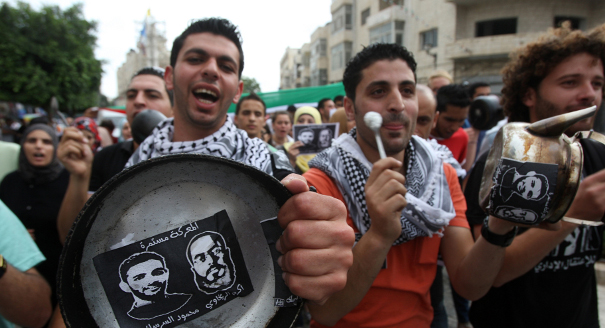
The recent hunger strikes of almost 1,600 Palestinian prisoners represent a watershed juncture in nonviolent resistance in Palestine. While Palestinians have long utilized methods of nonviolence—dating back to Mandatory Palestine of the thirties and epitomized by the First Intifada of the eighties—only recently has a truly international effort appeared. In the midst of the Arab uprisings, the international attention on the region provides a moment of focus for civil resistance, and the nascent coalition of actors utilizing these methods is growing. While the groups have different agendas and tactics, their notable successes in recent months show that, regardless of divisions among them, strategic nonviolence is gaining powerful momentum in Palestine.
The present international activity has been a long time coming. In 2001, the deeply controversial United Nations Durban conference convened to address Israeli repression of the Second Intifada. Though it failed to produce a formal resolution or offer recommendations, the NGO forum associated with the conference condemned “Israel as a racist, apartheid state” (Article 162), and spurred many to action. For Omar Barghouti, a prominent Palestinian activist, “Durban confirmed that grassroots support, even in the West, for the justness of the Palestinian cause was still robust.” Academic institutions, trade unions, and religious organizations began to use targeted boycotts and sanctions against Israel. In 2004, the US Presbyterian Church voted for “a process of phased selective divestment in multinational corporations doing business in Israel.” The Palestinian Campaign for the Academic and Cultural Boycott of Israel (PACBI) formed in April and issued a statement calling for the international community to boycott all Israeli academic and cultural institutions. Later that year, on July 9, an International Court of Justice advisory opinion deemed Israel’s construction of the separation wall and its West Bank settlements illegal.
But the largest, most cohesive, and most explicit demand for nonviolent resistance to both the occupation and Israel’s systematic human rights abuses against the Palestinians came the next year. In July 2005, a coalition of political parties, unions, and organizations representing Palestinian refugees, Palestinians under occupation, and Palestinian citizens of Israel issued the “Palestinian Civil Society Call for Boycott, Divestment and Sanctions (BDS).” Since the BDS call, there has been a marked and noteworthy increase in strategies of nonviolence; various groups have participated at some level, including members of the Palestinian Authority (PA), Israeli human rights organizations, religious institutions, students, Palestinian civil society groups, and American Jewish organizations—to say nothing of countless individuals.
These actors do not operate as a cohesive unit. They have expressed different levels of militancy, some advocate a boycott of goods produced in settlements, while others call for much wider action: a boycott of all Israeli goods, sanctions against the state (as well as academic and cultural institutions), and divestment from companies that invest in Israel. The movement has also received much criticism even from decriers of Israeli policy because the BDS National Committee does not advocate for a two-state solution, and focuses on the rights of the Palestinian community at large (which includes refugees).
Furthermore, cooperation and coordination between the PA and the signatories to the civil society call for BDS—as well as others engaged in nonviolent resistance—has been limited. Prime Minister Salam Fayyad has participated in door-to-door campaigns to encourage Palestinians to boycott settlement goods and made that call part of his 2010 campaign. The PA has since set up the National Dignity Fund to increase the availability of Palestinian produce in West Bank markets. Greater coordination between Palestinian civil society, the international adherents to the BDS call, and the Palestinian Authority (PA) would undoubtedly be a game changer, but this remains a remote possibility for the present. The PA is simply too invested in the peace process to fully support a large scale effort aimed at boycotts, divestment, and sanctions against all of Israel—which would undoubtedly lead to the loss of financial and diplomatic support during a time of tenuous political and financial stability.
But even with different goals and without the PA’s imprimatur, in May and June alone this year nonviolent resistance has achieved several notable successes. The General Conference of the United Methodist Church adopted a resolution on May 2 that, inter alia, urged the international community to prohibit financial support for construction of illegal settlements and, later that month, the Quaker Friends Fiduciary Corporation divested over $900,000 worth of shares from Caterpillar because of “its production and sale of weaponized bulldozers to Israel.” That same week, the US Campaign to End the Occupation, the Jewish Voice for Peace, and the American-Arab Anti-Discrimination Committee have delivered a petition with 11,000 signatures to the State Department, calling on it to speak out against administrative detention in Israel. A number of states have even passed legislation in protest of the occupation; South Africa announced on May 21 that it would brand all products from the settlements as “Made in Occupied Palestine,” and Denmark announced it will introduce a labeling system to denote such products. The Swedish Trade Union Federation also issued a statement of support on May 26 for the Palestinian trade unions’ call to boycott settlement goods, noting that they would “work to ensure that capital over which it has control is not invested in Israeli securities.”
Student groups at universities across the US and the UK have also been engaged. The UK National Union of Students adopted a proposal in May calling on local student unions to lobby their universities to cancel contracts with the bottling company Eden Springs, which has a bottling plant in the occupied Golan Heights. In a June 4 decision, a student run café at Evergeen State College, announced that it would formally boycott Israeli goods. On June 5, the student senate at Arizona State University “unanimously passed a bill demanding that ASU divest from and blacklist companies that continue to provide the Israeli Defense Force with weapons and militarized equipment.”
Protests and horizontal organization, such as the ongoing weekly protests in the West Bank city of Bil’in against the separation wall, have been an important component of the largely nebulous movement. But the hunger strikes of recent weeks have uniquely captured the attention of the international media. Beginning with Khader Adnan’s now-famous 66-day fast, the coordinated hunger strikes of approximately 1,600 detainees called unprecedented attention to the Israeli practice of “administrative detention,” which allows Israeli Forces to arrest Palestinians for up to six months without charge or trial, often longer if detention is renewed. It eventually led to a May 13 agreement brokered by Egypt that gave prisoners the right to have Gazan family members visit them and released 20 detainees from solitary confinement back into the general prison population. The agreement also mandated that renewing administrative detentions require evidence presented to a military court, but Palestinian prisoners have accused Israel of not following through with this stipulation. With implementation ostensibly uncertain, Palestinian prisoners are now threatening to renew hunger strikes if the provisions of the initial deal are not met.
The Arab uprisings have galvanized a renewed sense among Palestinians that people power can be an efficacious mechanism to redress long-held grievances. Erica Chenoweth and Maria Stephan have noted elsewhere that the use of nonviolence provides a higher probability of success in resistance campaigns—nearly twice the rate of violent counterparts. With that in mind, the surge in people power over the past few months signals a significant shift—and may yet lead to a breakthrough for the rights of those under occupation, in the diaspora, and in Israel.
Adam Gallagher, the Program Administrator for the Carnegie Endowment’s Middle East Program, is a PhD student at George Mason University and a contributor to Tropics of Meta.