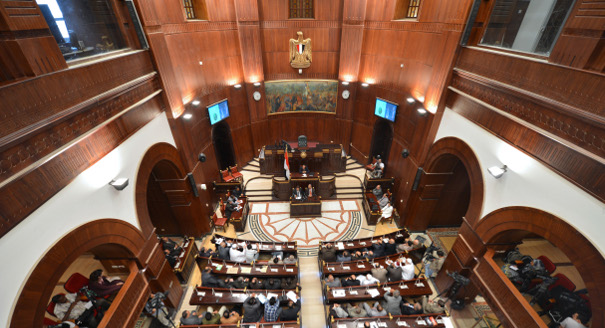
The Constituent Assembly of Egypt, after a tortuous process, released its first complete draft of the new constitution on 14 October. The chapters on the system of government have drawn the attention of analysts eager to assess the level of power the presidency would retain. At first glance, the draft establishes a system that has been described by assembly members and legal scholars as semi-presidential. This, however, is a misrepresentation: the semi-presidential system can create an extremely powerful president if the role of the prime minister is weak or ill-defined, and if the president is afforded broad powers. This is the case of Egypt’s draft constitution.
According to the draft, the directly elected president heads the executive and the state, serves as the supreme commander of the armed forces and names high-ranking officials. He has the power to call parliament into session, veto legislation, propose laws, dissolve the House of Representatives, and appoint up to one-fifth of the members of the Senate, the upper house of the bicameral parliament with equal legislative power as the lower house. The president names the prime minister and chairs cabinet meetings. He also appoints the heads of independent institutions and chairs the National Defense Council, which reviews the military budget without significant parliamentary oversight.
The president, under this draft, enjoys significant powers vis-à-vis all other actors: parliament is not autonomous because the president calls its sessions and proposes bills. Parliament’s accountability to the electorate is weakened by the fact that the president appoints a part of the senate. The president can also call binding referenda on issues related to “supreme interests of the state” without any restrictions. Furthermore, the draft is vague about whether the constitution could be amended through such referenda, giving the president a potential weapon to change the rules of the game.
The Egyptian draft seems to be based on the French model, a regime with one of the most powerful presidents in the democratic world, but in fact gives even more power to the president. The most conspicuous hole in the political system is the vague role afforded to the prime minister. In France, the requirement of countersignature—presidential decisions need to be co-signed by the prime minister to be valid—establishes a check on presidential power. The Egyptian draft contains no such requirement. Reportedly, the role and status of the prime minister, who is accountable to the president and parliament, is being intensively discussed in the Constituent Assembly.
Past authoritarian presidencies in the region selectively picked elements of presidentialism and semi-presidentialism that enabled them to consolidate their own power. Many of these elements existed in one democracy or other, but combined, they result in quasi-dictatorial rule. The Egyptian draft follows this logic. It seems that Egypt’s 1971 constitution also provided inspiration for this new draft constitution. In fairness, the Constituent Assembly, operating under the threat of dissolution by court decision, has been in a hurry to complete its work. Using historical precedent can be a way of narrowing the debate and saving drafting time.
By combining the features of a presidential system with those of a semi-presidential arbiter the constitution of Egypt would lead to a concentration of legal and de facto power in the presidency, in particular if the president hails from the majority party in parliament. Almost paradoxically, the system could tilt from power concentration to political gridlock if the president were faced with a parliamentary majority of opposing political forces. In such a case, the vagueness of the text would invite endless political and judicial battles over issues such as the role and accountability of the prime minister and the cabinet, the manner of electing parliament, the right to schedule parliamentary sessions, the review of the military budget, and presidential referenda.
A system of government that is likely to tilt either to the concentration of executive power or to intra-governmental gridlock lacks the balance required for establishing sustainable democracy. It is a poor choice for any country, and particularly for Egypt, which has seen concentration of executive power since Nasser and has been through an all-out battle between institutions of government since Mubarak’s demise. Recalibrating this system to establish a stable balance of power requires that the Constituent Assembly redefine the role of the president as an active head of the executive or an arbiter between political institutions, and that it clarify the role of the prime minister to establish electoral accountability and parliamentary autonomy. The text still being in flux and negotiations in the Constituent Assembly underway, this can still be addressed.
Michael Meyer-Resende is the executive director of the Berlin-Based NGO Democracy Reporting International. Vitalino Canas is a lecturer at the Law Faculty of the University of Lisbon and an expert on systems of government. This analysis takes into account the draft of 14 October and the changes of that draft published on 22 October.