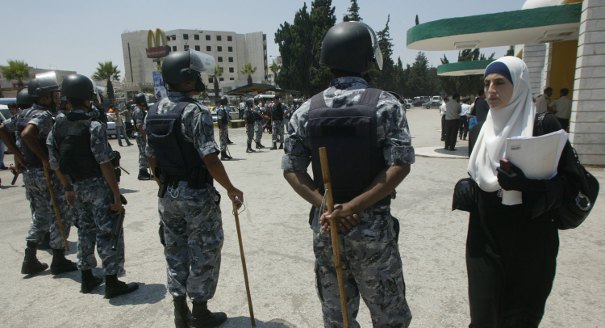
On March 31, violence made front-page news in Jordan yet again when three national universities experienced violent outbursts. At the University of Jordan, one student was stabbed in the neck, while at Al al-Bayt University a tribal conflict flared up on campus between two students. The real shock came at Mutah University in Kerak, where hundreds of students were involved in a brawl related to student council elections: one police car was set on fire and a 21-year-old bystander died of a chronic heart condition while trying to flee. The university was shut down “until further notice,” and reopened two days later. Jordanian universities are experiencing a near-crisis level of violence on campus that poses a threat not only to students’ learning and well-being, but also to country’s aspirations of building a university system in line with its knowledge economy rhetoric.
Campus violence has been on the rise in recent years: in 2011, 58 major brawls took place on university campuses—a substantial jump from the 31 in 2010. These incidents threaten Jordan’s reputation as a regional higher education exporter and its larger goals of building a globally competitive university system. There are some 28,000 international students currently in Jordan, many of whom pay substantially higher tuition rates, and whose presence enhances the nation’s regional educational reputation. But in 2012, 600 Saudi students stopped attending class a result of the violence at Mutah University. Additionally, the more recent incidents are thought to have driven 5,000 students from the Gulf to other universities in the region. The recently appointed Minister of Higher Education Amin Mahmoud has warned that Arab international students have already begun to orient themselves to universities outside Jordan—a serious concern for university budgets.
These problems are largely unique to Jordan. Campus-based activism elsewhere in the Arab world (as in Tunisia) for political rights or freedoms only occasionally turns violent. This type of activism remains limited in its scope in Jordan, though the country has recently witnessed similar trends of nonviolent protest with students at the University of Jordan and Tafileh University staging sit-ins or protests to demand better quality of life. Rather than to political activity, Jordanian violence is most directly attributable to tribal rivalries, which are exacerbated by tribal influence in national admissions policies and in university-based administrative decisions. Tribal honor is often linked to females’ conduct; fights frequently break out if girls from one tribe are accused of dating males from another tribe. In March 2012, a fight broke out at the University of Jordan when a male student saw a female relative talking to men from another tribe, and fired several blanks from a firearm. Fights also frequently spiral outside of campuses and cause damages to local cities.
That Jordan cannot control violence on its campuses also highlights a larger tension in the country’s higher education between the universities’ desire to be modern and egalitarian and susceptibility to tribal pressure, which occasionally allows individuals to evade bureaucratic rules. The outbreak at Mutah traces back to tension over student council elections—which are considered a platform for displays of tribal influence. Thabahtoona (the National Campaign for Defending Students' Rights) reports that students were forcibly prevented from entering voting rooms due to their tribal affiliation at the 2010 and 2011 student elections at the University of Jordan; similarly, Amman’s Al-Ahaliyya University suspended its elections for nine years due to violence. Following their reinstatement in 2011, relatives of losing candidates (many coming from outside the university) started throwing rocks after the results were announced—leading student council elections to be canceled once more.
Admissions policies are also widely recognized as a contributing factor; they grant students from certain tribes or backgrounds admissions and scholarships through elaborate affirmative action policies popularly known as makarim; meaning that those with much lower academic preparation are often admitted to national universities. According to a Jordan Times column last year by Mohammad F.A. Nsour (a professor of law at the University of Jordan), these students appear more likely to be involved in campus violence, presumably because they come from regions where violence is an appropriate response for defending tribal honor. Some universities—most notably the University of Jordan—have tried to limit the number of students they take on affirmative action, though not always successfully. But if violence continues to shift to those universities that continue to accept larger numbers of students through makarim, it could further exacerbate discrepancies in the quality of education that students from different backgrounds receive.
At the institutional level, a number of universities—including the Jordan University of Science and Technology and the University of Jordan—have been successful at limiting campus violence by immediately expelling offenders and instituting reforms such as requiring ID cards to enter campus, installing security cameras, and training campus security on how to control fights. One of the first measures taken by the newly appointed Minister of Higher Education was to condemn violence and to encourage university presidents to create an action plan against it. Similarly, in an emergency meeting on April 4, Jordan’s Higher Education Commission took a strong stance in response to the events at Mutah, reiterating that those involved in such actions must be expelled and prevented from re-enrolling to other universities in the country.
It remains to be seen if the policy will be implemented; until now, tribal power and connections seem to have undermined existing policies. The students responsible for the Mutah incident had already been expelled last year for similar behavior, but were permitted to reenroll due to tribal pressure, leading the Dean of Student Affairs, Misleh Tarawneh, to resign in protest. Ultimately, the national government can issue strict policies, but the power to admit, punish, and expel students remains in the hands of the local university administrators. When administrators succumb to tribal pressure and readmit offending students, they are not only threatening the safety of other students, but also the reputation of Jordan’s higher education system—ultimately putting narrow tribal concerns over the larger national interests.
Elizabeth Buckner is a Ph. D. candidate in international and comparative education at Stanford University.