Starting in late December, the show Elsandok Elaswad (The Black Box) on the Al Kahera Wal Nas (Cairo Centric) channel aired secretly taped personal calls made by such prominent figures as former head of the International Atomic Energy Agency Mohammed el-Baradei, Abdel Moniem Aboul Fotouh, and the head of the Misr al-Hurriya party, Amr Hamzawy—among other well-known activists. Spying on the phone calls, correspondence, and movements of activists and politicians has been a standard practice of Egyptian intelligence agencies such as National Security, General Intelligence, and Military Intelligence for decades. And despite Minister of Interior Mohamed Ibrahim’s denial of involvement, the decision to broadcast the phone conversations of such significant political figures could not have been taken without the approval of Field Marshall Abdel Fattah el-Sisi, Egypt’s minister of defense and de facto ruler. The wiretapping is a further indication of Egypt’s troubling trends regarding rule of law, revisionist narratives of the January 25 Revolution, and the lack of widespread pushback against privacy violations.
The leaked wiretaps violated international covenants, the constitution, and Egyptian law, revealing the overall decline in the rule of law. Article 17 of the International Covenant on Civil and Political Rights, for instance, specifies that “no one shall be subjected to arbitrary or unlawful interference with his privacy . . .” The current constitution affirms the inviolability of private life, as Article 57 says that the state may not infringe upon private life, including telephone calls, without a causal judicial order. Likewise, according to Article 99, “any assault on the personal freedoms or sanctity of the life of citizens . . . is a crime with no statute of limitations.” In the Egyptian penal code, Article 309 bis stipulates imprisonment for anyone who eavesdrops on or transmits telephone conversations without consent, while Article 73 of the 2003 Telecommunications Law dictates jail or a fine for telecommunications sector employees who are responsible for recording and disclosing calls. Notably, the Egyptian authorities did not take any steps regarding the leaks, even though Article 99 of the current constitution grants the National Council for Human Rights the right to report privacy violations to the public prosecutor, while the National Telecommunication Regulatory Authority has the legal right to ensure that telecommunications companies are protecting clients’ rights.
Even though a group of NGOs submitted a request for an investigation in the leaks to the Attorney General in late December, as did former MP Mostafa El-Naggar, one of the public figures targeted by the wiretaps, the prosecutor has yet to open an investigation. This is a worrying sign of the deterioration of the rule of law in Egypt. With human rights violations on the rise, the only hope remaining that privacy laws will be applied lies in the judiciary’s consideration of the lawsuit filed by El-Naggar against Elsandok Elaswad’s host, Abdul Rahim Ali, the proceedings of which began on February 22.
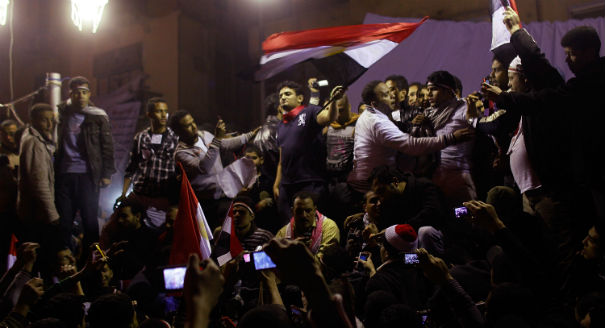
Egypt’s wiretapping scandal also reveals that the military authorities aim to rewrite the history of the January 25 Revolution, essentially adopting the version of events espoused by former president Hosni Mubarak and his vice-president Omar Suleiman. The state-run media has been waging an aggressive campaign to demonize any and all opposition to the military rulers, portraying the January 25 Revolution as a vast conspiracy that brought together youth activists and foreign powers with the goal of putting the Muslim Brotherhood in power. The wiretap leaks coincided with the buildup to the third anniversary of the January 25 Revolution; they were aimed at both preempting anti-military demonstrations and convincing the public that the military is the best defender against enemies and traitors lurking within. The military authorities are also seeking to refurbish the tainted image of the security and intelligence agencies, such as National Security (formerly known as State Security), which have been condemned by democracy and human rights advocates for the past three years and had lost some of their status after their headquarters were stormed in March 2011. The military’s message is that the intelligence agencies never stopped carrying out their patriotic duty of monitoring activists and opposition politicians. This message aims to instill fear among the members of the public, particularly those considering political activism, by threatening their privacy and reputations.
There has been little open criticism of the wiretaps; indeed media coverage and op-eds have applauded Elsandok Elaswad’s host for his ability to obtain wiretapped conversations of activists such as Ahmed Maher and Mohammed Adel (of the April 6 Movement), Mostafa El-Naggar and Abdel-Rahman Yousef (the former chairs of el-Baradei’s election campaign), Wael Ghoneim (the administrator of the We Are All Khaled Said Facebook page), Asmaa Mahfouz, and Mohamed Abbas, all of whom are pro-democracy activists who played prominent roles in toppling the Mubarak regime. Beyond a December 28 letter to interim President Mansour Adly signed by 50 public condemning the smear campaign and a handful of op-eds by democracy advocates, including the satirist Bassem Youssef, little else has been done. However, here are some indications that not all of society supports the wiretapping: for instance, YouTube views of the leaks have remained only in the tens of thousands, and Al Kahera Wal Nas’s viewer rankings are still fairly low, according to an Ipsos survey. However, this scattered opposition has not coalesced in any sort of organized campaign in defense of privacy, and even some of those who were targeted have failed to speak out to criticize the wiretaps, arguing there are more pressing issues, such as the political process and the conditions of detainees and university students. But the lack of reaction both from political activists and broader society reflect a deeper crisis, and raises questions about how willing Egyptians are to defend privacy and rule of law.
The wiretapping shows the extent of Egypt’s setbacks in citizens’ rights and the rule of law. The pro-democracy movement and civil society are weak and fragmented, offering little resistance to this or other human rights violations under the military rulers. With the likely election of former Minister of Defense Marshal Abdel Fattah el-Sisi, the future of freedom and the political process in Egypt looks gloomy.
Mohamed Abdel Salam is a researcher for the Association for Freedom of Thought and Expression in Cairo. The views expressed are the author's own and do not reflect the views of the Association.
This article was translated from Arabic.