Introduction:
Realities of the Saudi Labor Force:
The Saudi labor force is faced with significant challenges. According to the International Labor Organization (ILO), women nearly topped the aggregate unemployment rate in the Saudi labor force last year. Statistics suggesting greater willingness to commute to work also miss the point on deep-seated challenges. There is evidence to suggest that the kingdom is still focused on attracting foreign talent through lucrative recruitment packages. This aim is at odds with the country’s push to strengthen industries such as tourism, mining and financial services, and present an employment-ready local labor force that can expand economic contributions on all fronts.
The Saudi Crown Prince Mohammed bin Salman’s push for multibillion-dollar infrastructure development projects is another complicating factor. For instance, initiatives such as the $500 billion NEOM project have sent the demand for highly technical foreign talent – particularly in artificial intelligence and complex engineering – skyrocketing. As these initiatives demonstrate underwhelming returns on investment, Riyadh faces a dearth of skilled talent procurement options in its non-oil private sector. This sector has expanded considerably but still prioritizes international business investments to drive record-setting growth. With few signs of this investment-driven model changing, exploitative working conditions for Saudi Arabia’s sizeable expatriate labor force are also likely to be sustained, underlining the complexity of a labor market that government ministries have often billed as a key point of focus for new employment opportunities, particularly for the country’s women.
Saudi Women in the Financial Sector:
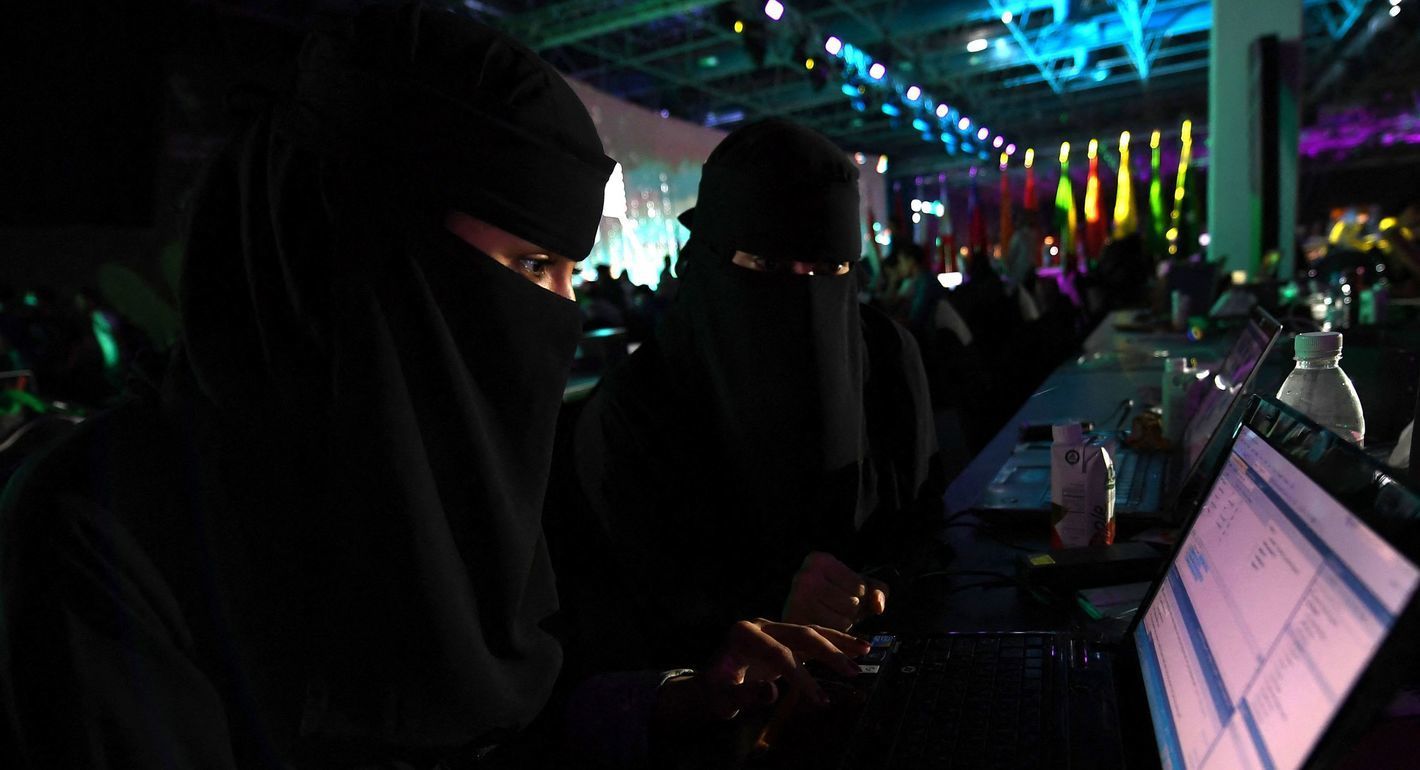
The state of Saudi women in the financial sector is also challenging. While a growing number of women are entering sectors spanning fintech and artificial intelligence, their income gains relative to their male counterparts remain limited. Legislation aimed at increasing their economic mobility, beginning with a long-overdue focus on maternity leave and job break support, is also difficult to interpret as empowering. For instance, since 2019, women aged 21 and older no longer require their guardians’ approval to take employment. Still, these provisions have little impact, given that the kingdom ranks 132 out of 148 countries in the World Economic Forum’s 2025 Global Gender Index.
The resulting gap in gender autonomy has a detrimental effect on women’s ability to take up high-growth jobs in the sector. Their penetration of the formal economy, including the banking sector, remains constrained by barriers to capital access, low financial literacy among less-educated workers, and limited national training initiatives to guide early-stage financial decisions. Saudi Arabia also lacks a dedicated Technical, Vocational Education and Training (TVET) strategy that prioritizes financial upskilling among early-career female entrepreneurs. The value of TVET to multi-sector employment gains is demonstrated; it has provided requisite skills training to help Saudi women penetrate industries of the future, including renewable energy and cybersecurity. But the absence of a dedicated TVET financial sector upskilling strategy has made it difficult for women to develop focused expertise across banking, insurance and fintech, so that it benefits their ability to earn future income, occupy top-tier organizational roles, and retain leadership potential.
Saudi Arabia’s wide-ranging e-commerce reforms offer a glimpse of improving labor force participation for its female population. But as the sector undergoes rapid growth, a pivotal research question merits policy attention: how can the sector serve as an effective mechanism for empowering women economically and integrating them more fully into the labor force amid the country’s ongoing socioeconomic transformation?
The question’s policy relevance is difficult to understate. Greater female penetration into the e-commerce sector aligns closely with Saudi Vision 2030’s target to increase female employment over the next five years. Vision 2030 investments are increasingly focused on non-oil sectors, spanning a diverse range of industries. However, limited guarantees of employment returns from many of these sectors suggest that the kingdom needs to leverage the existing potential of e-commerce among Saudi women to maximize economic impact.
The space for growth and female inclusion is considerable. Already, one-third of Saudi women identify as entrepreneurs, and over two-thirds of women-led enterprises are expected to see revenue growth in the coming years. But tangible gains for financial empowerment as well as women’s social and structural inclusion in the digital workforce are unlikely to materialize easily. It requires a dedicated national financial-inclusion strategy that is receptive to the regulatory and structural limitations currently faced by women entrepreneurs in the e-commerce sector.
The Potential of E-Commerce as a Gender-Inclusive Platform:
E-commerce’s potential to serve as a gender-conducive entrepreneurial platform is considerable. First, it offers an amalgamation of high-growth sectors spanning healthcare, technology and finance. There is evidence to suggest that Saudi Arabia’s women entrepreneurs, including 44% of millennials, are engaged in digital marketplaces and commodity marketing aligned with all three sectors. Riyadh’s recent progress in reducing barriers to initiating startups and its broader effort to outcompete e-commerce markets in the Middle East can play a leading role in lifting confidence in starting up a business. The kingdom’s Financial Sector Development Program (FSDP) can help catalyze this change. In 2024, it helped increase the share of total digital payments in Saudi Arabia, part of a broader effort to steer the country’s oil-dependent economy to a more diverse digital ecosystem. Given that growth in e-commerce ventures is vital to this transition, FSDP should promote pathways that increase female-led startup access to new financial services and products. The United Arab Emirates offers a proof point as online shopping becomes part and parcel of the country’s rapidly evolving retail landscape, the government has integrated payment, lending and insurance into its financial capital access system. This mechanism, which could prove to be a major value addition to the Vision 2030's Financial Sector Development Program (FSDP), can help reorient the kingdom’s expanded capital market access efforts to the needs of female e-commerce entrepreneurs. FSDP is a landmark initiative under Vision 2030 to prepare the ground for an expanded capital market.
To support such momentum, gender-responsive e-commerce regulations are a major consideration. The present scorecard for next-generation female earners is underwhelming. Stringent commercial registration requirements for new e-commerce platforms, limited provisions for underrepresented community members to access financial capital, and a lack of government guarantees to help scale female-led micro-SMEs to full-grown retail enterprises, all put limits on the Vision’s ability to support upskilling among the kingdom’s future female e-commerce leaders. This points to a pressing policy capacity challenge. The kingdom may fall short of its stated goal to increase private sector contribution to GDP by 25 percent unless it expands its high-growth e-commerce sector with scalable, female-led ventures at the forefront. Evidence suggests that the segment with the potential to transform the kingdom’s future entrepreneurship landscape in the coming years is the 15-34 age group, a bracket comprising nearly 50 percent of women. To harness this potential effectively, the kingdom would be well-advised to integrate flexible work models within the Vision’s Financial Sector Development Program (FSDP) to streamline women’s digital access to markets.
FSDP already includes a training and qualified professional development initiative that tasks the country’s Financial Sector Academy to improve qualified intake for fintech companies. This training should be remodeled to cater to various segments of Saudi female entrepreneurs in the e-commerce market. The “TikTok x Blossom SME Empowerment Program” provides early clues on how to make this happen. The three-month accelerator program enables early-stage female entrepreneurs to benefit from high-quality SME training through customized mentorship and improved investment access. Together, young female founders are better positioned to penetrate innovative growth markets, including the kingdom’s booming e-commerce sector. A starting point is to support inclusive workplace training that is focused on eliminating unconscious bias among potential employers. Evidence shows that some 85% of Saudi women remain confident in their ability to occupy top positions within organizations, including e-commerce firms. But limited organizational sensitivity to career breaks – a major consideration for Saudi women – is challenging their socioeconomic mobility and future contributions to the $267 billion financial sector. Efforts to address unconscious bias are therefore critical to ensure that a growing number of Saudi women in e-commerce can take career breaks without risking employment discontinuity. With caregiving responsibilities, demands for equal pay, anti-discrimination policies, and maternity benefits becoming dominant demands among female entrepreneurs, FSDP’s dedicated training initiative for entrepreneurial sensitivity could prove transformative.
Key Constraints Limiting Female Participation:
Despite making considerable gains in boosting female labor force participation, a series of constraints challenge female employment penetration in the e-commerce sector. These include limited familiarity with real cash payments and waning space to acclimatize female entrepreneurs with Riyadh’s Information and Communications Technology (ICT) reforms. This stems partly from a still-nascent digital payment culture among smaller women-led businesses. On the ICT front, Riyadh is in the process of engaging multibillion-dollar firms to transform the sector’s contribution to GDP from 1 percent to 5 percent by the end of the decade. According to the Saudi Arabian Ministry of Commerce, the ICT sector is already valued at over $40.9 billion. This presents an opportunity to advance female participation in the labor force: Saudi efforts to advance HUMAIN — a flagship AI-enabling data center production initiative — lack significant computing power support for female e-commerce startups. Scaling up women-led businesses, which accounted for nearly half of newly registered enterprises in the opening months of 2025, is a key requirement for achieving the targeted e-commerce expansion needed under Vision 2030. Strong data center linkages with women-led e-commerce startups can help bring down barriers to early career capital – a dynamic that women-led e-commerce startups in the United Arab Emirates have rapidly accommodated. Therefore, the absence of an ICT and e-commerce nexus that makes female-led e-commerce startups a stated priority under HUMAIN deserves policy attention in Riyadh.
Policies that support a healthy work-life balance also lack institutionalization across e-commerce sub-sectors. These include fintech, fashion, retail, and digital education. For instance, the kingdom’s “Quality of Life” program under Vision 2030 is seen as a major vehicle for improving living standards and ensuring that Riyadh positions itself as a megadiverse destination for work. But the program’s outsized focus on tourism, entertainment and sports sectors is a challenge. It risks confining well-being policies to sectors where future female economic empowerment is minimal, and access to the digital economy is limited.
Vision 2030 and the Current Policy Landscape:
To bolster female digital entrepreneurship, Riyadh’s Vision 2030 approach is increasingly focused on achieving 40 percent female workforce participation by the end of this decade. But actual implementation on the ground could require stronger measures to help the kingdom’s next-generation e-commerce entrepreneurs break new ground.
First, women-led startups receive venture capital support of just over 1 percent in the entire Middle East and North Africa region, and for an e-commerce sector that accounted for nearly a third of all consumer retail payments in 2024, scaling up capital access is a major priority. Saudi female entrepreneurs are bringing cutting-edge ventures to the fore: Mumzworld, the UAE-based e-commerce venture catering to maternal and childcare products for millions across the Gulf, is inspiring Saudi Arabia’s homegrown equivalents to enter the market. Similarly, fitness-focused “SheFit” and sports-focused Motion Academy also demonstrate considerable space for scalability if the requisite traction and data center support is afforded to these early-stage startups. The Saudi e-commerce ecosystem is largely focused on the number of e-commerce registrations that have materialized in recent years, and government priorities indicate a penchant to drive that number further. But mistaking quantity for regionally competitive e-commerce offerings risks understating the digital empowerment needs and market access motivations for Saudi women in 2025 and beyond.
It helps to acknowledge that the current demographic is distinct and hails from varied sociocultural backgrounds. Digital literacy is critical for this demographic because it equips women with the requisite know-how to scale up their ventures, understand which government investment streams match their capital needs, and address other key considerations. Research shows that several segments of this demographic lack income replacement options and may not necessarily have prior memory of penetrating the digital market across past generations. E-commerce is also a historically male-dominated sector, requiring considerable additional guarantees on women-centered digital literacy, online protections, women-led network access to existing industrial leaders, and early-stage capital commitments for small and medium-sized enterprises. Vision 2030 has made noticeable progress in advancing legal frameworks that propel workplace equality and advance long-delayed rights to empowerment. This includes the kingdom’s anti-harassment law of 2018, which criminalized workplace offenses and mandated safeguards.
The right for women to work in sectors where female participation has been historically low, including engineering and finance, has also been a key barrier to their economic mobility. But augmenting these provisions with women-centered policies on digital literacy, commerce-industry networking, and early capital access is a central shortcoming of the Vision 2030 approach. To ensure better alignment between female labor force expansion and the empowerment of that labor force in the digital economy, a composite of these policy offerings needs to be tailored to Saudi female e-commerce entrepreneurs. It could play a key role in expanding women’s total share of small and medium-sized enterprises (SMEs) in the kingdom, currently at nearly half. Evidence shows that female e-commerce changemakers have leveraged very limited early enterprise capital and industrial scaling support to help the kingdom develop new sectors, including e-commerce.
Policy Recommendations for a Gender-Inclusive E-Commerce Ecosystem:
An education, media-intensive approach:
Vision 2030’s stated priority for Quality of Life advancement should focus on the educational and media enablers of female entry into the e-commerce market. Princess Nourah University’s Women in Business program could serve as a training partner for small e-commerce entrepreneurs. By sanctioning media coverage of small-scale e-commerce enterprises with varied market expansion prospects, Vision 2030 can help communicate their constraints to regional and international investors who are keen to prioritize early-stage deals and position early career women as growth enablers. A formal priority for media and education-led visibility of Saudi female entrepreneurs can challenge stigmas that they lack full-time employment prospects. The presence of several major educational institutions focused on gender-diverse e-commerce leadership in Saudi Arabia is central to advancing this objective. They have the ability to train women in SMEs to become part of the regional e-commerce ecosystem for capital, exposure and better supply chain integration.
Streamlining Regulations:
The kingdom has made considerable gains in commercial registrations for women-led enterprises in the opening months of 2025. The laws enabled trade name advancements for new commercial registrations, a move that helped eliminate bureaucratic bottlenecks for small women-led startups and eased their transition into the e-commerce market. As new e-commerce ventures spanning multiple growth sectors demonstrate potential to penetrate Saudi Arabia’s AI-enabled data center ecosystem, those registrations need to include a data center registration code for women-led small and medium-sized enterprises. As part of its economic diversification strategy, Saudi Arabia set up a new company called HUMAIN in May to develop data centers to help high-growth sectors adopt AI technologies. Part of that drive includes a $1.4 billion investment to develop similar data center facilities to address future enterprise needs in major industrial sectors, including e-commerce. Therefore, making data center registration codes standard practice for women-led e-commerce SMEs could help integrate these businesses in the kingdom’s AI infrastructure and its $131 billion digital economy.
A threefold metric can help empower female e-commerce entrepreneurs who are already in the labor force: type, strategic weight, and sector relevance.
On type, registration can be expedited based on the startup venture’s relevance to the data center growth type. Evidence shows that fintech e-commerce ventures – including those involving Saudi women at the forefront of coding and financial analytics – are on the rise. HUMAIN’s stated objective to advance ventures also requires high computing power – a major incentive to Vision 2030’s AI-enabled GDP growth advancement in the coming years. Given these demands, registration that helps link specific ventures across high-priority sectors with data centers is a win-win for women’s empowerment and Vision 2030’s economic growth expansion goals.
On strategic weight, the contribution of each e-commerce venture to the yearly growth targets of the kingdom should become a vital consideration. This could enable specific ventures that already have policy support at the top to become priorities for early capital support, given Saudi Arabia’s track record of promoting similar accessible financing solutions for national targets – such as homeownership. Fashion, tutoring, and cosmetics are some of the high-demand e-commerce sub-sectors that have attracted attention from female entrepreneurs. Advancing them in line with Vision 2030’s regulatory framework is thus a vital consideration to boost the kingdom’s goal of diversified economic growth, where women’s empowerment is a central consideration.
On sector relevance, fields spanning healthcare, fintech, sustainable fashion, agritech and information technology suggest multiple avenues of sector-driven GDP contributions in the longer run. Given that female-led e-commerce ventures are acquiring a foothold across many of these fields, it is in Riyadh’s interests to promote regulations that help assist with capital support based on the level of labor force participation concentrated in each sector. An approach that is sensitive to labor force participation levels across diverse sectors can help scale up capital for small enterprises that demand large capital, while giving tailored support to medium-sized enterprises that have already utilized early capital. Monsha'at is a proof-point: a Saudi system designed to ease business transition from traditional commerce to e-commerce has helped focus government priorities on sectors where female labor force participation is high. Regulations that gauge women empowerment based on metrics such as growth in income, decision-making autonomy, and digital market access can play a leading role in helping Monsha'at prepare the ground for future innovation, effectively helping women integrate deeply within the labor force across these e-commerce sub-sectors.
Conclusion:
As this research shows, e-commerce’s potential to advance women’s empowerment is immense. The sector can serve as a catalyst for early-stage female entrepreneurs to break glass ceilings, while positioning the kingdom as a digital innovation powerhouse in the Middle East.
E-commerce’s utility shows in its multi-sector traction, ability to cater to a broadening pool of Saudi women millennials, and future promise to integrate closely into Saudi Arabia’s record-setting data center investments. But to position it as an effective mechanism for the economic empowerment of Saudi women, the government needs to streamline existing regulations and pursue targeted training that deepens their exposure to early-stage capital and scalable SMEs. These are the future determinants of a well-integrated labor force where flexible work models, digital literacy, and regional data center support are tailored to meet the needs of Saudi Arabia’s promising female e-commerce entrepreneurs.
Addressing these needs in isolation may not prove productive. Despite the Saudi e-commerce sector being expected to triple in size by 2033, women entrepreneurs continue to face limited access to capital, while those with requisite financing could still require tech-focused startup mentorship. Initiatives such as the Taibah Valley Innovation Hub illustrate this reality. It is designed to encourage investments in next-generation enterprises and spur business acceleration but faces headwinds in empowering the kingdom’s future female e-commerce entrepreneurs. This is because state efforts are still focused on providing basic artificial intelligence training to Saudi Arabia’s working-age population, including future female entrepreneurs, underscoring the need for business-specific digital literacy training in a fast-evolving sector.
Unless a composite of versatile work models, data center guarantees and regionally competitive talent training informs capacity-building, the kingdom faces an uphill task empowering Saudi women in a sector that is central to Riyadh’s long-term economic ambitions.
As this paper makes clear, a drastic growth in Saudi Arabia’s e-commerce sector does not guarantee women’s empowerment. Central to that effort is to make state policy receptive to increased capital access for women, advance long-term digital literacy, and ensure that the country’s data center ecosystem lends computational support to female-led, early-stage e-commerce startups. This is essential to ensure their scalability in the Saudi digital economy.
As things stand, regulations aimed at easing women’s transition into the employment market are not effectively tailored to address the challenges faced by women-led SMEs in Saudi Arabia. Without addressing structural barriers to their participation, Riyadh risks understating progress towards its Vision 2030 agenda. After all, the kingdom’s next generation of female e-commerce changemakers requires policy support on financial inclusion, adaptable work models and digital training. These are essential ingredients to steer specific ventures towards long-term growth and sustainability in the fast-evolving Saudi e-commerce market.
The Saudi government also needs a shift in perspective. Equipping women with the skills for upward mobility in the digital economy is a precondition to advance its economic diversification drive. Women-led SMEs are growth engines for the e-commerce market, and prioritizing an e-commerce-led economic transformation in the kingdom will yield limited gains if the backbone of the Saudi labor transformation – its expanding female labor force – is denied due recognition on finance, regulation and customized business scalability support.