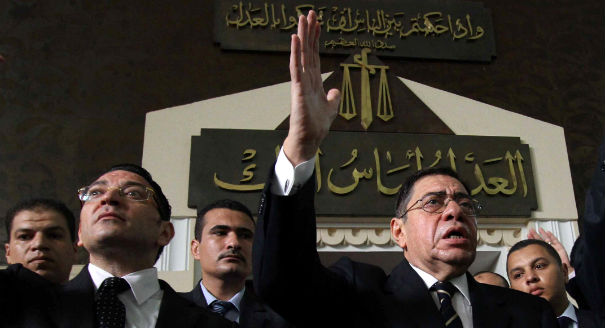
When Egyptian courts sentenced over 1,000 defendants to death in the spring of 2014, and when former President Hosni Mubarak was months earlier acquitted of human rights violations despite decades of documented torture, serious questions about the independence of the judiciary arose. Of all institutions, Egypt’s judiciary was believed to be the least likely to partake in such affronts to individual rights. A closer look, however, reveals that Mubarak’s efforts to dismantle judicial independence successfully produced a conservative body whose top echelon supported the pro-stability narrative that invited the generals back to rule. As a result, legal reforms are unlikely to come from within the judiciary.
But this was not always the case. The Egyptian judiciary used to boast a proud tradition of judges vigilantly guarding their independence. Indeed, many of Egypt’s judges are acculturated to defend against executive branch infringements. Yet it is this streak of independence that has ultimately led to the subjugation of the judicial leadership into the authoritarian deep state. After over a decade of flexing its muscle to expand political and civil rights, the Supreme Constitutional Court (SCC) issued a seminal decision in 2000 mandating that judges monitor elections. The decision empowered a nascent independence movement within the Judge’s Club to openly challenge executive overreaching and demand more judicial autonomy.
At this point Mubarak realized that his political survival depended on taming the judiciary. In an unprecedented move in 2002, he unilaterally transferred Judge Fathi Naguib, known for his loyalty to the regime, from the Ministry of Justice to head the SCC. He was instructed to pack the court with judges unlikely to challenge executive authority. Mubarak then set his sights on the ordinary judiciary and attempted to squash the burgeoning judicial independence movement. To that end, the executive branch under his tenure used direct and indirect tools to incentivize judicial self-restraint and discourage judicial activism. This included hiring more police academy graduates into the judiciary, vetting new hires for affiliations with the judicial independence movement or opposition groups, and assigning regime-friendly judges to cases involving the regime’s core interests. These circumstances persist today.
The Minister of Justice also appoints the presidents of the highest courts from among the judges at the appeals courts, some of whom also serve on the Supreme Judicial Council (SJC). The SJC has extensive powers in determining the pay, promotion, and transfer of judges. These powers can be used to reward or punish perceived disloyalty. The Minister of Justice or the President must approve each judge who occupies these positions. Over time, this executive control has effectively curbed judicial independence. The SJC’s role as a gatekeeper has caused Egypt’s past presidents to take great interest in ensuring those promoted to the SJC are either regime loyalists or predictably uncritical of the state. Indeed, reformists have long accused the executive of making judicial appointments based on political considerations that would ensure a cooperative SJC and judiciary in line with the regime’s core interests.
Judges whose rulings are consistently unfavorable to the regime may in turn find themselves transferred to a remote area in southern Egypt far from their families. A judge up for promotion as chief of an appellate court may be passed up if the regime fears they will not protect its core interests. Similarly, appointments to lucrative secundments to the Ministry of Justice, international organizations, and embassies abroad are doled out as rewards for compliant judges and withheld from those who pursued independent stances. Although many of these decisions originate from the Minister of Justice—the SJC has the authority to decline the minister’s decisions—it rarely does so for fear of retaliation. Because these decisions are made in secret without public oversight, there are minimal checks on the Ministry of Justice, the presidency, and the SJC to prevent the abuse of power.
Egypt’s politics of patronage and clientelism have further compromised judicial independence. Like other state institutions, the judiciary is wrought with nepotism, and the appointment process is far from meritocratic. Judges’ family members and relations are often appointed to judgeships despite poor academic records that disqualify them. The president of the Tanta Court has 21 sons and nephews who are either judges or prosecutors, for instance, even though some have academic records that should have disqualified them from the judiciary. Upon appointment, these judges also benefit from special treatment, such as generous leaves of absence or secundments, and stand a higher likelihood that their requests for favorable court transfers are approved.
The committee that investigates judges’ alleged ethical and legal violations is another powerful disciplining mechanism that the state uses. Despite the judiciary’s requests to transfer it to the SJC, this investigative committee remains under the control of the Ministry of Justice. The Minister of Justice has the authority to appoint the head of the office and use the office to punish judges in the regular courts who go too far in challenging executive actions. Some judges, for instance, have been pushed out of the judiciary after baseless investigations are used to harass and embarrass them. These judges are then offered to have their file closed in exchange for their resignations. Others are coerced to leave the country to limit their influence over other judges.
Since Morsi’s ouster, the judiciary has created “special circuits” within the ordinary criminal courts to try high-profile cases.1 Under the pretext of providing speedy trials in an otherwise overburdened judiciary, the executive branch has created yet another avenue to influence the outcome of cases. The Chief Appellate Judge in each jurisdiction, who is selected by the SJC, handpicks the judges assigned to these courts. Critics accuse the executive branch of establishing these circuits to serve the role that special security courts did when emergency law was in effect for Mubarak’s entire tenure. For 30 years, high-profile cases were placed before judges the regime could rely on to punish political dissidents.
In light of the myriad tools used to restrain judicial independence, it is unsurprising that portions of the judiciary are cooperative in the ongoing crackdown on political dissidents. The current political climate makes it too costly for a judge to challenge the executive’s core interests. Already, judges who publicly condemned the events of July 3, 2013 as an illegal military coup have been targeted by the Ministry of Justice’s investigative committee. Judge Zakaria Abdel Aziz, the former head of the Judge’s Club when the judicial independence movement was at its peak, has been charged for alleged involvement in political activities. Similarly, Judges Mahmoud El-Khodeiry and Mahmoud Mekki, also key figures in the pro-judicial independence protests in 2005-2007, are under investigation for “engaging in politics” in violation of the Judicial Authority Law. Many of the judges who boldly challenged Mubarak’s rule years before the January 2011 uprising are now finding themselves systematically purged from the judiciary.
Fortunately, Egypt’s judiciary is far from monolithic and is made up of many judges committed to creating an independent judiciary that can protect Egyptians from government abuses and preserve order. But until the laws governing the judiciary are amended to pry it away from the Ministry of Justice and the presidency, Egypt’s legacy of independence is doomed to be a distant past and nothing more than a hollow promise.
Sahar Aziz is associate professor at Texas A&M School of Law where she teaches Middle East Law, civil rights, and national security. She is the author of Bringing Down an Uprising: Egypt’s Stillborn Revolution and Revolution Without Reform? A Critique of Egypt’s Election Laws.
1. Based on interviews the author conducted with Egyptian judges. ?