The two most influential Islamic groups in Turkey—namely the Justice and Development Party (AKP) led by President Recep Tayyip Erdogan and the Gülen movement led by Pennsylvania-based retired Imam Fethullah Gülen—have been openly at war with each other for over a year. The Gülen movement, a former Islamic ally of the AKP, has tended to eschew partisan politics in favor of media and cultural influence within Turkey, yet it has become the target of Erdogan’s “with us or against us” rhetoric and governance style.
These developments mark a dramatic reversal. When it first took office in 2002, the AKP government sought to build alliances with other Islamist parties, liberals, and religious movements. Acutely aware that the first Islamist Prime Minister, Necmettin Erbakan, was ousted in 1997 by an army-engineered soft coup, Erdogan and his men strove to enlarge their ruling circle with other stakeholders to resist secular backlash. Gülen entered a partnership (albeit short-lived) with the AKP, becoming an effective powerhouse in Turkey and expanding its media empire and educational program, including thousands of schools and dormitories. Indeed, Gülen invested heavily in the education sphere as part of his decades-old strategy to raise a pious, nationalist, and conservative elite that would hold sway in the Turkish state and society.
Although the AKP and the Gülen movement disagreed in their interpretation of Islam, they have cooperated since the early 2000s in their campaign against military tutelage. Consequently, when the Turkish military was severely weakened by the so-called Ergenekon or “coup” trials of 2008-13—which sent hundreds of active and retired military officers as well as other dissidents to prison—disputes between the AKP and Gülen began surfacing. The major cleavage, however, occurred on December 17, 2013, when a corruption scandal rocked the AKP. Dozens of businessmen known to be Erdogan’s close allies—including four influential ministers and three of their sons—were implicated by leaked tapes and photos (published mostly in Gülen-affiliated media, and then shortly thereafter in the mainstream press) that showed bribes being delivered to a minister’s office. During a follow-up investigation, the police seized $17.5 million in cash allegedly used for bribery. Some of that money was reportedly found stashed in shoe boxes at two of the implicated ministers’ homes in addition to the home of the director of the state-owned Halkbank. The leaked tapes published on social media and in Turkish newspapers also implicated Erdogan’s son.
Responding to the scandal, Erdogan and the AKP criticized the prosecutors and police chiefs behind the investigations, arguing that the incident was a Gülen-organized plot to overthrow the government. That Erdogan’s government announced a measure in November 2013 to shut down test preparation schools—a major recruitment tool for Gülen—might have pushed the movement to expose the corruption scandal.
Nonetheless, Erdogan has since rallied his supporters in what he has dubbed an “independence war” with Gülen. Although the president fired four ministers following the corruption scandal, he maintains that the claims are a Gülen conspiracy in collaboration with “dark foreign forces.” Similarly, other AKP officials have accused Gülen of orchestrating the media campaign and operating the anonymous Twitter accounts that first leaked the corruption claims. To date, the Gülen movement denies involvement and no evidence exists linking it to the social media campaign. Several probes by newly appointed prosecutors continue to explore the link.
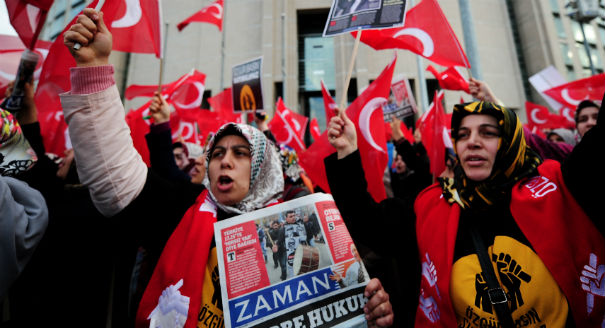
The Gülen movement, though only comprising between 2 to 3 percent of Turkey’s electorate, holds considerable sway in other spheres, especially the media. Zaman, the most circulated Turkish newspaper, selling nearly one million copies a day, is Gülen-affiliated. More than half a dozen nationwide television channels, hundreds of local television and radio stations, and other newspapers and magazines are Gülen-owned or affiliated. In total, the movement is estimated to have shares in 15 to 25 percent of Turkish media. Gülen also commands a global lobbying power unrivaled in Turkish politics—a Gülen umbrella assembly group headquartered in Washington, DC has over 200 branches across America . This enormous soft power is now shaping opinion in many Western capitals in favor of regime change in Turkey.
But for now, Erdogan and the AKP appear to have the upper hand. The government has passed legislation to increase the authority of the intelligence services and police, granting them more detention powers. These laws have led to thousands of detentions and pretrial arrests in the government’s campaign against opposition groups, including Kurdish activists, twitter users, and Gulen movement members. Additionally, following Erdogan’s and the AKP’s electoral wins in the 2014 presidential and local elections, the bribery charges were dropped altogether later in December. Erdogan appears to have kept his promise to “boil or molecularize” the Gülen movement to “sterilize” it as part of an offensive against Gülen-affiliated media, financial institutions, and business forums. Yet this apparent domestic victory is only half the picture. While the Erdogan government seems ahead in domestic hardball politics—purging the Gülen followers and even arresting the president of Samanyolu Media Group, a flagship TV channel of Gülen—his approach and tactics are creating a backlash. Already, Erdogan’s tactics have tarnished his democratic credentials, and most foreign governments and media—particularly in the West—view him as an autocratic leader.
Although only a few years ago Turkey was considered a model Muslim democracy, Ankara is now viewed as an isolated or pariah state. Transparency International’s annual Corruption Perceptions Index has documented the country’s growing corruption, and Freedom House downgraded Turkey to “Not Free” in its 2014 rankings. Despite these developments, there seems to be no alternative political movement emerging to replace the AKP. A number of small right-of-center parties were recently founded by former AKP members but, for now, none are likely to command much support in the general elections slated for early June.
After decades of repression under the secular Turkish Republic, the recent direction taken by Turkey’s AKP has increasingly discredited its reputation. Erdogan’s crackdown on rival religious groups reflects the AKP’s growing authoritarianism and attempts to consolidate power. But for now, in spite of Erdogan’s confrontational personality and largely unchecked authority, limits enshrined in the current constitution will make it difficult for him to fully dominate the Turkish state. Erdogan is looking to the June elections to see if his AKP can secure a wide enough victory to overhaul the constitution and move Turkey from a parliamentary to presidential system. If the AKP secures the electoral victories it is hoping for—considering that the rule of law has already greatly eroded within the past year—Erdogan is likely to become an ever-more unquestionable and unaccountable leader.
Ilhan Tanir is a Turkey analyst and freelance journalist based in Washington, DC.