To address the country’s growing energy needs, the government is granting the private sector a leading role.
Link Copied
By Alfred Jasins and Brendan Meighan
Published on Mar 31, 2015
After years of doing little to rectify Egypt’s energy and electricity troubles, the government has finally moved to pursue sustainability. Energy demand, fueled by government subsidies, had for years outpaced domestic production. This has led to a large subsidy bill, electricity production that falls far short of demand, strained relationships with foreign energy companies, and a growing dependence on more expensive foreign sources of oil and gas. But the Egyptian government, under President Abdel Fattah el-Sisi, has begun to take substantive measures to address these issues. This includes subsidy reform and a renewed focus on alternative sources of energy, such as renewables like solar and wind.
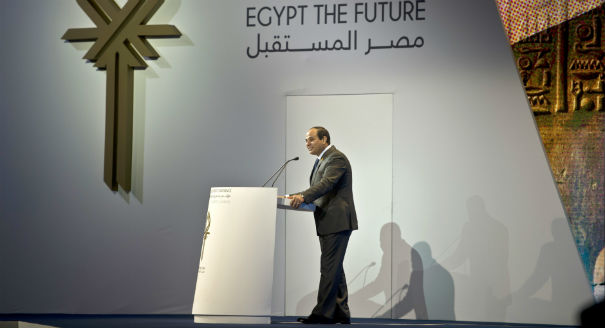
To develop future energy projects the government is relying heavily on the private sector and has laid out new laws and regulations to accommodate private investment, in particular for foreign firms. Egypt’s efforts to attract multinationals culminated earlier this month with the much-heralded Economic Development Conference that attracted billions of dollars in investment—with the bulk of it directed toward energy and electricity projects.
Egypt’s energy sector has long been on an unsustainable trajectory. Oil and gas consumption grew 36 percent and 62 percent, respectively, over a ten-year period ending in 2013, a trend that is not expected to lessen for the foreseeable future. This spiraling demand is in part fueled by heavy government subsidies on petroleum products and electricity, which in turn has led to a ballooning subsidy bill that has crippled the government’s fiscal position and the overall economy. Last year, the energy subsidy bill amounted to EGP 126 billion, or 22 percent of the budget and 7 percent of GDP, double where it stood just prior to the 2011 revolution and up more than 100-fold from twenty years ago.
Rising subsidy-fueled energy demand has also coincided with diminishing hydrocarbon reserves and production rates. This dynamic has forced the government to begin redirecting international oil and gas companies’ share of fuel intended for export to the domestic market. Not only has this drained foreign currency reserves—which have dropped by over $20 billion since the end of 2010 and are now below the critical IMF threshold of financing three months of imports—but doing so has also strained relationships with oil and gas companies and curtailed much-needed investment in the sector. Of particular concern was Egypt’s arrears to oil and gas companies that totaled roughly $7 billion before the government had paid down a significant portion to reach $3.1 billion, where it currently stands.
By the time President Sisi was inaugurated last year, petroleum investments were down over 60 percent from the year prior, subsidies had reached record levels, and alternative sources of energy were still on the backburner. The economy at this point could no longer bear the burden of the current state of the energy sector.
Central to all of Egypt’s recent energy and power reforms are efforts that cater to private business and to attracting foreign investment. The government, which has long monopolized the transmission and selling of electricity, can no longer afford to finance the power needs of the country. According to information posted on Egypt’s Economic Development Conference website, Egypt needs to increase capacity by 5.2 gigawatts annually through 2022 to meet demand which, in total, more than doubles current capacity. But doing so would require $35 billion, or $5 billion in annual investment for the next seven years. The amount required is roughly $20 billion more than Egypt’s current foreign currency holdings. What this all adds up to is Egypt needs the financing power of the private sector if it wants to keep its lights on.
In an effort to pave the way for securing foreign investment in the lead up to the economic conference, Egypt implemented a number of pro-business initiatives. This included a feed-in tariff system for renewable energy, which allows power producers to sell electricity generated from renewables back to the national grid, in addition to a new investment law that received cabinet approval in mid-March, which provides foreign investors additional protection from legal disputes and cuts through bureaucratic red tape, among other incentives. The government also implemented fiscal policies that will benefit foreign investment in energy, including subsidy reforms such as an across-the-board price increase for fuel and electricity this past July.
The government’s measures to reform and develop the power and energy sectors culminated with the Egypt’s Economic Development Conference that attracted billions of dollars in private investment, the bulk of which was directed toward electricity. This included massive commitments from international conglomerates like Siemens and GE, both of which are taking a leading role in Egypt’s future power generation. Siemens alone is committing over $10 billion to develop the electricity sector. All told, Egypt signed a reported $22 billion in memorandums of understanding for power generation, with another $21.5 billion in oil and gas projects agreed on.
While reforms to attract private sector investment have been necessary to repair the current state of energy and power transmission in Egypt, measures to curtail the effects of increasing fuel and electricity prices on the poorest and most vulnerable parts of the population seem to have taken a back seat for the time being. However, the government will likely utilize the smart card system currently being implemented for fuel distribution to combat black market exploitation and smuggling. This offers a potential mechanism to allow the government to direct subsidized fuel to those most in need, similar to the system currently in place for bread subsidy distribution. No such mechanism has been put in place for electricity consumption.
The recent drop in crude oil prices will offer inflationary relief for the time being, but steep price increases in natural gas, which accounts for the bulk of electricity generation in Egypt, will keep power prices elevated. Fuel and electricity prices rose across-the-board this past July, with the most popular car fuel increasing 78 percent, marking the first step in the government’s energy subsidy reform. But Egypt still has a long way to go before prices reach market rates. According to the latest numbers from the Egyptian General Petroleum Corporation, which manages the country’s oil interests, domestic revenues from energy account for just 57% of their cost, or a roughly LE 23 billion shortfall. Adding to this burden is the expected increase in price for both domestically produced and imported natural gas. Over the past year, for example, foreign companies in Egypt have managed to secure more competitive prices than the government pays for natural gas, which now range from $4 - $6 per million British thermal units (Btu), up from $2.50 - $3. Import prices are expected to be even higher. Egypt recently secured the necessary facility to begin importing liquefied natural gas (LNG). These shipments are estimated to cost anywhere between $9 and $12 per million Btu. These inflationary pressures from natural gas prices will extend beyond just electricity to other industries and sectors that depend on natural gas as a key input, including fertilizer and petrochemicals, as well as taxis in Egypt that use natural gas for fuel.
Egypt’s economic conference was the launching point of a development strategy heavily reliant on the private sector and foreign investment. Since the conference, many Egypt experts have criticized the new plan due to its seemingly sole dependence on massive foreign investment and infrastructure projects to prop up the economy—a plan reminiscent of Mubarak’s liberal market policies that enriched a handful but had minimal benefit for the masses. Though partly valid, these criticisms do not apply to Egypt’s current initiatives in developing the country’s power infrastructure. Egypt has little choice other than to turn to private investment to further develop the electricity infrastructure and end the regular power outages taking place in the country. With billions in additional investment needed, opening up the transmission of electricity to private business allows the government to keep Egypt’s lights on while not draining the country’s coffers. This is coupled with private sector initiatives to develop power generation from renewable energy such as wind and solar and other alternative sources like coal and nuclear, which is necessary to diversify away from diminishing oil and gas resources. The government, however, still needs to counterbalance this pro-business agenda with measures to protect the country’s poorest and most vulnerable from the inevitable rise of energy and electricity prices.
Alfred Jasins and Brendan Meighan are economic researchers at the American Chamber of Commerce in Egypt.
Carnegie does not take institutional positions on public policy issues; the views represented herein are those of the author(s) and do not necessarily reflect the views of Carnegie, its staff, or its trustees.
Can economic ties help contain conflict between Egypt and Israel, or do they simply postpone confrontation? Drawing on the German-Russian experience, the article examines how the gas deal creates mutual dependence, keeps channels of cooperation open, and raises the cost of conflict, without necessarily delivering lasting peace.
Is the Gulf moving beyond the dollar? This article examines how China is expanding the renminbi's role across Gulf markets, what that means for regional finance, and why the future of global currencies is more complex than the de-dollarization debate suggests.
In a volatile Middle East, the Omani port of Duqm offers stability, neutrality, and opportunity. Could this hidden port become the ultimate safe harbor for global trade?
How can Saudi Arabia turn its booming e-commerce sector into a real engine of economic empowerment for women amid persistent gaps in capital access, digital training, and workplace inclusion? This piece explores the policy fixes, from data-center integration to gender-responsive regulation, that could unlock women’s full potential in the kingdom’s digital economy.
Kuwait’s government has repeatedly launched ambitious reforms under Kuwait Vision 2035, yet bureaucratic inefficiency, siloed institutions, and weak feedback mechanisms continue to stall progress. Adopting government analytics—real-time monitoring and evidence-based decision-making—can transform reform from repetitive announcements into measurable outcomes.