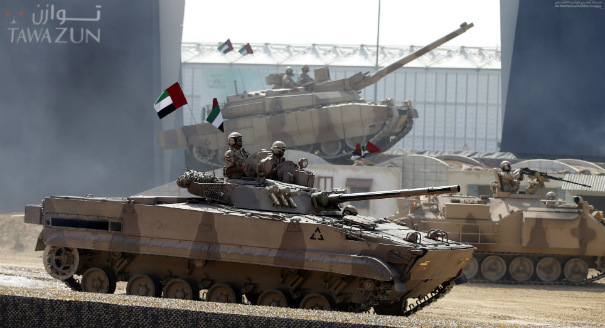
In the past eighteen months, military equipment produced in the United Arab Emirates (UAE) has made its way as far as Russia and as close as Kuwait, with contracts signed at Abu Dhabi’s International Defense Exhibition and Conference in February for future deliveries of Emirati weapons to Egypt and the UAE armed forces. Motivated by strategic, economic, and symbolic ambitions alike, the UAE’s attempts to bolster its defense industrial base have clearly begun to take shape. Unlike other Arab states also seeking to develop their defense industries, such as Saudi Arabia, the UAE has also been more explicit about its goals to become a net arms exporter.
Several states pursue defense industrialization because they perceive it as a win-win solution to create high-skilled jobs and simultaneously support the armed forces—all while gaining prestige because of the incredibly difficult nature of building and sustaining a defense industrial base. Most importantly, arms industries are seen as instruments to become more autarkic in the long term instead of relying on arms exporters such as the United States for military equipment.
Coincident with its bolder military presence and strategic aspirations in the Middle East and North Africa (MENA) region, the UAE has already exhibited preliminary signs of using its defense industry to strategic ends. Whereas past arms imports trends show the UAE’s tendency to be attracted by the “glitter factor” of expensive weapons, their own arms industry appears to be focusing on developing “good enough” solutions that can be mastered by the UAE armed forces and may have wider appeal in foreign markets. In December 2014, a major restructuring initiative was announced to create the Emirates Defense Industries Company (EDIC), signaling that, in addition to governance reforms from 2010 onward, the UAE was taking its defense industrial base seriously. Creating the EDIC helped this industrial base diversify the economy and, more significantly, better align the national defense industry to serve the UAE armed forces and regional clients.
While armaments increasingly carry a “Made in the UAE” brand, this does not mean the UAE is necessarily expanding production. First, efforts to Emiratize manufacturing face a significant structural roadblock: the native population in the UAE is small. Given its small educated labor force and low investments in research and development, the Emirati defense industry remains reliant upon foreign engineers for high-skilled workers, meaning sustainable industrial advances are not guaranteed.
Second, rather than designing weapons from scratch or improving existing blueprints, Emirati firms have a tendency to acquire blueprints for weapons or weapons platforms—such as fighter jets, land vehicles, ships, and some firearm systems—and rebrand them as “indigenous.” For example, Tawazun Precision Dynamics derived its Al-Tariq precision-guided munitions (PGMs) from a partnership agreement in 2012 with the South African firm Denel, which makes Umbani PGMs, and the South African RG-31 armored vehicle and RG-35 mine-protected vehicle were rebranded as the Agrab and the N35, respectively. Furthermore, even if the shell of a platform can be considered local, its parts and components are often clearly imported.
Third, the UAE has been bolstering its defense capabilities by making investments in strategic sectors. Privinvest, a partial owner of the Emirati shipbuilding group Abu Dhabi MAR, has made investments in various European shipyards, including the French CMN, the designer of the Baynunah-class corvettes used by the Emirati navy. The UAE has also invested in unmanned systems for air and sea, with stakes in the Italian firm Piaggio Aerospace, due to deliver unmanned aerial vehicles to UAE this year, and the Finnish unmanned surface vessel maker Boomeranger. Such investments do not necessarily guarantee Emirati industrial skills will develop, but they do bolster marketable Emirati military capabilities.
These three reasons highlight how the UAE leverages its capital resources to further its status as home to a local defense industry. After all, if the sole objective were to decrease dependence on a traditional arms exporter, it would be cheaper and easier to simply diversify sources of arms. The exorbitant costs of creating an arms industry are secondary concerns to techno-nationalist and strategic ambitions. With larger foreign exchange reserves than most European states and the eighth largest oil reserves in the world, the UAE has the capital and political will to fund an arms industry. Even despite decreasing oil and gas prices, the Emirates maintain substantial state-owned investment groups thirsty for diversified investments.
Regardless of whether the production is truly “indigenous,” the results are already seen in military contexts. The Saudi-led intervention in Yemen has been a test battleground for Emirati land vehicles, reportedly including the NIMR II Ajban 440A 4x4 chassis, Enigma 8x8 infantry fighting vehicle, and the N35 armored personnel carrier (APC). The Saudi-led coalition has also approved Baynunah-class corvettes as one of the few naval vessels to enter embargoed ports in Yemen.
The UAE also uses its locally produced armaments to show an interest in conflicts in which it is not directly involved, reportedly including sending an Al-Sabr drone (co-produced with an Austrian firm) to support NATO in Afghanistan and transferring APCs and other land vehicles manufactured in Ras al-Khaimah to Kurdish forces in Iraq.1 This allows the defense industry to boast “battle-proven” systems when bidding on contracts, and once again demonstrates how the UAE is using this industrial base to bolster its global image—potentially reaching more international export markets for military equipment, namely in Eastern Europe and Asia, but also other MENA states. The UAE already uses Algeria as a partner to venture into African markets and Turkey as an industrial partner from which it can glean expertise.
Furthermore, should the Gulf Cooperation Council (GCC) achieve closer defense cooperation, the UAE is attempting to position itself to take leadership on defense services and maritime security. Regarding services, the creation of EDIC is a strategic move to become the regional hub for maintenance, repair, and overhaul. As GCC countries become increasingly militarized, the existence of such a service-oriented firm that enjoys well-established relationships with Western arms manufacturers—including for fleets of aircraft, such as F-18 fighters, operated by many Gulf states—is intended to situate the UAE at the forefront of military action.
As part of the UAE’s intention to become an exporter of maritime equipment in particular, the Mubadala subsidiary Abu Dhabi Ship Building (ADSB) is a key provider of local maritime security equipment. Already Oman and Kuwait operate landing craft produced in the UAE, with Saudi Arabia also rumored to be considering a major purchase of the Baynunah. The UAE may sell other border patrol and surveillance capabilities, such as its unmanned systems, to fellow GCC members concerned about protection of and freedom of navigation in the Arabian Gulf.
These developments show the UAE is stepping up as a security provider in the region. Abu Dhabi is far from independent from foreign sources of military equipment, but it is clearly using defense industrialization to increase its profile in a bolder, more militarized approach to conflict.
Zoe Stanley-Lockman is the defense data research assistant at the European Union Institute for Security Studies (EUISS) and coauthor of the March 2017 EUISS Chaillot Paper “Defense Industries in Arab States: Players and Strategies.” Follow her on Twitter @zoemsl.
1. Interview with a U.S. security analyst, June 3, 2016.