This Ramadan, the Egyptian army is charitably distributing millions of food boxes in poor urban and rural areas across the country. Conscripted soldiers from various military branches pack food items including sugar, rice, beans, pasta, cooking oil, tomato paste, and tea in boxes that each carries the label of the Armed Forces’ Supply Authority, along with that of “Tahya Misr,” President Abdel Fattah el-Sisi’s charitable fund. Conscripts load these boxes in gigantic military trucks and drive them to every provincial locality. Once distributed for free, the boxes are for the first time this Ramadan being sold for 25 Egyptian pounds ($1.40), much lower than their market price of 87 pounds ($4.80), even after being substantially subsidized by Tahya Misr. Such food charity, once a tool for civilian political actors to garner support ahead of elections, is now deployed as a tactic by the military to stave off huger riots and ensure political stability. However, the post-IMF loan financial hardships are hitting the military hard enough to sell the boxes, and the institution may find it difficult to afford this tactic in the long term.
The Egyptian military has joined an existing practice of distributing free food provisions to the fasting poor during Ramadan. Charitable food distribution spread widely under former president Hosni Mubarak, and the month of Ramadan was known as the time of “politicized” charities within his neoliberal economic milieu. Mubarak’s market reform schemes from 1991 onward left the lower classes facing shrinking state supplies of subsidized basic goods. Civilian political forces then competed to fill the gap in the welfare economy. In particular, the ruling National Democratic Party and its largest opposition, the Muslim Brotherhood, took the opportunity of this holy month to donate food, competing with each other to win the poor’s votes in future parliamentary elections. Moreover, civil society organizations, many of which had political affiliations, sought not just to give food to the poor but also to build hospitals and distribute clothes. With no electoral gains to seek at the time, the army did not take part.
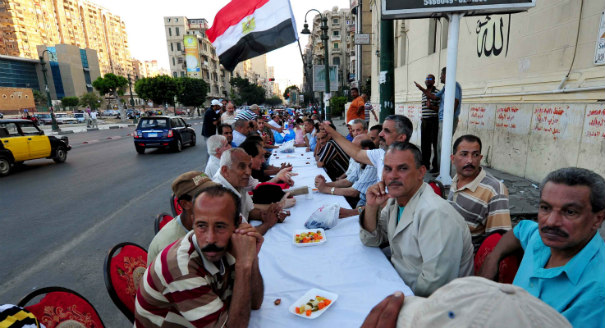
After deposing Mubarak, the Supreme Council of Armed Forces (SCAF) distributed tens of thousands of free food packages during Ramadan in 2011 and organized “Tables of the Merciful” (mawa’id al-rahman), where it served free iftars throughout the month. Though it was primarily an emergency tactic to appease the masses amid post-revolutionary economic turmoil, SCAF also used it to build a popular image for the army as the benevolent savior and guardian of the nation. The council had to compete with other civilian forces, especially Islamists, to win the masses’ political support. The military has used every Ramadan since to show its benevolence, including in summer 2013when it seized back power from the Muslim Brotherhood.
Since it has eliminated or fundamentally weakened other civilian rivals in the state, the Egyptian military regime currently relies on food donations to avoid social unrest. Sisi’s own neoliberalism, marked by obtaining a loan from the World Bank in 2015 and another from the IMF in 2016, required the military regime to finish what Mubarak started by drastically reducing food, gas, electricity, and medical subsidies. More importantly, they required currency devaluation, which inflated prices but left incomes stagnant. The army’s food charity is now no longer a matter of propaganda, but a necessary security measure to contain potential social strife.
Neoliberalism and charity continue to go hand in hand as they did under Mubarak. In November 2016, when the IMF loan was approved and the central bank floated the Egyptian pound, the army sold eight million food boxes at a cheap price for fear of hunger riots. The military institution is able to provide such large food supplies because it owns massive farms, manages numerous food processing mills and food import businesses, and uses the free labor of hundreds of thousands of conscripted youth to produce food. Sisi’s military-supported philanthropic initiative, the “Tahya Misr” fund, which he established in 2014 to further expand securitized charities, backs these efforts. The armed forces donated 1 billion Egyptian pounds ($55 million) to this fund in its first year of operation alone, and business tycoons likewise donated millions, whether out of loyalty or in response to intimidation. Entissar Amer, Sisi’s wife, moreover encouraged Egyptian women to donate via campaigns that were well covered and celebrated in state-affiliated media
Interestingly, other security apparatuses, namely the General Intelligence Directorate and the Ministry of Interior, are also trying to connect with society and seek some public support through Ramadan food charity, putting themselves in direct competition with the military. They similarly distribute free food boxes that carry their own labels in provincial areas and poor urban localities. Yet these other security bodies do not have the same abundant commercial wealth or human resources to stand against the army in this contest for the best public image.
The army’s use of food charities to prevent social unrest especially targets areas that witnessed intense workers’ protests before and after 2011, such as the city of Mahalla, which has a large public-sector textile plant. Similarly, they make sure to reach areas experiencing terrorist attacks, such as Minya, where the Islamic State killed dozens of Coptic Christians on May 26. They also try to reach the Sinai Peninsula, which suffers from both extremism and a harsh government crackdown. For example, a Ministry of Defense video from May 22 shows residents of North Sinai, where the Islamic State regularly attacks army units and local civilians, praising the army’s pious efforts—as well as the stability and security it brings—while patiently standing in long lines to receive their cheap food packages.
As it seems highly unlikely that Egypt’s economic conditions will improve soon, the military institution will likely not be able to afford to continue such costly charity across the country. This may affect political stability and security in the long run, for if hunger riots erupt, the military might resort to the same tool it used to contain widespread protests in 2011: brutal violence against the discontented masses.
Zeinab Abul-Magd is an associate professor of Middle Eastern history at Oberlin College and author of Militarizing the Nation: the Army, Business, and Revolution in Egypt (Columbia University Press, 2017).