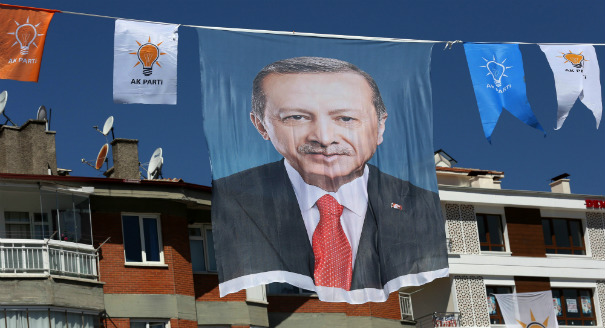
Erdogan has managed to gain appeal across the region by emphasizing his independent foreign policy and successful economic and religious stewardship while still maintaining an appearance of electoral democracy.
Link Copied
By A.Kadir Yildirim
Published on Jun 13, 2018
On the eve of early parliamentary and presidential elections on June 24, Turkish President Recep Tayyip Erdoğan appears poised to claim yet another victory, with enduring popularity even beyond Turkey’s borders. What is more surprising is that Erdoğan managed to sustain his appeal in the face of Turkey’s growing authoritarianism and rapidly deteriorating human rights record.
A recent survey sheds some empirical light on the various dynamics that underlie Erdoğan’s regional popularity, with notable implications for the relationship between religion and politics.1 The survey data show Erdoğan’s popularity is particularly strong among some segments of the population. Respondents who ideologically self-identified as Islamist, favored a prominent role for religious leaders in politics, and considered religion to be important in their lives trusted Erdoğan the most as an authority on religious matters. By contrast, respondents with a college education or who had a monthly income over $1,000 were less likely to trust Erdoğan.
Figure 1: Favorability of Religious Leaders Figure 2: Trust in Religious Leaders
A number of factors explain these findings. For many, Erdoğan’s appeal as a leader is rooted in the unique array of attributes he embodies. First and foremost, Erdoğan boasts a successful economic performance at the helm of the Turkish economy, in which national income more than tripled in a little over a decade. Turkey’s GDP stood at $238 billion in 2002 when the AKP assumed the government. As of 2016, Turkish GDP rose to $864 billion in nominal terms (more than $2 trillion in purchasing power parity). Similarly, while per capita income was $3,660 in 2002, it increased to $10,862 at the end of 2016. Erdoğan’s economic policies focused on improving the regulatory environment for business, boosting exports, lowering the inflation rate, and attracting foreign investment. In this regard, Erdoğan has done something not many politicians have been able to do in the Middle East; he delivered tangible policy outcomes that improved the lives of many.
Another reason for Erdoğan’s popularity is religion. The survey results show that politicians who infuse political rhetoric with religious discourse command notable approval rates and trust of the public, more so than traditional religious authorities or state religious officials. Erdoğan has mastered this skill. The fact that he is able to pull in overwhelming levels of support from those who favored greater political role for religious leaders and self-identified as Islamists brings this point home. Erdoğan is not merely viewed as a politician but as a religiopolitical figure. When he speaks for religion, he has credibility to do so.
As far as support for democratic governance and trust in Erdoğan, data show a troubled relationship. Those survey respondents who are neutral in favoring democracy tend to trust Erdoğan more than others, but even then the relationship is far from being statistically significant. One reason for this outcome is Erdoğan’s instrumental approach to democracy. While Erdoğan says he is committed to democracy, his conception of democracy is constrained to a purely majoritarian and electoral one. Despite early hesitation with democratic politics, Islamist politicians now view elections as the ultimate instrument of political legitimacy. Erdoğan’s success in electoral politics showed the way to weaponize elections to not only win even greater power but also take on political rivals.
While he improved the state of democratic politics in his first decade in power by extending rights of ethnic and religious groups and providing greater freedom of expression, Erdoğan gradually subjugated the democratic process in the following years while keeping within the basic parameters of an electoral democracy. In the process, Turkey moved from “partly free” according to Freedom House’s annual Freedom in the World report to “not free” in 2018. Nonetheless, the fact that he continues to play the electoral game (instead of ruling in an outright dictatorial manner) is one of the key elements of his continued popularity. For example, a recent statement by Ibrahim Mahmoud (of Omar al-Bashir’s National Congress Party in Sudan) reflects this sentiment on democracy and its Islamist utility: “When we began reforming our political system in 2014 as part of our peace process, we looked for new models for the NCP… One of the parties we looked at was the AKP because this is a party with both an Islamic and a democratic frame of reference.”
Lastly, Erdoğan’s “independent” foreign policy course that seamlessly alternates between pro- and anti-Western positions boosts his strongman image. In important ways, Erdoğan’s early tenure in power was marked by a decidedly pro-Western stance, encompassing the European Union membership process, close relations with the United States, and a friendly period with Israel. By contrast, Turkey’s recent past is marked by a sharp turnaround in relations with the West such that at times strained relations have even raised the prospect of an armed conflict with the United States in Syria. When Erdoğan speaks of U.S., Israeli, Dutch, or German “hypocrisy,” it resonates with citizens of the region as an act of defiance of the West’s unfair treatment of the Middle East or of Muslims. That this staunchly anti-Western discourse is not borne out by tangible policy change is of little import.
By diverging from Turkey’s historically submissive, Western-oriented foreign policy discourse, Erdoğan proves that he can maintain an active independent foreign policy—a highly desirable rhetorical element of Islamist ideology. In a circular reasoning, any negative response to Erdoğan’s anti-Western rhetoric from the United States or the European Union automatically registers as retaliation against the growing power and influence of Erdoğan and Turkey’s independent policymaking, thereby proving the point that Erdoğan is truly independent. Not only does this anti-Western stance boost Erdoğan’s favorability in the region, but it also offers a textbook case of how mustering popular anti-Western sentiment can be a political resource, as the recent Jerusalem embassy row illustrates. When the United States opened its new embassy in Jerusalem on May 14, 2018, Erdoğan was one of the first leaders in the region to condemn the move and expel senior Israeli diplomats, aiming to appeal to the nationalist and Muslim vote on the eve of a tight electoral competition in Turkey.
Given these dynamics, Erdoğan’s politics carry pragmatic lessons for Islamist and non-Islamist politicians alike. Religion’s obvious appeal in bolstering popular support aside, Erdoğan’s success in gaining region-wide popularity is predicated upon delivery of economic growth, upholding electoral democracy, and standing up to the West. In a region beset by democratic and economic challenges and foreign intervention, Erdoğan’s strong leadership offers and multifaceted platform holds great promise.
A.Kadir Yildirim is a fellow in the Middle East at Rice University’s Baker Institute for Public Policy focusing on religion and politics and Middle Eastern politics. Follow him on Twitter @akyildirim.
1. In this study undertaken by the Baker Institute for Public Policy and funded by the Henry Luce Foundation, we surveyed more than 14,000 respondents in 11 countries in the region in order to analyze the political and social dynamics of religious politics and map Islamic authority in the Middle East. The survey was conducted online with residents of these countries who were 18 or older.
Carnegie does not take institutional positions on public policy issues; the views represented herein are those of the author(s) and do not necessarily reflect the views of Carnegie, its staff, or its trustees.
Can economic ties help contain conflict between Egypt and Israel, or do they simply postpone confrontation? Drawing on the German-Russian experience, the article examines how the gas deal creates mutual dependence, keeps channels of cooperation open, and raises the cost of conflict, without necessarily delivering lasting peace.
Is the Gulf moving beyond the dollar? This article examines how China is expanding the renminbi's role across Gulf markets, what that means for regional finance, and why the future of global currencies is more complex than the de-dollarization debate suggests.
Syria's transition promised a fresh start. But are old habits of power making a comeback? This analysis looks at the warning signs and what it will take to build a more accountable state.
Syria’s worsening drought is no longer a seasonal crisis. This report explains what climate change is doing to rainfall, groundwater, and food security, and what solutions experts say are still possible.
From anime heroes to online gaming communities, Morocco’s Gen Z is building a new protest culture. What does this digital imagination reveal about youth politics, and how should institutions respond?