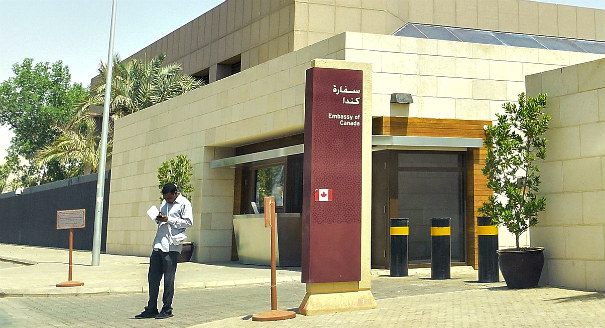
On August 3, Canada’s Foreign Minister Chrystia Freeland criticized Saudi Arabia’s detainment of Saudi human rights activists (including some related to Canadian citizens) via Twitter. Although Ottawa’s chief diplomat used standard language, nearly identical to statements issued by other Western statesmen regarding Saudi Arabia’s human rights violations, Riyadh reacted in an unprecedented way by ejecting the Canadian Ambassador, freezing all new bilateral trade (worth roughly $4 billion annually) and investment transactions, initiating a program to relocate thousands of Saudi students currently in Canada to other countries, and suspending flights to and from Canada, among other procedures.
Prior to this incident, Canada was insignificant to Saudi Arabia’s foreign policy. In contrast to some other NATO members, Canada has generally been an outside observer of the Middle East and North Africa (MENA). However, in recent years, Canada’s foreign policy has increasingly centered around efforts to promote peace, security, and economic livelihood in war-torn and impoverished states. In response to the Syrian and Iraqi crises, the Canadians accepted roughly 70,000 refugees from both countries, and invested millions of dollars into Iraq, Syria, Lebanon, and Jordan to reverse the tides of instability plaguing the Levant.
Yet, as with Sweden and Germany, Canada’s more values-oriented foreign policy has strained its relationship with Saudi Arabia, which has been pursuing an increasingly aggressive foreign policy of its own in the region. Facing perceived threats from an ascendant Iran, Riyadh has sought to protect its interests in an increasingly chaotic environment. Saudi Arabia waged direct military interventions in Bahrain and Yemen in 2011 and 2015, respectively. Such Saudi-led maneuvers and military interventions have become more combative since Mohammed bin Salman was appointed crown prince in June 2017. Riyadh pressured Lebanon to take action against Hezbollah in November 2017, five months after implementing a blockade on Qatar for supporting the Muslim Brotherhood. These regional interventions exemplify how the kingdom is attempting to pressure smaller Arab states in the region into operating in lockstep with Riyadh. Yet from the perspective of liberal democracies such as Canada, the new Saudi foreign policy raises concern about regional stability and human rights, most notably in Yemen, where the Saudi-led intervention bears much responsibility for the impoverished country’s humanitarian disaster.
In targeting Canada, Riyadh first seeks to deliver a message to Western governments at large that criticism of the kingdom’s management of internal affairs on human rights grounds crosses a red line. But the latest spat with Canada also builds up national sentiment against Western interference, aiding internal efforts to consolidate power and crack down on dissent. By challenging Ottawa, Riyadh further wants to communicate to a domestic audience that the regime is strong and capable of challenging such a big power—albeit a soft target, given its relatively low profile in Saudi Arabia’s network of global allies and the fact that its bilateral trade with Saudi Arabia has never surpassed several billion dollars.
Ultimately, the Saudi leadership is set on rallying the Saudi public behind the kingdom’s regional and domestic agendas as Crown Prince Mohammed bin Salman further consolidates power. As the Yemen war remains a disaster for Saudi Arabia—not only from security and financial standpoints, but also in terms of the kingdom’s international standing—the campaign against Canada serves to deflect Saudi citizens from the conflict and rally them behind the flag. The kingdom, where roughly 70 percent of the population is below the age of 30, is undergoing a generational shift with Mohammed bin Salman at the helm. Achieving modernization and economic diversification requires the next generation of Saudis to embrace new ideas, and the success of Vision 2030, which aims to drastically transform Saudi Arabia within twelve years, will depend on the extent to which young Saudis play a lead role in driving such changes. By playing the hyper-nationalist card, Mohammed bin Salman hopes to bring about greater unity among his fellow Saudi millennials even as the kingdom’s current domestic and foreign policies create controversy within Saudi Arabia and abroad.
However, Riyadh’s indiscriminate policies and exaggerated reactions have made regional countries, especially small ones, increasingly anxious and unsure how to react. Ultimately, some Saudi allies—Bahrain, Comoros, Djibouti, Egypt, Jordan, Mauritania, the Palestinian Authority, Somalia, Sudan, the United Arab Emirates, and Yemen’s internationally-recognized government—defended their interests in maintaining strong ties with the kingdom by expressing rhetorical support for Riyadh’s actions. Yet none of these states changed their diplomatic and economic relations with Canada, highlighting Riyadh’s rather weak position in this dispute. Acting at Saudi Arabia’s request, Gulf Cooperation Council (GCC) Secretary-General Abdullatif al-Zayani expressed his support for the Saudi actions against Canada. Because he did not consult with GCC members before making this statement, other Gulf countries rushed to clarify their individual positions. Kuwait and Oman expressed independent, neutral stances and emphasized their hopes the dispute would be resolved quickly. Although they did not defend Riyadh against Ottawa, they each aimed to avoid provoking Saudi Arabia by implying that Canada should not have “interfered.” Qatar was also quick to underline that the GCC statement does not reflect its opinion, stressing that Doha and Ottawa maintain strong relations. In this sense, the Saudi–Canada dispute has further highlighted the GCC’s dysfunctional state of affairs.
Riyadh’s actions may have also upset relations with Western allies, a vital source of investment in the kingdom’s mega-projects. U.S. press reacted negatively to Riyadh’s actions against Canada at a time when the kingdom is seeking to attract billions of dollars in foreign investment for Vision 2030. Although Canada has not been a major investor in Saudi Arabia, Riyadh’s reaction feeds into the perception that Mohammed bin Salman is an excessively impulsive leader—a perception further reinforced by the arrest of human rights activists who have pushed for women’s right to drive. Such brashness serves to unsettle investors who are struggling to understand how the new Saudi Arabia functions. Saudi Arabia already has a problem with capital flight over the past few years spurred by low oil prices. In 2017, a net $80 billion (10 percent of its GDP) flowed out of Saudi Arabia, up from $55 billion in 2016. According to Gulf scholar Karen Young, the spat with Canada “has heightened the sense of risk in the Saudi investment climate and is certain to scare even more capital away.”
Foreign investors, who were optimistic about Riyadh implementing effective economic reforms when Vision 2030 was announced in April 2016, have seen how the Saudi leadership continues to prioritize regime security above respect for the rule of law. Doubtless, Riyadh’s overreaction to Ottawa’s criticism—on top of the anti-corruption probe launched in November 2017 and arrest of scores of dissidents and activists—further undermines Saudi narratives that the kingdom is modernizing and ripe for foreign investment. To the contrary, Riyadh’s foreign and domestic politics appear to be driven more by brazen decisionmaking that avoids careful consideration or discussion. This may prove to be the biggest cost that Saudi Arabia pays for its anti-Canada campaign.
Giorgio Cafiero is CEO of Gulf State Analytics. Ali Bakeer is an Ankara-based political analyst and researcher. Follow them on Twitter @GiorgioCafiero and @AliBakeer.