One year after protests you called for on Facebook began, how have they evolved? Have their key demands, tactics, and grassroots structure remained the same?
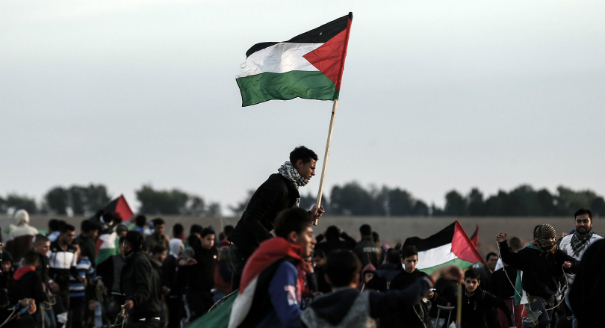
When I called for the Great Return protests, it started out as a dream. After interacting with the people in the community, it needed to become a practical, applicable plan highlighting the difference between a dream and reality. My first post was a dream for a massive peaceful protest in which Gazans would take part and decide to peacefully cross the barbed wire fencing us in, demanding life, liberty, and the return of refugees in keeping with UN Resolution 194. After crossing the barbed wire, they would reside in a city on the land occupied in 1948, in a city which I proposed naming Bab al-Shams (“Gate of the Sun”), staging a peaceful sit-in.
The current reality is not exactly the same as this idea, but the overlap between the dream and reality cannot be ignored. There are two notable differences between our current formula and the original idea. The first are the mounting casualties every Friday, for which the occupation government bears responsibility first and foremost, as it deliberately sought to raise the cost of the peaceful marches, even in the absence of any serious threat to its soldiers on the ground. This was done for political reasons, to kill off the idea and sap Palestinians’ confidence in their ability to win through nonviolent mass protest. The original idea was to call for people to hold cultural, artistic, and heritage activities in a safe zone in front of the barbed wire fence, in order to rally the masses and mobilize the entire community to be involved in this peaceful struggle. To be fair, the protesters remain peaceful even now, and there are a number of cultural and artistic activities every Friday, but clearly there is a deliberate Israeli decision to wear down the Palestinian will through the accumulation of victims among peaceful protesters.
The second difference is that the original idea called for grassroots protests led by community leaders, but the strength of the factions in the Gaza Strip boosted the march’s factional nature, as faction leaders turned out in large numbers. It is important to note that these factions are a fundamental part of the community and cannot be ignored. The factions are a part of the people and must participate in all aspects of resistance, but I think that the nature of the march is clearer when it is led by normal people and youth activists unaffiliated with the standard factions.
What has been the role of civil society in turning a protest moment into a broader campaign for the right of return?
One of the distinguishing features of the Great Return protest movement is that it mobilized grassroots and community groups, and expanded the concept of mobilization beyond elite groups and political factions. With regards to civil society, the Great Return protest was a key chance to develop these organizations’ role so that they actually taking part in a national event on the ground. Representatives of dozens of NGOs took part in the Great Return protest movement through cultural, artistic, theater, and human rights activities.
What do you think is the most important aspect of these protests—or the movement behind them—that was not and is not covered in international media?
The most important aspect of the Great Return march is that it represents the true voice of the Palestinian people. On the first day of protests, I saw an unforgettable scene. I saw tens of thousands of women, men, children, and older people around me, even elderly women on crutches, slowly making their way over a kilometer to take part in this unifying national event. The Great Return march is a cry for life and represents the true state of the Palestinian people. International actors need to listen directly to the people.
Although Hamas has not played a role in organizing these protests, it has increasingly supported them, which some have argued has hurt the movement’s nonviolent image. How has this affected the protest movement?
Let us take a closer look at reality. In Gaza, you do not have two societies, where one is the Palestinian people and the other is Hamas. There is a single society whose members belong to diverse factional, political, and ideological affiliations. Thus, all of these factions are present among the people, including Hamas—as the 2006 elections in which it won a majority remind us. I think that Hamas’s popularity has declined, but we cannot assume it has disappeared. So when we call for a unifying national action, this necessarily means that all people will take part regardless of their affiliations or beliefs. When I wrote the overlying principles for the Great Return march on my Facebook page on February 20, 2018, the principles stipulated peaceful, grassroots, and patriotic protests, in which everyone could take part and raise only the Palestinian flag, taking as a basis the UN resolutions, particularly Security Council Resolution 194. The issue then is not whether Hamas or anyone else will participate, but rather what the principles and foundations on which participation is based. Yes, Hamas took part in the Great Return marches, being a leading component of society, as did most of the other Islamist, secularist, and left-wing factions. The upside to this is that the participation of all these factions was based on these being peaceful grassroots marches, and is an opportunity to strengthen the culture of nonviolent resistance. The affiliation of the march participants does not matter so much as that they were peaceful, completely unarmed, and were making legitimate demands during the marches.
Unfortunately, we have observed that since the onset of the marches it is Israel that has pushed for violence, increasing Palestinian casualties. We understood from this that Israel does not want the Palestinians to use nonviolent resistance because nonviolent resistance will damage the propaganda image Israel markets to the world. The Great Return march was a historical opportunity to strengthen the voices who believe in nonviolent resistance, and these voices should be supported so that people can believe in their ideas.
Ahmed Abu Artema is an independent journalist from Gaza. Zaha Hassan conducted this interview via email. The interview was translated from Arabic and lightly edited for style.