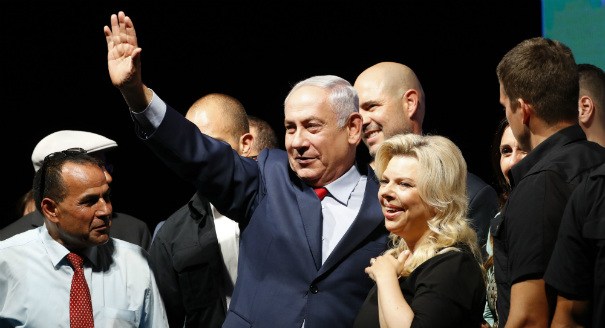
Ahead of Israel’s parliamentary elections on April 9, Benjamin Netanyahu is fighting for his political future and possibly personal freedom, with Attorney General Avichai Mandelblit having recommended Netanyahu be indicted on charges of bribery, fraud, and breach of trust. As the Israeli public processes this scandal, the most recent polling gives former Chief of Staff of the Israel Defense Forces (IDF) Benny Gantz and his centrist coalition a two-seat advantage over Netanyahu’s right-wing bloc. Netanyahu’s personal predicament thus calls into question the future of his Likud party and the Israeli right altogether.
Each of Likud’s successive leaders since 1973 has served as prime minister: Menachem Begin, Yitzhak Shamir, Benjamin Netanyahu, and Ariel Sharon. It has been nearly two decades since Likud last faced significant opposition. The Labor Party, Israel’s traditional left-wing opposition, has not won a single election since 1999—largely due to demographic changes within Israel favoring the religious right. Labor has also gradually lost support to the Joint Arab List and smaller parties, such as left-wing Meretz and centrist Yesh Atid. The centrist Kadima Party’s challenge was also short-lived. While it won the 2006 elections and formed a government under Ehud Olmert, the party then dissolved because of infighting and a poor showing in the 2015 election.
Yet, with the controversy surrounding Netanyahu affecting Likud’s public image, the traditional party of the Israeli right faces a serious electoral threat from a newly consolidated center. When Benny Gantz made clear in late 2018 that he was interested in running for office, the independent general was courted by nearly all of the political parties, from right-wing Likud to left-wing Yesh Atid and Labor. However, in December he decided to form his own centrist party, Hosen L’Yisrael (Israel Resilience). In January, he joined forces with Moshe Ya’alon, former head of the IDF and founder of the small Telem Party, to form the Kahol Lavan (Blue and White) electoral alliance. The centrist Yesh Atid (There is a Future), led by former Minister of Finance Yair Lapid, joined the alliance in February and convinced former IDF head Gabbi Ashkenazi to join the campaign as well.
At first glance, Netanyahu’s Likudniks seem to be in lockstep with him. Indeed, there is relatively little ideological distance between the top contenders for the leadership of the Likud. None of them supports a two-state solution with the Palestinians. They outbid each other on who is the most religious, who is the most hawkish on Iran, who is the strongest supporter of the settlers, who has been the biggest supporter of the nation-state law. Yet Netanyahu is facing internal challenges from party leaders who believe they have a better chance at winning the next election for Likud.
Most notably, since mid-February, Netanyahu has been locked in a guerrilla war against Gideon Sa’ar. Sa’ar had abruptly resigned as minister of interior in September 2014 with little explanation, prompting speculation at the time that he was either gearing up to challenge Netanyahu or was going to be indicted. Although neither was the case, he had placed second to Netanyahu in that year’s primaries, and once Sa’ar announced he would be running for parliament again in 2019, Netanyahu became paranoid that Sa’ar would again challenge him for the party’s leadership. And in February, Sa’ar won fourth place on Likud’s electoral list in the party’s primaries for the April 2019 elections. He benefits from a younger, more media savvy persona (his wife was a popular former media presenter) and has a natural rapport with younger Israeli voters whom Netanyahu failed to win over.
The other main contender against Netanyahu would likely be Yisrael Katz, the acting Minister of Foreign Affairs and former Minister of Transportation. Katz is seen as one of the last of Likud’s “big beasts” from its founding years, and tends to appeal to “baby boomers” and some secular parts of the right-wing electorate. The list of potential contenders for Likud leadership is long and includes such well-known names as: Speaker of the Knesset Yule Edelstein, Minister of Strategic Affairs Gilad Erdan, Minister of Culture Miri Regev, Minister of Regional Cooperation Tzachi Hanegbi, former Mayor of Jerusalem Nir Barkat, and Minister of Immigrant Absorption Yoav Gallant. However, if Netanyahu is formally indicted, as seems imminent, Katz or Sa’ar would likely mount the most serious campaign for the leadership.
The issue with a leadership challenge is one of timing. With the elections less than a month away, a challenger would have to run a sprint and a marathon at the same time, reasserting their partisan bona fides with the base while re-introducing themselves to the general public. The difficulty of pulling off a leadership change and then running a successful general election campaign makes challenging Netanyahu seem less likely as polling day comes closer. An intra-party coup could possibly reset things in the right’s favor, as it appears a desire to remove Netanyahu from office is the one thread holding the centrist coalition together. Many are critical of the direction Netanyahu has taken Israel, but it is unclear what direction Gantz and Lapid will take at all. If anything, they have hinted they will continue Netanyahu’s security policies and water down the nation-state law.
For an entire generation of Israelis, Netanyahu is the only leader they have known, and is thus difficult to imagine the Israeli right without him. Unlike the Labor Party after Ehud Barak’s defeat in 2001, Likud itself is unlikely to engage in a protracted ideological debate over the future of the party or face political irrelevance. After all, for all of Netanyahu’s problems—personal, political, and legal—Likud’s policies remain popular. On foreign and national security issues, namely negotiating with the Palestinians, the Syrian war, and the rivalry with Iran, Likud owns the narrative. Labor and Meretz’s policies are unpopular and receive little serious attention. On domestic issues, such as the nation-state law, which defines Israel as an ethno-national Jewish state and minimizes minority rights, Likud delivered a key promise to its base and coalition’s supporters. This consolidation of the right-wing, religious, Zionist vote around Likud is Netanyahu’s ultimate political legacy. Where Netanyahu has not been able to expand Likud’s appeal, he has backed mergers among smaller, far-right parties to grow the right-wing bloc, thus expanding the sway of his allies and making it easier to form a potential coalition government without needing to compromise with the center or the left.
If Likud were to lose the upcoming elections, mainstream Israeli politics would likely shift toward a new grand coalition between Likud, Kahol Lavan, and a handful of right-wing parties, including Moshe Feiglin’s Zehut. While a coalition with Likud would violate previous promises made by Kahol Lavan, Feiglin’s past as a troublemaker makes both sides hesitant to form a coalition with him. In 2014, Feiglin led the movement for Jews to worship on the Temple Mount, causing chaos and violence. Netanyahu saw to it that he received a low position in the Likud primaries, casting him into political oblivion for a time.
A second major change would be the question of Likud leadership and the broader right in Israel. It seems highly unlikely that if Likud loses the general election, Netanyahu will be able to maintain the leadership, even if the vote is close. It is highly unlikely that he will be able to effectively serve as either leader of the opposition or as number two in a coalition government (as either minister of defense or finance) while facing criminal prosecution on three counts.
Albert B. Wolf is the Dean of the College of International Studies at the American University of Kurdistan, Duhok. Follow him on Twitter @albertwolf82.