

{
  "authors": [
    "Abdellatif El Hamamouchi"
  ],
  "type": "commentary",
  "blog": "Sada",
  "centerAffiliationAll": "dc",
  "centers": [
    "Carnegie Endowment for International Peace"
  ],
  "collections": [],
  "englishNewsletterAll": "menaTransitions",
  "nonEnglishNewsletterAll": "",
  "primaryCenter": "Carnegie Endowment for International Peace",
  "programAffiliation": "MEP",
  "programs": [
    "Middle East"
  ],
  "projects": [],
  "regions": [],
  "topics": []
}
Source: Getty
Escalating Repression in Morocco
Following a crackdown on the independent press in Morocco, human rights activists face increased repression and extended prison sentences.
On March 23, 2022, Moroccan authorities arrested blogger and human rights defender, Saida al-Alami, over her social media criticism of the Moroccan government and security services. Al-Alami, a well-known and vocal activist, has consistently expressed her criticism of authorities, as well as her solidarity with journalists known for their critical opinions, on Facebook. The General Prosecutor accused Al-Alami of a number of serious violations including “insulting a body regulated by law,” “insulting public officials while carrying out their duties,” “contempt of judicial decisions,” and “broadcasting and distributing false allegations without consent.” Ultimately, the Casablanca Court of First Instance sentenced Al-Alami to two years in prison.
A few days after Al-Alami’s arrest, the Al Hoceima (North) Court of First Instance issued a four-year prison sentence for blogger and former activist in The Hirak Rif Movement, Rabih al-Ablaq, as a result of videos that he posted to Facebook and Youtube which criticized King Mohammed VI and Prime Minister Aziz Akhenoush and questioned the source of their wealth. Al-Ablaq’s trial before the Al Hoceima Court began on April 11, and the King’s attorney (the General Prosecutor) accused him of “publicly violating the duty of reverence and respect for the king’s person.”
This crackdown on activists and bloggers has brought into focus the Moroccan authorities’ increasing intolerance for the independent press, which is becoming a “distant memory” according to Eric Goldstein, Deputy Middle East and North Africa Director at Human Rights Watch. To carry out this crackdown, authorities have utilized the model that prevailed under former Tunisian dictator Zine El Abidine Ben Ali. This proven strategy seeks to silence dissident voices by using sexual assault and immoral behavior allegations guaranteed to destroy the reputations of the accused.
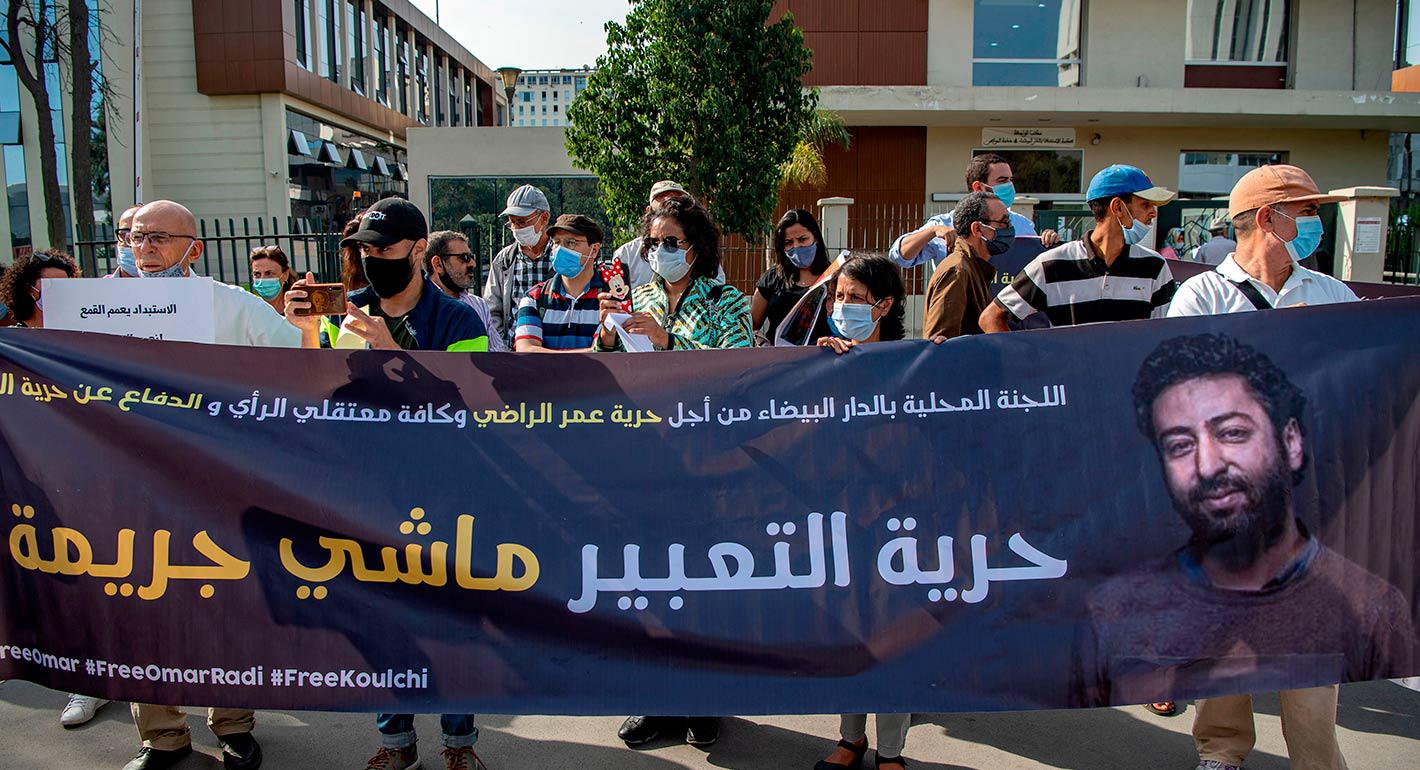
Tawfiq Bouachrine, director and founder of Morocco’s most independent—yet now discontinued— newspaper, Akhbar al-Youm, was arrested and sentenced to 15 years in prison for “human trafficking.” Subsequently, Bouachrine’s lawyer, Mohamed Zayan—former Moroccan Human Rights Minister—was also sentenced to three years in prison following a complaint filed against him by the Ministry of Interior. Soulaiman Raissouni, Bouachrine’s replacement as editor-in-chief of Akhbar al-Youm, was then arrested and charged for sexual assault of another man. Hajar Raissouni, Soulaiman’s niece, was later arrested on charges of “extramarital sex and abortion.” Similarly, last year, Omar Radi, a well-known journalist, was charged with “espionage and rape.” He was convicted and sentenced to six years in prison last March.
Ultimately, by harassing, intimidating, and arresting independent journalists, activists, and influential social media bloggers, the Moroccan authorities aim to create an atmosphere of terror among prominent social media figures and within the community of human rights activists. Simultaneously, the weaknesses and growing fragmentation of the democratic opposition—who appear unable to overcome their ideological conflicts and intellectual polarization—are making the situation even worse. Their division is ultimately serving the authoritarian wing within the regime and allowing it to further control the situation.
Moroccan authoritarianism is not only using the judiciary and penal system to intimidate the opposition and rein in independent journalism, but it is also successfully “weaponizing” public defamation through newspapers and media outlets that are openly loyal to the regime. Such defamation is primarily used to discredit critical voices through the publication of unfounded criminal allegations and bogus charges against them. It is also used to threaten and break the morale of journalists awaiting arrest or trial. Maati Monjib, a historian and journalist, is a case in point. He was subjected to a defamation campaign carried out by the slanderous media weeks before his arrest on December 29, 2020 and was later sentenced to a year in prison for “endangering state security.”
The slanderous media, which remains under the control of the authoritarian wing of the regime, seeks mainly to influence the target’s rhetoric, positions, initiatives, and reactions towards the government. It relies on smear campaigns to threaten its targets and indirectly control their public decisions. In the case of journalists, these tactics seek to influence the target’s editorial line by pushing them to exercise self-censorship of all the articles, studies, or ideas that they produce.
Despite widespread criticism of Morocco’s deteriorating human rights situation, the Moroccan regime, indifferent to its international reputation, continues unabated its clampdown on journalists and human rights defenders. Indeed, on April 12, 2022, the U.S. Department of State issued its 2021 Country Reports on Human Rights Practices. In relation to Morocco, the report noted “the growing arbitrary arrests of journalists and civil society activists” and the spread of media defamation campaigns that “harass and intimidate journalists.”
It seems unlikely that the regime will stop these practices, especially as it is forced to deal with the repercussions of inflation and the aftermath of the Covid-19 pandemic which negatively affected the middle and lower classes. In fact, as Maati Monjib explains, the economic difficulties may actually incite the regime to continue to target activists and protestors through legal proceedings and increased community surveillance.
Abdellatif El Hamamouchi is an investigative journalist and political science researcher from Morocco. He is a member of the Central Office of the Moroccan Association for Human Rights. He writes for The Intercept, Open Democracy, and The New Arab. He is also the author of Moncef Marzouki: His Life and Thought, co-written with Maati Monjib and published by the Arab Center for Research and Policy Studies in Doha. Follow him on Twitter: @AHamamouchi.
About the Author
Abdellatif El Hamamouchi
Carnegie does not take institutional positions on public policy issues; the views represented herein are those of the author(s) and do not necessarily reflect the views of Carnegie, its staff, or its trustees.