

{
  "authors": [
    "Gashaw Ayferam"
  ],
  "type": "commentary",
  "blog": "Sada",
  "centerAffiliationAll": "dc",
  "centers": [
    "Carnegie Endowment for International Peace"
  ],
  "collections": [],
  "englishNewsletterAll": "menaTransitions",
  "nonEnglishNewsletterAll": "",
  "primaryCenter": "Carnegie Endowment for International Peace",
  "programAffiliation": "MEP",
  "programs": [
    "Middle East"
  ],
  "projects": [],
  "regions": [],
  "topics": []
}
Source: Getty
Sudan’s Conflict in the Shadow of Coups and Military Rule
The country has been plagued by so many coups that military-led government is the rule, rather than the exception.
Situated in the Sahel region of the “coup belt”, Sudan has a long history of coups d’état and military rule, which has stood in opposition to the persistent struggle of the Sudanese people to midwife a democratic political order. The ongoing civil war, which erupted in mid-April 2023 between the Sudanese Armed Forces (SAF) and the paramilitary Rapid Support Forces (RSF), is partly influenced by this political legacy, where power is accessed and transferred through force rather than elections.
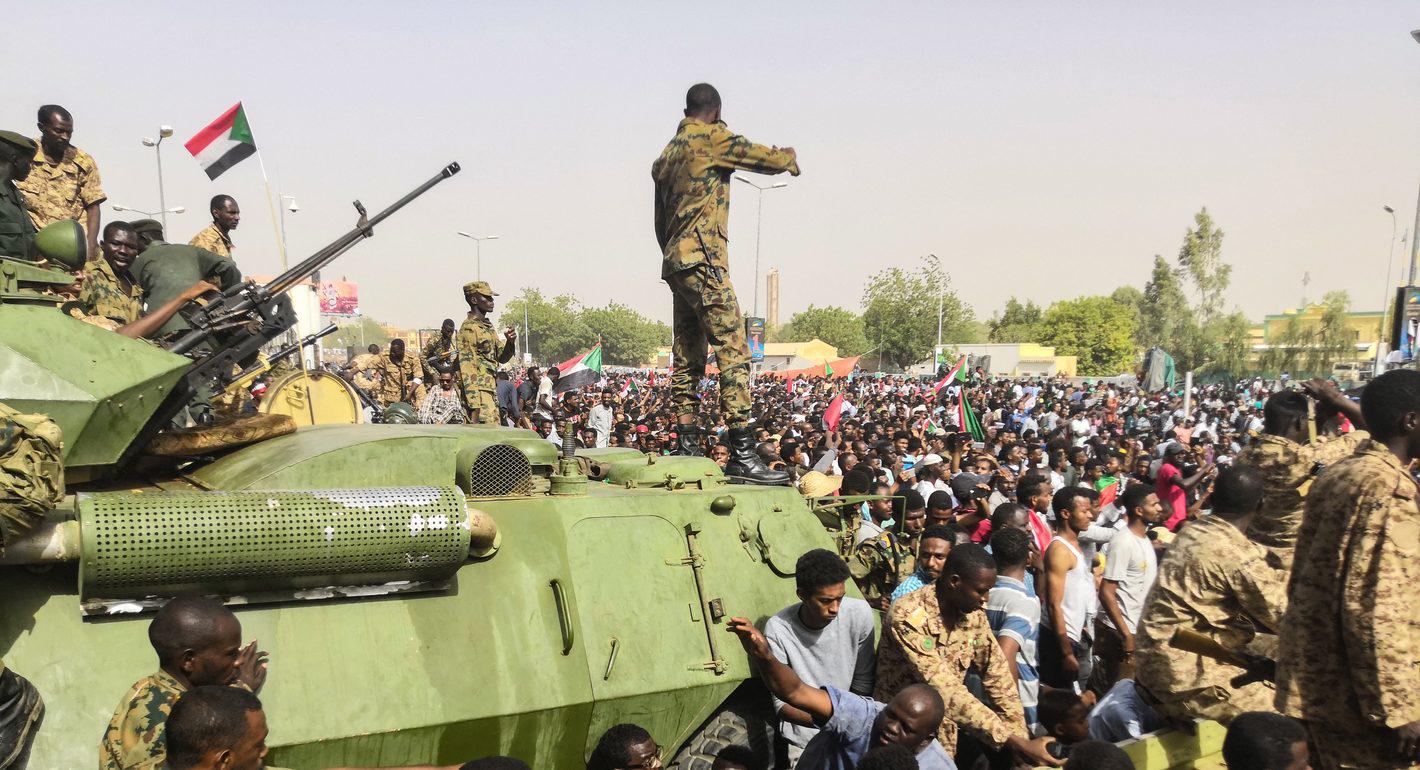
In its modern history, Sudan has experienced nearly thirty-five coups d'état, making the country a “laboratory of coups.” Of these attempted military takeovers, six were successful, while twelve failed and seventeen were foiled in advance. While some simply transferred power from one military leader to another, others ended short-lived periods of democratic rule (1956-1958, 1964-1969, and 1985-1989). Former President Omar Al-Bashir, who was ousted in April 2019, had previously seized power in a coup against the democratically elected government of Sadiq Al-Mahdi in 1989. Most recently, the SAF’s General Abdel Fattah al-Burhan and the RSF’s General Mohamed Hamdan Dagalo interrupted Sudan's progress towards democratic rule by instigating another coup in October 2021, which terminated Sudan’s transitional civilian government and returned the country to military rule.
In Sudanese politics, in other words, the military coup is the primary means of regime change—a trend also observed in other African countries during the second half of the twentieth century, and in Niger, Mali, Burkina Faso, and Chad just in the past three years. This differs from some African democracies including Ghana, Mauritius, South Africa, Senegal, and Botswana, the latter four of which have never had a military takeover, where power tends to be obtained through democratic procedures (although often superficial and “defective”).
Sudan's history of military regime change has been fueled by a complex interplay of internal and external factors, but the root cause lies in the country’s militarized governance system. Among the necessary conditions for the reoccurrence of coups, Sudan's government has a culture of rent-seeking, cronyism, kleptocracy, and the commoditization of public office for personal gain. The military has gained financial power independent of the state by positioning themselves as entrepreneurs in key economic sectors. More than 80 percent of the state resources are in the hands of the security and paramilitary forces. The former control 250 companies in critical sectors such as defense, banking, gold and rubber mining, flour and sesame production, construction, livestock exports, and transport. Gold mining in particular, which has reconfigured power dynamics in Sudan since 2011, is one of the key economic resources at the center of the current conflict. The RSF has controlled the main gold mines and smuggling routes, enabling the paramilitary to compete with the SAF and fund illicit business ventures across a variety of sectors.
As evident in 2019, the Sudanese people's desire for democratic rule can be exploited by military groups as a pretext to overthrow the ruling elite. However, Sudanese society may be able to overcome this historical burden if democratic forces receive meaningful support to increase their bargaining power against the state. International and regional actors, including the US, the United Arab Emirates, Saudi Arabia, Egypt, Israel, and countries in the Intergovernmental Authority on Development (IGAD), should apply coordinated pressure to prevent any one warring party from gaining an advantage on the battlefield. By targeting business networks to bankrupt the warring parties, such an international coalition can increase the costs of continuing the war, which could ultimately lead to the cessation of hostilities and a permanent ceasefire.
Gashaw Ayferam is a doctoral candidate at Addis Ababa University and researcher at the Institute of Foreign Affairs. His research interests include green energy transition, hydro-politics, and geopolitics in the Red Sea and Horn of Africa.
About the Author
Gashaw Ayferam
Carnegie does not take institutional positions on public policy issues; the views represented herein are those of the author(s) and do not necessarily reflect the views of Carnegie, its staff, or its trustees.