• Research
  • Emissary
  • About
  • Experts
Carnegie Global logoCarnegie lettermark logo
Democracy
  • Donate
{
  "authors": [
    "Mahran Issa"
  ],
  "type": "commentary",
  "blog": "Sada",
  "centerAffiliationAll": "",
  "centers": [
    "Carnegie Endowment for International Peace"
  ],
  "englishNewsletterAll": "",
  "nonEnglishNewsletterAll": "",
  "primaryCenter": "Carnegie Endowment for International Peace",
  "programAffiliation": "",
  "programs": [],
  "projects": [
    "Shrinking Civic Spaces for Palestine/Israel Discourse"
  ],
  "regions": [
    "Palestine",
    "Middle East"
  ],
  "topics": []
}
Attribution logo
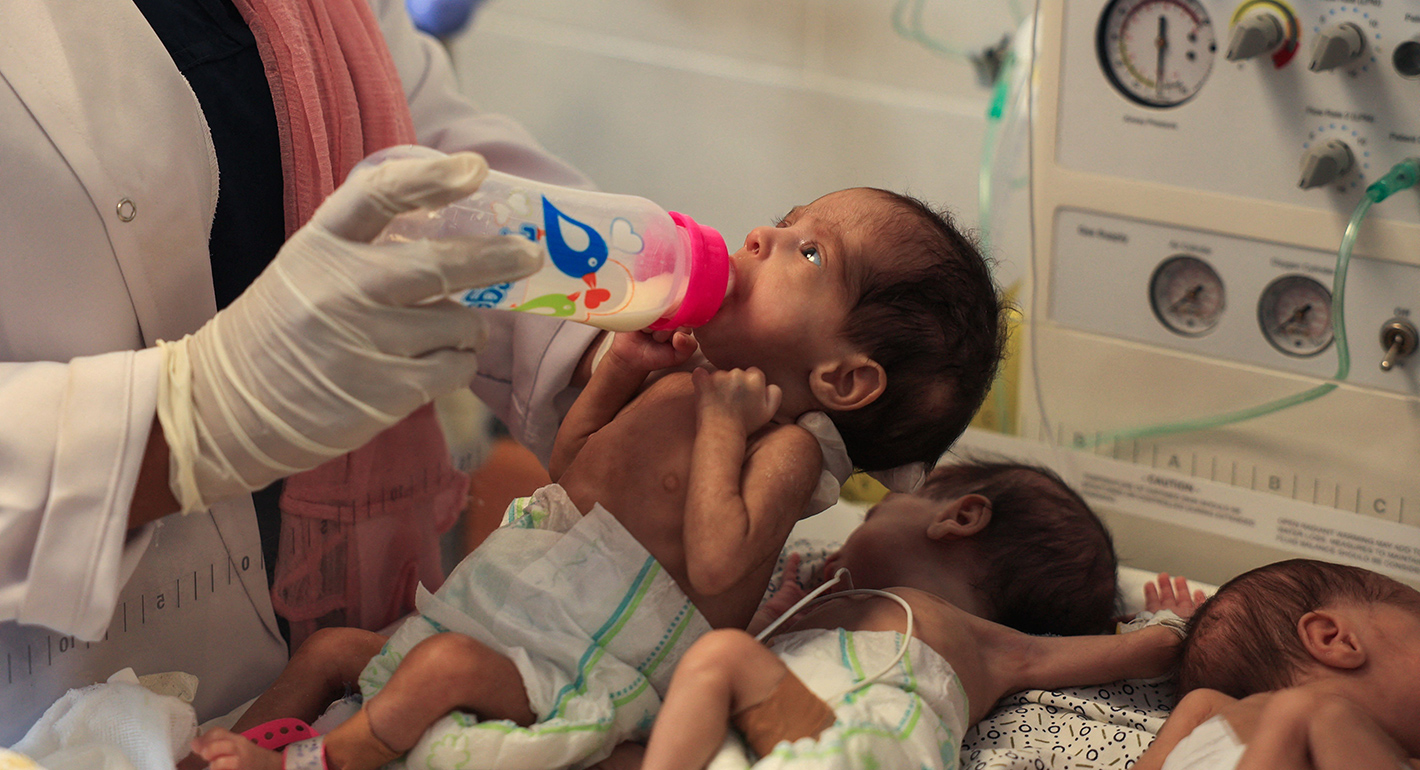
A Palestinian medic cares for premature babies, evacuated from Gaza City's Al Shifa hospital, ahead of their transfer from a hospital in Rafah in the southern Gaza Strip to Egypt, on November 20, 2023, amid ongoing battles between Israel and the militant group Hamas.
Commentary
Sada

The High Costs of Displacement: Difficult Childbirth in Gaza

As often occurs in conflict zones, Palestinian women and children have paid the highest price of Israel’s military assault in Gaza.

Link Copied
By Mahran Issa
Published on May 14, 2024
Sada

Blog

Sada

Sada is an online journal rooted in Carnegie’s Middle East Program that seeks to foster and enrich debate about key political, economic, and social issues in the Arab world and provides a venue for new and established voices to deliver reflective analysis on these issues.

Learn More
Protestors at UCLA

Project

Shrinking Civic Spaces for Palestine/Israel Discourse

This two-year project examines the increasing restrictions placed on Palestinian and Israeli civil society and how the failure to reach a comprehensive Palestinian-Israeli peace impacts communities and civil rights in the United States.

Learn More

Invalid video URL

Palestinian Ministry of Health statistics said that about 60,000 pregnant Palestinian women in the Strip suffer from malnutrition and dehydration because of the war and the scarcity of food supplies entering the Strip. Women constitute 49 percent of the Gaza Strip's population, most of whom are of childbearing age. There are about 5,000 women giving birth every month in harsh, unsafe and unsanitary conditions. Last February, UNICEF warned that the sharp rise in malnutrition among children and pregnant and lactating women in the Gaza Strip poses a serious threat to their lives.

Birth Under Bombardment, a documentary produced by Sada, sheds light on the suffering of Palestinians in Gaza with a specific focus on pregnant women. Among these is Alaa Taha, who was displaced from her home and recounts her perilous journey out of the north of the Gaza Strip. Traversing tens of kilometers on foot, Taha's journey was marred by falls that resulted in severe bleeding and endangered her unborn child.

On the other hand, Falestine Abu Wardeh's experience reveals the severe healthcare crisis in Gaza. Abu Wardeh narrowly escaped death during a difficult caesarean section, when her bladder was accidentally damaged and doctors were forced to removed her uterus—a result of medical oversights amid scant supplies, including anesthesia.

The situation is similarly dire at Rafah's Emirati Hospital, which specializes in obstetrics and gynecology. As reported by its director, Haider Abu Sneema, approximately 1.5 million Palestinians—including 60,000 pregnant women—have sought refuge in Rafah and have overwhelmed the hospital. With around 400 pregnant women arriving every day, and the maternity department only able to deliver 80 to 100 daily births, the healthcare system is under immense strain.

Indeed, the medical infrastructure throughout Gaza is beyond overstretched, with hospitals operating at less than a quarter of their pre-war capacity. This means that mothers and newborns are often immediately discharged to make beds available for other patients, posing grave risks to their well-being.

Beyond childbirth, these women face severe shortages in food, water, baby formula, and other essential supplies due to Israel’s restrictions on humanitarian aid. The ensuing malnutrition has hampered their ability to breastfeed—as experienced by Warda Matar, a new mother sheltering in the Nuseirat camp, who resorted to feeding her newborn dates.

Since the military operations commenced on October 7, 2023, the toll on Gaza has been catastrophic. Over 35,000 Palestinians have been killed and most of them are women and children. Despite these grim statistics, a ceasefire remains elusive, prolonging the agony for Gaza’s civilian population.

Mahran Issa

Mahran Issa is a Palestinian journalist from Gaza based in Istanbul, and the producer of the film Birth Under Bombardment: The Throes of Displacement in Gaza.

PalestineMiddle East

Carnegie does not take institutional positions on public policy issues; the views represented herein are those of the author(s) and do not necessarily reflect the views of Carnegie, its staff, or its trustees.

More Work from Sada

  • Commentary
    Sada
    A House Divided: How Internal Power Struggles Shape Iraq’s Foreign Policy

    Iraq’s foreign policy is being shaped by its own internal battles—fractured elites, competing militias, and a state struggling to speak with one voice. The article asks: How do these divisions affect Iraq’s ability to balance between the U.S. and Iran? Can Baghdad use its “good neighbor” approach to reduce regional tensions? And what will it take for Iraq to turn regional investments into real stability at home? It explores potential solutions, including strengthening state institutions, curbing rogue militias, improving governance, and using regional partnerships to address core economic and security weaknesses so Iraq can finally build a unified and sustainable foreign policy.

      Mike Fleet

  • Commentary
    Sada
    The Role of E-commerce in Empowering Women in Saudi Arabia: Assessing the Policy Potential

    How can Saudi Arabia turn its booming e-commerce sector into a real engine of economic empowerment for women amid persistent gaps in capital access, digital training, and workplace inclusion? This piece explores the policy fixes, from data-center integration to gender-responsive regulation, that could unlock women’s full potential in the kingdom’s digital economy.

      Hannan Hussain

  • Commentary
    Sada
    A War Fueled by Hate Speech: Sudan’s Fall into Fragmentation

    Hate speech has spread across Sudan and become a key factor in worsening the war between the army and the Rapid Support Forces. The article provides expert analysis and historical background to show how hateful rhetoric has fueled violence, justified atrocities, and weakened national unity, while also suggesting ways to counter it through justice, education, and promoting a culture of peace.

      Samar Sulaiman

  • Commentary
    Sada
    Disarming Palestinian Factions in Lebanon: Can a Security Experiment Evolve into Sovereign Policy?

    The August 2025 government decision to restrict weapons to the Lebanese state, starting with Palestinian arms in the camps, marked a major test of Lebanon’s ability to turn a long-standing slogan into practical policy. Yet the experiment quickly exposed political hesitation, social gaps, and factional divisions, raising the question of whether it can become a model for addressing more sensitive files such as Hezbollah’s weapons.

      Souhayb Jawhar

  • Commentary
    Sada
    Kuwait’s Bureaucracy at a Crossroads: Why Government Innovation Stalls and How Analytics Can Reignite Reform

    Kuwait’s government has repeatedly launched ambitious reforms under Kuwait Vision 2035, yet bureaucratic inefficiency, siloed institutions, and weak feedback mechanisms continue to stall progress. Adopting government analytics—real-time monitoring and evidence-based decision-making—can transform reform from repetitive announcements into measurable outcomes.

      Dalal A. Marafie

Get more news and analysis from
Carnegie Endowment for International Peace
Carnegie global logo, stacked
1779 Massachusetts Avenue NWWashington, DC, 20036-2103Phone: 202 483 7600Fax: 202 483 1840
  • Research
  • Emissary
  • About
  • Experts
  • Donate
  • Programs
  • Events
  • Blogs
  • Podcasts
  • Contact
  • Annual Reports
  • Careers
  • Privacy
  • For Media
  • Government Resources
Get more news and analysis from
Carnegie Endowment for International Peace
© 2026 Carnegie Endowment for International Peace. All rights reserved.